
Germany gives pharmaceutical companies unusually rapid access to a major European market. A newly authorised medicine can generally enter reimbursed use while its comparative benefit and long-term reimbursement amount are still being determined.
That opportunity comes with a demanding evidential test.
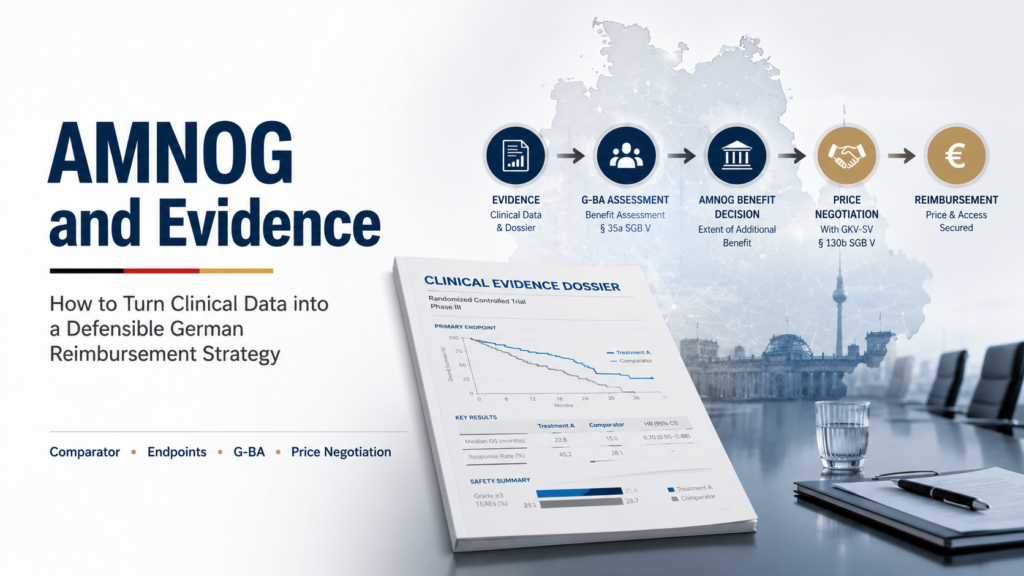
Under the German Pharmaceutical Market Reorganisation Act AMNOG a manufacturer must show whether its medicine provides additional patient-relevant benefit over the treatment considered appropriate for the German healthcare system. The Federal Joint Committee, the Gemeinsamer Bundesausschuss (G-BA), assesses the evidence. Its resolution then becomes the foundation for reimbursement negotiations with the National Association of Statutory Health Insurance Funds, the GKV-Spitzenverband.
This means AMNOG is not simply a dossier procedure completed after approval. It is an evidence-based system. Choices made during clinical development, comparator selection, endpoint choice, trial design, subgroup planning, follow-up duration and quality-of-life measurement can determine the commercial position years later.
The practical question is therefore not merely:
How do we submit an AMNOG dossier?
It is:
How do we design, analyse and translate evidence so that it answers the German comparative question and supports a defensible reimbursement amount?
This is a how-to guide to doing exactly that.
AMNOG begins where regulatory approval ends
European marketing authorisation and German early benefit assessment answer different questions.
The regulatory question is whether a medicine has sufficient quality, safety and efficacy to be authorised for use. AMNOG asks whether the medicine produces additional patient-relevant benefit compared with an appropriate comparator therapy in a defined German patient population.
A medicine can therefore be innovative, clinically useful and appropriately authorised while still receiving an unfavourable AMNOG result. This can happen when:
- the pivotal trial used a comparator that the G-BA does not accept;
- the study measured regulatory endpoints that Germany does not regard as sufficiently patient-relevant;
- quality-of-life evidence is missing or incomplete;
- the German population is divided into subgroups that were not planned prospectively;
- follow-up is too short to establish durable benefit;
- the evidence relies on an unadjusted indirect comparison or weak external control; or
- treatment effects are too imprecise to support a confident conclusion.
The G-BA normally completes the early benefit assessment within six months of German market entry. The benefit assessment is published after approximately three months, followed by written comments and an oral hearing. The final G-BA resolution follows around three months later. (G-BA)
The manufacturer then enters a six-month price-formation phase with the GKV-Spitzenverband. The process normally involves four negotiation meetings. If the parties cannot agree, an arbitration board determines the unresolved terms. (gkv-spitzenverband.de)
The essential distinction is:
The G-BA determines the added-benefit position. It does not directly negotiate the final reimbursement amount.
AMNOG is a comparative scientific question
The best way to understand AMNOG and evidence is to stop treating it as an administrative submission and recognise it as a structured comparative research question.
The assessment asks:
For the patients covered by the German indication, does the medicine improve outcomes that matter to patients, compared with the treatment Germany regards as appropriate, and how certain is that conclusion?
A reimbursement-specific PICO framework provides a useful starting point.
| Evidence component | German AMNOG question | What the manufacturer must establish | Strategic consequence |
|---|---|---|---|
| Population | Which patients fall within the authorised indication, and will the G-BA divide them into distinct subgroups? | The trial population, German target population and proposed subgroups must be clinically coherent and numerically defensible. | Plan subgroup analyses prospectively and prepare robust German epidemiology. |
| Intervention | Is the medicine used exactly as authorised and as expected in German practice? | Dose, treatment line, sequence, combination, duration and stopping rules should match the final label. | Evidence outside the authorised use may be excluded or given limited weight. |
| Comparator | What is the appropriate comparator therapy for each patient group? | The trial control or indirect-comparison network should correspond to a G-BA-accepted treatment alternative. | Comparator mismatch can undermine otherwise strong clinical evidence. |
| Outcomes | Do the endpoints demonstrate patient-relevant benefit? | Evidence should cover mortality, morbidity, symptoms, quality of life and clinically relevant harms. | Regulatory endpoints and biomarkers are not automatically sufficient. |
| Effect magnitude | How large and clinically meaningful is the difference? | The effect must be statistically credible and important enough to matter to patients. | Statistical significance alone does not establish meaningful added benefit. |
| Evidence certainty | How confidently can the observed difference be attributed to treatment? | Randomisation, bias, precision, missing data, consistency and study quality must support the conclusion. | The same effect may receive different weight depending on whether it supports a hint, indication or proof. |
| Generalisability | Can the results be transferred to German care? | Patient mix, background therapy, treatment centres and care pathways must be relevant to Germany. | International trial evidence may require bridging or supplementary analysis. |
| Subgroups | Does benefit differ between clinically relevant patient groups? | Effects should be biologically plausible, statistically credible and preferably prespecified. | A narrow positive subgroup may preserve value but reduce eligible volume. |
| Harms | Do adverse effects offset some of the benefit? | Safety must be analysed comparatively, rather than merely described. | Toxicity, discontinuation and treatment burden can weaken a strong efficacy result. |
The German comparator is therefore not a technical detail added to a global value dossier. It defines the counterfactual against which added benefit will be judged.
A trial can be scientifically rigorous and still be poorly suited to AMNOG if it answers the wrong comparative question.
A simple, copy-safe representation
Recognised AMNOG benefit = comparative relevance × patient relevance × effect magnitude × evidence certainty × German applicability
This is not a statutory formula. It is a practical representation of the assessment logic.
A large numerical effect may still lead to limited benefit recognition if the comparator is inappropriate, the study is single-arm, follow-up is short or confidence intervals are wide. A more moderate effect may produce a stronger result when it comes from direct, well-conducted comparative evidence using patient-relevant outcomes.
The practical lesson is clear:
AMNOG evidence should be designed backwards from the future German decision problem, not assembled retrospectively from whatever evidence is available at launch.
Step 1: Resolve the German comparator before pivotal development
Comparator selection is often the most consequential AMNOG decision.
The comparator used in a global Phase III study may not be the therapy ultimately selected by the G-BA. German clinical practice may also evolve between protocol design and market entry. A comparator that was reasonable when recruitment began may no longer represent the accepted German standard several years later.
A robust strategy therefore requires a living comparator map.
This should examine:
- therapies authorised for the indication;
- current German clinical guidelines;
- actual treatment practice;
- previous G-BA comparator decisions;
- likely changes in the standard of care;
- subgroup-specific comparators;
- administration and monitoring requirements;
- annual treatment costs;
- generic and biosimilar competition;
- and the feasibility of direct or adjusted indirect comparisons.
When more than one comparator is plausible, the company should model the evidential and commercial consequences of each.
A head-to-head trial against an accepted comparator is generally the strongest position. Where that is not feasible, the manufacturer may need an adjusted indirect comparison, network meta-analysis or external-control strategy. These approaches can be valid, but they usually introduce more uncertainty than a direct randomised comparison.
The G-BA offers scientific advice on comparator choice, study design and dossier requirements. The greatest value is obtained when advice is requested early enough for the development programme to change. (G-BA)
What to do
Before confirming Phase III design:
- identify the likely G-BA comparator for every anticipated subgroup;
- review recent G-BA decisions in the indication;
- test whether German practice differs from the global control arm;
- obtain G-BA scientific advice where necessary;
- build an indirect-comparison contingency plan; and
- update the comparator map throughout development.
Step 2: Select outcomes Germany can recognise
AMNOG focuses on patient-relevant benefit.
The principal domains are:
- mortality;
- morbidity, symptoms and complications;
- health-related quality of life; and
- adverse events and treatment-related harm.
A biomarker, radiological measure or intermediate endpoint may be scientifically important without automatically demonstrating patient benefit. Surrogate endpoints may be considered, but their relationship with a patient-relevant outcome must be sufficiently credible and validated.
This creates a common development failure. A programme may be optimised for regulatory approval but fail to collect enough evidence for German benefit assessment.
The solution is not to abandon the regulatory endpoint. It is to build an endpoint architecture that serves both regulatory and reimbursement needs.
Depending on the disease, this may require:
- validated symptom measures;
- disease-specific patient-reported outcomes;
- robust quality-of-life data;
- functional status;
- treatment-free intervals;
- hospitalisation or complication outcomes;
- avoidance of transplant failure or repeat intervention;
- reduced dependence on supportive care;
- adverse-event severity and duration;
- treatment discontinuation;
- and follow-up long enough to establish durability.
Quality-of-life evidence deserves particular attention. It is frequently weakened by missing data, unbalanced attrition or poorly timed assessment. In diseases where a survival difference is difficult to establish, credible quality-of-life evidence may become central to the German value case.
What to do
Before finalising the pivotal evidence plan, review every major endpoint against five practical questions:
| Endpoint | Why it matters for AMNOG | Main risk | What to strengthen |
|---|---|---|---|
| Overall survival | Directly patient-relevant and often highly influential | Immature follow-up, treatment switching or wide confidence intervals | Longer follow-up, prespecified switching analyses and sensitivity testing |
| Progression-free survival | Clinically important, but may not always be accepted as a fully validated surrogate for patient benefit | The G-BA may question whether delayed progression translates into longer life, fewer symptoms or better quality of life | Link progression data to symptoms, treatment burden, subsequent therapy and survival |
| Response rate | Useful for showing treatment activity, especially in early or rare-disease evidence | Usually insufficient on its own to establish additional patient-relevant benefit | Add duration of response, symptom improvement and treatment-free time |
| Health-related quality of life | Directly relevant and potentially decisive where survival differences are uncertain | Missing data, unvalidated instruments or poorly timed assessments | Use validated measures, protect completion rates and prespecify missing-data analyses |
| Serious adverse events | Can strengthen or weaken the overall benefit-harm judgement | Simple event counts may not reflect timing, duration or exposure | Compare severity, time to event, treatment discontinuation and exposure-adjusted rates |
The purpose of this review is not to label endpoints as acceptable or unacceptable in the abstract. It is to identify where the evidence may be challenged and strengthen the programme while there is still time to change the protocol, analysis plan or follow-up schedule.
Step 3: Design for magnitude and certainty
AMNOG separates two questions:
- How large is the added benefit?
- How certain is the evidence?
The extent of benefit may be categorised as major, considerable, minor, non-quantifiable, no additional benefit proven or less benefit. The evidential certainty may support a hint, indication or proof.
IQWiG’s methods consider study design, risk of bias, consistency, precision and outcome relevance when assessing certainty. (IQWiG)
This means a spectacular result from a fragile study may have less value than a moderate but robust effect from a well-designed randomised comparison.
The company should assess certainty at both study and outcome level. Particular attention should be given to:
- randomisation and allocation concealment;
- open-label bias;
- blinded outcome assessment;
- missing observations;
- treatment switching;
- informative censoring;
- multiplicity;
- inconsistent follow-up;
- post-hoc analyses;
- selective reporting;
- subgroup interaction;
- and the width of confidence intervals.
What to do
Create an AMNOG certainty forecast before database lock. For each important outcome, estimate:
- likely direction and magnitude of effect;
- expected confidence interval;
- risk-of-bias classification;
- potential effect modifiers;
- missing-data exposure;
- and the likely German certainty category.
Do not wait for the dossier to discover that an important result is technically positive but too uncertain to support a strong conclusion.
Step 4: Treat subgroups as both a scientific and pricing issue
The G-BA can assign different benefit outcomes to different patient groups.
A medicine may receive considerable benefit in one subgroup, minor benefit in another and no demonstrated benefit in a third. The product may still have one national reimbursement amount, meaning that a strong result in a narrow population can be diluted by a larger population with weak evidence.
Subgroups should therefore be anticipated during development, not invented after results are known.
Relevant variables may include:
- treatment line;
- biomarker status;
- disease severity;
- previous therapy;
- age;
- comorbidity;
- transplant eligibility;
- clinical stage;
- mutation or phenotype;
- and the availability of alternative treatment.
Post-hoc subgroup analyses are vulnerable to multiplicity, low statistical power and chance findings. A credible subgroup should have biological or clinical plausibility, prespecification where possible and convincing evidence of treatment-effect modification.
What to do
For every likely German subgroup, prepare:
- its clinical definition;
- the expected comparator;
- the available direct evidence;
- effect size and certainty;
- German patient numbers;
- likely uptake;
- treatment duration; and
- commercial contribution to the blended reimbursement position.
A subgroup strategy is not merely about finding the most favourable result. It is about demonstrating which patients receive the benefit and why.
Step 5: Understand how trial architecture can become price architecture
Clinical trial design can influence both the benefit assessment and subsequent economic discussions.
An additive design evaluates the new medicine on top of existing treatment:
Total pathway cost = existing treatment cost + new medicine cost
A substitutive design evaluates the new medicine as a replacement:
Net pathway cost = new medicine cost − displaced treatment cost
This distinction matters to the payer. An additive medicine creates a different budget consequence from a therapy that replaces a costly existing treatment.
Dintsios and Beinhauer examined German oncology products and found that study design was associated with negotiated reimbursement outcomes alongside other factors such as target-population size and European prices. Their analysis does not establish an automatic pricing rule, but it demonstrates that clinical and economic architecture are connected.
The company should therefore map:
- what treatment is added;
- what treatment is displaced;
- whether monitoring changes;
- whether administration moves between settings;
- whether hospital use is reduced;
- whether supportive care changes;
- and which costs genuinely arise because of the new medicine.
Claims about cost offsets must be conservative. Unsupported assumptions about avoided hospitalisation, relapse or re-treatment can weaken an otherwise credible value case.
Step 6: Translate the G-BA outcome into a negotiation corridor
The G-BA resolution is the point at which scientific evidence becomes commercial leverage.
It does not calculate the final price. Nor does it assign a fixed monetary premium to major, considerable, minor or non-quantifiable benefit. It establishes the evidential position from which the manufacturer negotiates the Erstattungsbetrag with the GKV-Spitzenverband under §130b SGB V.
Germany therefore operates a negotiated value corridor, not a published national euro-per-QALY tariff.
The negotiation considers interconnected factors, including:
- extent of added benefit;
- certainty of evidence;
- annual treatment costs of the appropriate comparator;
- prices of comparable medicines;
- prices in relevant European countries;
- eligible patient numbers;
- subgroup distribution;
- budget impact;
- expected uptake;
- treatment duration;
- volume arrangements;
- statutory pricing provisions;
- and the likely result of arbitration.
A simple commercial representation is:
Negotiated reimbursement amount = function of benefit, certainty, comparator cost, subgroups, European prices, comparable medicines, patient volume and negotiation risk
This is not a statutory calculation. It is a strategic model of the main forces shaping the result.
Read the whole G-BA resolution, not only the headline category
The negotiation team must interpret the resolution at several levels.
| Dimension | Why it matters commercially |
|---|---|
| Extent of benefit | Determines whether the company has a strong, limited or negative basis for a premium. |
| Certainty | A proof, indication or hint may support very different confidence in the durability of the claim. |
| Subgroup | Shows how much of the labelled population receives the positive finding. |
| Outcome domain | Mortality, morbidity, quality of life and safety may carry different clinical and negotiating significance. |
| Comparator | Provides the principal clinical and economic reference point. |
| Population size | Converts per-patient price into total budget exposure. |
| Duration and uptake | Determine whether acquisition cost translates into limited or sustained expenditure. |
| Evidence restrictions | May create requirements for further evidence, reassessment or controlled use. |
A benefit category should never be interpreted in isolation.
The comparator is a central economic anchor
Where no additional benefit is demonstrated and no reference-price group is available, the comparator’s annual treatment cost becomes a powerful ceiling or anchor.
Where benefit is recognised, a premium may be defensible, but the magnitude does not depend on the benefit category alone.
A considerable benefit in a very large population with high budget impact may produce a different commercial outcome from the same classification in a very small population. A strong result over an inexpensive generic may also be harder to monetise than a comparable result over an expensive specialist treatment.
Build a corridor, not one target price
Before the final resolution, the manufacturer should define four commercial positions.
| Position | Definition |
|---|---|
| Opening position | The highest scientifically and commercially defensible reimbursement amount. |
| Target settlement | The expected acceptable price under the most likely G-BA outcome. |
| Settlement floor | The lowest amount consistent with commercial viability and strategic objectives. |
| Arbitration trigger | The point at which arbitration, withdrawal or another strategy becomes preferable to further concession. |
Every position should be supported by evidence.
The manufacturer must be able to explain:
- why the proposed premium is proportionate;
- why comparator cost alone does not capture the full value;
- which pathway changes are credible;
- how the patient population was calculated;
- how evidence uncertainty has been reflected;
- what volume assumptions are realistic;
- and why the proposed settlement is preferable to arbitration.
Scenario-based price planning
| G-BA outcome | Likely commercial effect | Likely payer argument | Manufacturer response | Preparation required |
|---|---|---|---|---|
| Major added benefit | Strongest basis for a substantial premium. | Even a major benefit may not justify the proposed launch price or total budget exposure. | Demonstrate exceptional clinical importance, durability and inability of existing care to reproduce the outcome. | High evidence-based opening position, pathway model, European benchmarks and arbitration case. |
| Considerable added benefit | Strong positive platform with meaningful premium potential. | Benefit is important but not transformative, or is weakened by uncertainty. | Show consistency across outcomes and explain the consequences for the treatment pathway. | Model several premium levels and test population, duration and uptake sensitivity. |
| Minor added benefit | Positive but constrained negotiation corridor. | Incremental effect is too limited for a large premium. | Emphasise patient relevance, safety, administration, quality of life and cumulative value. | Disciplined target and realistic floor. |
| Non-quantifiable benefit | Benefit is accepted, but magnitude cannot be reliably estimated. | Uncertainty should significantly reduce the price. | Explain why benefit cannot yet be quantified and how evidence will mature. | Consider evidence-linked, time-limited or volume-sensitive options. |
| No added benefit proven | Comparator cost becomes dominant. | Superiority has not been demonstrated. | Challenge methodological errors where defensible; otherwise focus on viable contractual and evidence-generation options. | Comparator-cost pricing, reference-price, opt-out and arbitration scenarios. |
| Mixed subgroup result | Positive value is diluted by neutral or negative groups. | The national amount must reflect the whole treated population. | Defend the size and importance of the positive subgroup and realistic patient weighting. | Subgroup-weighted epidemiology, uptake and price models. |
| Positive effect with low certainty | Attractive magnitude but strong payer leverage. | The effect may weaken with longer follow-up or better-controlled evidence. | Demonstrate consistency, plausibility and an evidence-maturation plan. | Reassessment and risk-sharing scenarios. |
| Safety or quality-of-life benefit without survival gain | Potentially valuable but often harder to monetise. | Effects may be subjective or incompletely measured. | Demonstrate instrument validity, robust missing-data analysis and clinical consequences. | Quantify treatment discontinuation, supportive care and resource implications. |
Model subgroup dilution
Where benefit differs by subgroup, use a simple commercial model:
Blended price position = sum of each subgroup’s value position × its expected share of treated patients
This is not the formal statutory pricing formula. It is a practical way of testing how subgroup distribution could affect the negotiation.
The manufacturer should scrutinise:
- incidence and prevalence;
- diagnosis rates;
- biomarker frequency;
- treatment eligibility;
- contraindications;
- treatment-line distribution;
- expected uptake;
- competing therapies;
- and prescribing restrictions.
Small changes in subgroup weights can materially alter the commercial corridor.
Distinguish launch price, reimbursement amount and net revenue
These terms are not interchangeable.
| Price level | Meaning |
|---|---|
| Launch price | The manufacturer-set initial price applying during the first six months. |
| Erstattungsbetrag | The amount agreed with the GKV-Spitzenverband or determined through arbitration. |
| Effective net price | The amount retained after statutory rebates, confidential deductions, volume terms and other adjustments. |
| Net contribution | Effective net revenue after manufacturing, distribution, evidence and implementation costs. |
Since the GKV Financial Stabilisation Act, the reimbursement amount applies retrospectively from the seventh month after market entry. A large difference between launch price and final reimbursement amount can therefore create a significant repayment exposure. (G-BA)
A commercially realistic model is:
Realised net value = negotiated reimbursement amount − statutory deductions − contractual discounts − volume adjustments − implementation costs
This is particularly important for ATMPs and high-cost orphan medicines, where manufacturing, centre qualification, follow-up and evidence-generation obligations can be substantial.
Treat indication extensions as lifecycle pricing events
A new indication can trigger another benefit assessment and alter the overall commercial profile of the product.
Later indications may involve:
- different comparators;
- different benefit categories;
- larger populations;
- different treatment durations;
- and materially different budget impact.
A strong first indication can therefore be commercially diluted by a later, much larger indication with weaker evidence.
The company should model the full asset lifecycle, not only the first launch.
Prepare concessions in advance
Concessions should follow a sequence, not arise reactively during meetings.
Each concession should answer four questions:
- What are we giving?
- What are we receiving in return?
- Does the concession weaken another market or indication?
- Does it damage the arbitration position?
Price reductions, volume protection and evidence commitments should ideally be exchanged for something of value, such as:
- greater population certainty;
- agreement duration;
- reduced evidence obligations;
- protection from additional downward revision;
- clearer volume terms;
- or a defined reassessment mechanism.
Prepare for arbitration from day one
Arbitration should not be treated as a remote legal contingency.
The company should maintain an arbitration-ready record containing:
- interpretation of the G-BA resolution;
- comparator-cost analysis;
- subgroup and population evidence;
- comparable-product prices;
- relevant European prices;
- pathway and budget-impact models;
- offers and counteroffers;
- and the rationale for each commercial position.
The test is simple:
Could an independent arbitration body understand from the written record why the manufacturer’s proposed reimbursement amount is proportionate to the recognised benefit?
Where the answer is no, the negotiation package is incomplete.
The 2025 analysis by Afschin Gandjour reinforces that German negotiation is economically distinct from a conventional cost-per-QALY system. His modelling suggests that negotiation, efficiency-frontier analysis and cost-utility analysis can produce materially different price levels. The paper is conceptual rather than a universal pricing formula, but it shows why AMNOG should not be treated as an informal version of NICE.
Step 7: Prepare the negotiation before the G-BA decision
Waiting for the final resolution is too late.
The manufacturer should develop the benefit-to-price strategy while the assessment is still underway.
A complete negotiation package should contain:
| Document | Purpose |
|---|---|
| Benefit-to-price bridge | Explains how each recognised outcome supports the proposed reimbursement amount. |
| Comparator-cost analysis | Establishes annual treatment costs and relevant differences in delivery or monitoring. |
| European price benchmark | Shows the product’s position across relevant markets. |
| Comparable-medicine analysis | Identifies therapeutic and commercial precedents. |
| German population model | Quantifies eligible patients and uncertainty ranges. |
| Subgroup-weighted model | Tests how different benefit groups affect the blended position. |
| Budget-impact model | Estimates total payer exposure under realistic uptake. |
| Gross-to-net model | Converts reimbursement amount into realised revenue. |
| Objection-response book | Prepares answers to expected GKV-Spitzenverband challenges. |
| Concession matrix | Defines the sequence, value and limits of concessions. |
| Arbitration file | Preserves the evidence and rationale needed if agreement fails. |
The negotiation itself is iterative, not a single meeting. Each round should have:
- a defined objective;
- an authorised range;
- anticipated payer objections;
- evidence responses;
- permitted concessions;
- and an escalation threshold.
Step 8: Manage orphan-drug and ATMP uncertainty differently
Orphan medicines and advanced therapy medicinal products often reach market with evidence that would be considered immature in a conventional large-population programme.
Common challenges include:
- very small patient numbers;
- single-arm trials;
- external or historical controls;
- short follow-up;
- uncertain durability;
- centre effects;
- rapidly evolving standards of care;
- complex manufacturing;
- and potentially curative outcomes not yet observed over the long term.
For qualifying orphan medicines below the current statutory turnover threshold, additional benefit is considered established through marketing authorisation, while the G-BA determines its extent from the available evidence. The threshold is currently €30 million over the relevant 12-month period; once exceeded, the product becomes subject to a regular comparative assessment. (G-BA)
This does not remove the evidence challenge. A non-quantifiable benefit may be legally positive but commercially difficult to translate into a strong price.
Companies should distinguish between resolvable uncertainty and structural uncertainty.
Resolvable uncertainty may include immature survival, incomplete quality-of-life follow-up, centre variation or limited utilisation evidence. Structural uncertainty may arise because randomisation is infeasible, the population is extremely small or the intervention is a one-time irreversible therapy.
The response should be an evidence-maturation plan that may include:
- prospective registries;
- German centre cohorts;
- updated external controls;
- long-term follow-up;
- predefined reassessment milestones;
- and transparent criteria for interpreting future outcomes.
Uncertainty should become a structured evidence and contractual strategy—not simply an argument over the initial discount.
Step 9: Align EU Joint Clinical Assessment with AMNOG
Since 12 January 2025, new oncology medicines and ATMPs have been subject to the EU Joint Clinical Assessment framework. The JCA focuses on comparative clinical domains, while national authorities retain responsibility for appraisal, reimbursement and price. (Public Health)
For manufacturers, this creates alignment requirements but not a single European reimbursement decision.
The company should prepare a PICO divergence map showing:
| EU JCA element | German AMNOG consideration |
|---|---|
| European assessment population | German authorised population and G-BA subgroups |
| European comparator set | German appropriate comparator therapy |
| Shared clinical outcomes | German interpretation of patient relevance |
| JCA evidence package | Additional German analyses and epidemiology |
| European timing | German dossier, hearing and resolution timetable |
| JCA conclusions | National added-benefit judgement and price consequences |
The JCA may reduce duplication in clinical evidence assessment, but it does not remove the need for a specifically German evidence and negotiation strategy.
Step 10: Monitor the wider German pricing environment
AMNOG does not operate in a vacuum.
The negotiated reimbursement amount can be affected by:
- statutory manufacturer rebates;
- price moratoria;
- volume agreements;
- confidential reimbursement arrangements;
- combination-treatment provisions;
- hospital purchasing;
- and subsequent legislation.
German law now provides a route for confidential reimbursement amounts under specified conditions linked to domestic pharmaceutical research activity. The mechanism has procedural and financial implications and should be reviewed on a product-specific basis. (gkv-spitzenverband.de)
Germany is also considering further cost-containment measures through the 2026 GKV Contribution Rate Stabilisation Bill. The government draft entered the legislative process in spring 2026 and should still be treated as proposed legislation until enacted. (BMG)
The key lesson is that a favourable G-BA outcome and agreed reimbursement amount do not automatically equal the final commercial value retained by the manufacturer.
Recent causal evidence strengthens the case that AMNOG materially affects German pharmaceutical prices. A 2026 study of 77 anticancer medicines across 24 OECD countries estimated that the German negotiation process reduced post-negotiation prices by approximately 15.8%. Importantly, the study found no evidence that manufacturers systematically raised launch prices in anticipation of later reductions. The estimate should not be treated as a universal AMNOG discount, but it demonstrates that benefit-linked negotiation can produce a measurable price effect beyond ordinary market ageing and international price trends.
The practical AMNOG evidence checklist
Before pivotal development is finalised, a manufacturer should be able to answer these questions:
| Question | Why it matters |
|---|---|
| What comparator is Germany likely to select? | It defines the central comparative question. |
| Does the pivotal programme compare directly with it? | Direct evidence usually carries the strongest relevance. |
| Are the endpoints patient-relevant? | Regulatory success does not guarantee AMNOG recognition. |
| Is quality-of-life evidence robust? | It may become central where survival evidence is immature. |
| Which subgroups could receive different ratings? | Subgroup dilution can materially affect price. |
| Is follow-up long enough? | Short follow-up reduces confidence in durability. |
| What certainty category is likely? | Evidence certainty affects negotiating leverage. |
| Is treatment additive or substitutive? | Trial architecture influences pathway and budget arguments. |
| What price corridor follows from each G-BA outcome? | A single target price is not sufficient. |
| What evidence can be generated after launch? | Remaining uncertainty should be manageable. |
| What is the retrospective repayment exposure? | The final amount applies from month seven. |
| What happens after indication extensions? | Lifecycle growth can change the blended value position. |
| What is the settlement floor? | Negotiators need an authorised commercial boundary. |
| Is the arbitration file ready? | Negotiation choices should preserve escalation options. |
A weak answer to any of these is not simply a dossier-writing problem. It may become a future pricing problem.
The central lesson: in AMNOG, evidence strategy is price strategy
AMNOG is often described as a six-month benefit assessment followed by a six-month price negotiation.
That description is procedurally correct but strategically incomplete.
The German reimbursement position is created much earlier:
Trial design → German comparative evidence → G-BA added-benefit outcome → negotiating leverage → reimbursement amount → realised net value
Companies that begin AMNOG planning during dossier preparation are documenting decisions that have already been made.
Companies that begin before pivotal development can still influence:
- the comparator;
- the endpoints;
- the subgroups;
- the quality-of-life programme;
- the follow-up period;
- the certainty of evidence;
- the treatment-pathway narrative;
- and the future price corridor.
AMNOG does not place a price on innovation as an abstract concept.
It places negotiating weight on benefit that is:
- comparative;
- patient-relevant;
- methodologically credible;
- applicable to German care;
- and sufficiently certain.
That is why AMNOG and evidence cannot be separated.
In Germany, evidence strategy is price strategy.
References
- Federal Joint Committee. Benefit Assessment of Medicinal Products
https://www.g-ba.de/english/benefitassessment/ - Federal Joint Committee. Benefit assessment under §35a SGB V
https://www.g-ba.de/themen/arzneimittel/arzneimittel-richtlinie-anlagen/nutzenbewertung-35a/ - IQWiG. General Methods, Version 7.0
https://www.iqwig.de/methoden/general-methods_version-7-0.pdf - GKV-Spitzenverband. AMNOG negotiations under §130b SGB V
https://www.gkv-spitzenverband.de/krankenversicherung/arzneimittel/verhandlungen_nach_amnog/rabatt_verhandlungen_nach_amnog.jsp - European Commission. Joint Clinical Assessments
https://health.ec.europa.eu/health-technology-assessment/implementation-regulation-health-technology-assessment/joint-clinical-assessments_en - Dintsios CM, Beinhauer I. The impact of additive or substitutive clinical study design on the negotiated reimbursement for oncology pharmaceuticals after early benefit assessment in Germany. Health Economics Review. 2020;10:7.
https://doi.org/10.1186/s13561-020-00263-2 - Gandjour A. Reimbursement prices of new, innovative medicines in Germany: a comparison of negotiation and cost-effectiveness analysis. Health Economics, Policy and Law. 2025.
https://doi.org/10.1017/S1744133124000288 - Ivandic V. Requirements for benefit assessment in Germany and England: overview and comparison. Health Economics Review. 2014;4:12.
https://doi.org/10.1186/s13561-014-0012-5 - Perin FS. The role of Health Technology Assessment in reimbursement decisions and pricing of new medicines across diverse healthcare systems. CAFE Working Paper No. 36. Birmingham City University, 2025.
https://www.open-access.bcu.ac.uk/ - Cencora. How AMNOG strikes a balance between innovation and financial sustainability
https://www.cencora.com/resources/pharma/htaq-summer-2024-how-amnog-strikes-a-balance - IGES. The German AMNOG Procedure
https://healthecon.iges.com/amnog/index_eng.html - European Commission. Implementation of the EU Health Technology Assessment Regulation
https://health.ec.europa.eu/health-technology-assessment/implementation-regulation-health-technology-assessment_en - German Federal Ministry of Health. GKV Contribution Rate Stabilisation Bill, 2026
https://www.bundesgesundheitsministerium.de/presse/pressemitteilungen/gkv-beitragssatzstabilisierungsgesetz-kabinett-29-04-26 - German Social Code Book V, §35a
https://www.gesetze-im-internet.de/sgb_5/__35a.html - Inside EU Life Sciences. Germany plans significant cuts in drug pricing and reimbursement
https://www.insideeulifesciences.com/2026/04/28/germany-plans-significant-cuts-in-drug-pricing-and-reimbursement/ - Kintiga. AMNOG Report 2025: Between innovation and cost control
https://kintiga.com/amnog-report-2025-between-innovation-and-cost-control-navigating-the-future-of-pharmaceutical-market-access-in-germany/ - Cytel. Unlocking Germany’s pharmaceutical market: a guide to AMNOG and market access
https://cytel.com/perspectives/unlocking-germanys-pharmaceutical-market-a-guide-to-amnog-and-market-access/