
Why the best first market is not the biggest one, but the place where value becomes visible fastest
Ask a MedTech, IVD, AI or digital health company where it wants to launch first in Europe, and the answer is often familiar.
Germany, because it is large.
France, because it is structured.
The UK, because NICE is influential.
The Netherlands, because evidence generation is pragmatic.
The Nordics, because registries are strong.
Spain or Italy, because clinical centres can be excellent.
Belgium, because it is compact, specialist and strategically placed.
Any of these answers can be right.
Any of them can be wrong.
The better question is not:
Which country is biggest?
It is:
Where is the shortest credible path from regulatory approval to visible clinical value, reimbursement recognition, evidence generation and meaningful revenue?
That is the real European launch question.
Country prioritisation is no longer a sales-map exercise. It is an evidence strategy, reimbursement strategy, procurement strategy, HTA strategy, clinical ecosystem strategy and capital-allocation decision.
The first country does not just open a market.
It shapes the story the rest of Europe will believe.
CE marking opens the door. It does not create access.
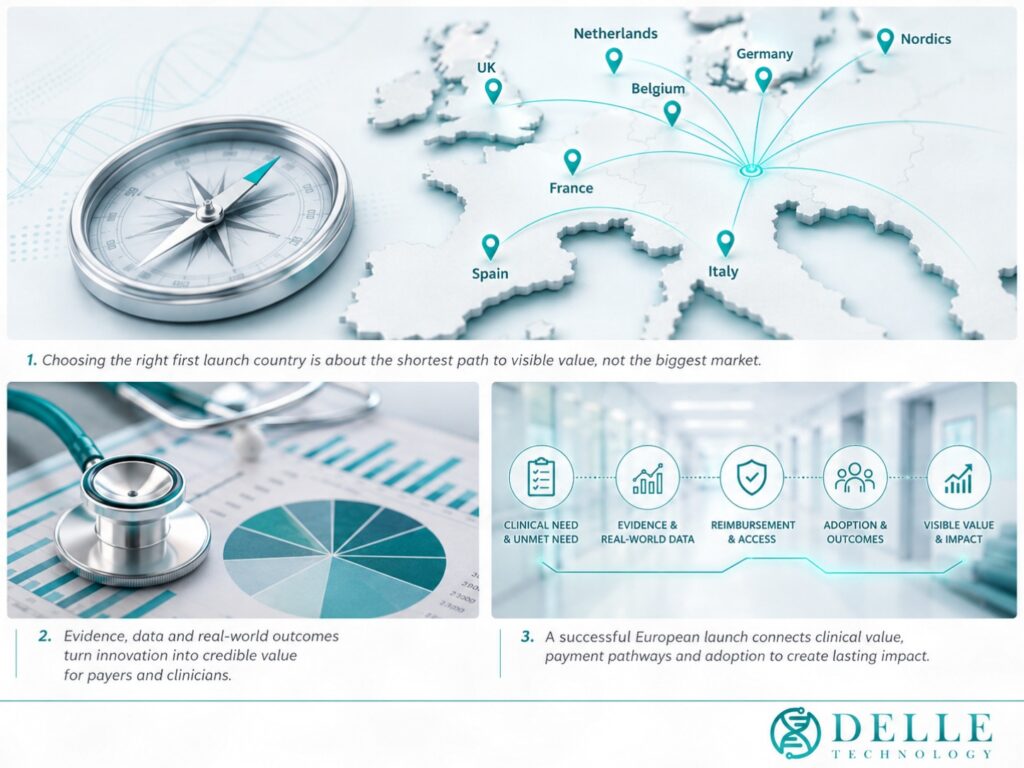
Europe can look deceptively unified from the outside. A CE mark under the EU Medical Device Regulation or In Vitro Diagnostic Regulation allows a product to be placed on the market.
But health systems ask different questions.
A CE mark asks:
Can this product be marketed?
Payers, hospitals and HTA bodies ask:
Should it be paid for?
For which patients?
In which setting?
Using which code or tariff?
From whose budget?
Compared with what?
With what clinical, economic and real-world evidence?
That gap between regulatory permission and health-system adoption is where many European launches slow down.
A technology can be approved but financially invisible.
It can be clinically elegant but uncoded.
It can be supported by clinicians but blocked by procurement.
It can save money for the system while increasing the cost pressure on the department expected to buy it.
The first launch country should therefore be chosen by approval-to-visible-value friction.
Table 1. The wrong question versus the better launch question
| Common question | Better question |
|---|---|
| Which is the largest European market? | Where can value become visible fastest? |
| Where do we have distributor interest? | Can the distributor explain the reimbursement route? |
| Where are there many patients? | Where is unmet need measurable and politically visible? |
| Where is the product approved? | Where can approval turn into paid clinical use? |
| Where are clinicians enthusiastic? | Which clinicians can generate evidence and influence adoption? |
| Where is the tariff highest? | Does the tariff actually cover the technology and workflow? |
| Where can we sell first? | Where can first use de-risk the next three markets? |
| Where is the access route simplest? | Where can evidence, payment, procurement and adoption align? |
The first launch country should not simply be a territory.
It should be an evidence platform.
The first country shapes the European narrative
A good first market can generate reference centres, real-world evidence, clinical publications, payer feedback, procurement experience, registry data, patient pathway validation and investor confidence.
A poor first market can consume capital, fragment the evidence story, disappoint distributors and make the technology look harder to adopt than it really is.
For boards and investors, launch sequencing is a capital-efficiency decision.
For clinicians, it is a credibility decision.
For payers, it is an evidence decision.
For companies, it can be the difference between a launch that compounds and a launch that stalls.
Table 2. What a good first launch country should produce
| Output from first market | Why it matters |
|---|---|
| First paid use | Shows the product can move beyond regulatory approval |
| Reference centres | Creates clinical credibility and peer influence |
| Real-world evidence | Shows performance in routine care |
| Registry or audit data | Makes adoption measurable |
| Health economic data | Supports payer and HTA discussions |
| Procurement learning | Reveals real buying barriers |
| Patient pathway validation | Shows where the product fits |
| Society engagement | Builds clinical legitimacy |
| Patient organisation support | Makes unmet need visible |
| Investor confidence | Turns access progress into company value |
Payment systems can hide innovation
For many hospital technologies, the first barrier is not clinical enthusiasm.
It is a payment architecture. https://odelletechnology.com/reimbursement-intelligence-hub/https://odelletechnology.com/reimbursement-intelligence-hub/
European systems use different forms of activity-based payment: DRGs, HRGs, GHM/GHS and national tariff structures. These systems classify hospital activity and control expenditure. They do not automatically reward innovation.
A new device may reduce complications, readmissions, revisions or length of stay. But if it is bundled inside an existing tariff, the hospital may face an immediate cost without an immediate payment.
This is one of the most common MedTech adoption problems:
value appears in one part of the system while cost appears in another.
A laboratory pays for a diagnostic; the emergency department saves admissions.
A hospital buys a surgical device; the payer benefits from avoided revisions.
An IT budget funds a digital platform; clinicians capture the workflow benefit.
A provider reorganises remote monitoring; the payer captures avoided hospital use.
Unless this value-flow problem is understood, the reimbursement strategy is incomplete.
Table 3. How payment architecture can block adoption
| Barrier | What it looks like | Why it matters |
|---|---|---|
| Bundled payment | Product cost sits inside an existing DRG, HRG or GHM/GHS | Hospital may have no additional funding |
| No visible code | Product cannot be clearly coded or grouped | Activity becomes financially invisible |
| Wrong budget holder | Buyer pays but another stakeholder benefits | Adoption incentive is misaligned |
| Capital cost barrier | Equipment must be bought before savings are realised | Procurement may delay adoption |
| Consumable burden | Per-case cost exceeds tariff assumptions | Finance may resist clinical enthusiasm |
| Evidence mismatch | Trial proves performance but not pathway value | Payer questions remain unanswered |
| Procurement complexity | Multiple stakeholders must approve | Sales cycle becomes slow and unpredictable |
The new European layer: EU HTA and JCA
The EU Health Technology Assessment Regulation is changing the evidence conversation.
For selected technologies, Joint Clinical Assessment will increasingly create a shared European clinical evidence spine. National payers will still make reimbursement, pricing and adoption decisions. But they will interrogate the clinical evidence through a more coordinated European lens.
That matters for MedTech and IVD companies.
It means comparator choice, endpoints, subgroup definitions, trial geography and real-world data planning cannot be left until after regulatory approval. They must be designed early, with national reimbursement questions already in mind.
The practical lesson is simple:
The first market is no longer just the first sales market. It may be the first evidence market for Europe.
Early HTA, early scientific advice and payer dialogue should therefore influence:
- pivotal study design
- comparator selection
- outcome measures
- registry strategy
- real-world evidence plans
- site selection
- publication strategy
- and country sequencing
The most expensive evidence is often the evidence a company realises it needs after the trial is already complete.
Table 4. Evidence decisions that should be made before launch
| Evidence decision | Why it matters |
|---|---|
| Comparator choice | The wrong comparator can weaken HTA and payer relevance |
| Endpoint selection | Regulators, clinicians and payers may value different outcomes |
| Resource-use collection | Needed for budget impact and cost-effectiveness analysis |
| Subgroup definition | Determines who should receive the technology first |
| Country/site selection | Determines whether evidence is transferable |
| Registry linkage | Supports real-world follow-up and reassessment |
| Patient-reported outcomes | Captures quality of life and lived burden |
| Implementation measures | Shows workflow, training and adoption feasibility |
| Publication strategy | Builds credibility beyond the first market |
Risk-sharing and outcomes-based access
European payers are increasingly interested in uncertainty management.
For some technologies, especially high-cost devices, diagnostics, digital health, remote monitoring and AI-enabled tools, the question may not be:
Can we prove everything before launch?
It may be:
Can we share risk while generating evidence?
This is where risk-sharing, conditional funding, managed entry, outcome-based agreements and coverage with evidence development can become strategically important.
They are not shortcuts.
They are evidence contracts.
Used well, they can allow earlier adoption while protecting payers and creating structured real-world evidence. Used poorly, they can become vague discounts, weak pilots or unfunded data burdens.
The right first country may be the one that can support a credible agreement between price, outcome, evidence and risk.
Table 5. Risk-sharing and evidence-generation options
| Mechanism | Best suited to | Strategic value |
|---|---|---|
| Coverage with evidence development | Promising technologies with residual uncertainty | Allows use while evidence matures |
| Conditional reimbursement | Technologies with plausible benefit but incomplete data | Links access to further evidence |
| Outcomes-based agreement | Products with measurable short- or medium-term outcomes | Aligns payment with performance |
| Budget-cap agreement | Technologies with uncertain uptake or budget impact | Reduces payer exposure |
| Registry-linked reimbursement | Implants, procedures, diagnostics, AI and digital tools | Turns use into measurable evidence |
| Regional pilot | Technologies requiring pathway redesign | Tests implementation before scale |
| Value-based procurement | Products with outcome, workflow or system benefits | Moves discussion beyond unit price |
The key is not to promise value.
It is to measure it.
Procurement is becoming strategic
Procurement is often treated as the final administrative step.
It should not be.
Procurement is where value, evidence, finance, workflow and risk meet.
European health systems are increasingly exploring value-based procurement and innovation procurement tools, including pre-commercial procurement and public procurement of innovative solutions. These approaches can favour companies that demonstrate outcomes, lifecycle value, service impact and real-world performance rather than simply offering the lowest unit price.
This is especially relevant for:
- digital health
- remote monitoring
- AI platforms
- service-wrapped diagnostics
- surgical systems
- capital equipment
- and technologies with measurable operational benefits
A company that understands procurement early can design evidence around the buyer’s real concerns: total cost, implementation burden, training, cybersecurity, interoperability, maintenance, outcomes and risk.
Table 6. What value-based procurement wants to see
| Procurement concern | Evidence needed |
|---|---|
| Unit price | Acquisition and per-patient cost |
| Total cost of ownership | Consumables, maintenance, training, service, upgrades |
| Workflow impact | Staff time, theatre time, reporting time, pathway changes |
| Clinical outcomes | Complications, revisions, admissions, diagnosis, control |
| Operational value | Capacity, throughput, waiting-list impact, workforce pressure |
| Risk | Safety, liability, data protection, continuity of service |
| Implementation | Training, interoperability, governance, adoption support |
| Sustainability | Durability, lifecycle cost, waste, system resilience |
Procurement is no longer just about buying.
It is about proving that the technology can live inside the system.
The missing layer: ecosystem science
A reimbursement map is essential. But it is not enough.
The best launch strategy asks whether a country has the ecosystem needed to turn a product into practice.
That means looking at:
- registries
- national audits
- atlases of variation
- medical societies
- patient organisations
- specialist centres
- clinical guideline groups
- political priorities
- unmet need
- regional inequality
- workforce pressure
- real-world evidence infrastructure
- and data governance
A country with a reimbursement route but weak clinical infrastructure may be a poor first market.A smaller country with strong registries, visible variation, motivated clinicians and politically recognised unmet need may be far more valuable. https://odelletechnology.com/how-joint-scientific-consultations-under-the-eu-hta-regulation-impact-your-technology/
Table 7. Ecosystem signals that should influence country prioritisation
| Ecosystem signal | Why it matters |
|---|---|
| Registries | Turn clinical use into measurable outcomes |
| Atlases of variation | Reveal gaps, inequalities and avoidable variation |
| National audits | Show performance, quality and unmet need |
| Medical societies | Build legitimacy and influence guidelines |
| Patient organisations | Make unmet need visible and political |
| Specialist centres | Provide credible first-use settings |
| Guideline groups | Shape pathway positioning |
| Political priorities | Accelerate attention when evidence is credible |
| Data infrastructure | Helps evidence travel to later markets |
| Procurement culture | Determines whether clinical interest becomes purchasing |
This is why Odelle describes launch country selection as ecosystem science.
The question is not simply whether a country can pay.
The question is whether the country can make value visible.
Data infrastructure and the RWE engine
The next generation of European launch strategy will be shaped by data.
The European Health Data Space and national data assets are making health data strategy more important for MedTech, IVD and digital health companies. Countries with better registries, claims data, hospital datasets, disease networks and real-world evidence infrastructure may become disproportionately valuable as launch markets.
For some products, the first country should be selected partly because it can function as an RWE engine.
This is particularly important for:
- implantable devices
- surgical technologies
- diagnostics
- AI-enabled software
- remote monitoring
- digital therapeutics
- chronic disease platforms
- rare disease technologies
- and technologies requiring long-term follow-up
The question is not just:
Can we sell here?
It is:
Can we learn here in a way the rest of Europe will trust?
AI and digital: approval is only one layer
For AI and digital health, the European launch question is even more complex.
These technologies may face multiple layers:
- MDR or IVDR
- software-as-a-medical-device classification
- cybersecurity and data protection
- AI governance
- post-market monitoring
- transparency and explainability expectations
- clinical workflow validation
- HTA and reimbursement
- procurement and IT approval
- and real-world performance monitoring
The EU AI Act adds another governance layer for high-risk AI systems, including requirements around risk management, transparency, data governance and post-market monitoring.
For AI-enabled medical technologies, this means some countries may be more suitable as structured reference environments than others.
The best first AI market may not be the one with the most hospitals.
It may be the one where clinical governance, data access, IT readiness, regulatory confidence and RWE infrastructure can support safe, measurable deployment.
Table 8. AI and digital launch readiness
| Domain | What to assess |
|---|---|
| Regulatory classification | MDR, IVDR and software status |
| AI governance | Risk management, transparency, monitoring, oversight |
| Data access | EHR, registry, claims or disease dataset feasibility |
| Workflow fit | Whether the tool saves time or creates burden |
| Clinical accountability | Who acts on the output and who is responsible |
| Cybersecurity | Hospital and national security expectations |
| Interoperability | Integration with existing systems |
| HTA evidence | Clinical benefit, utility, efficiency and implementation |
| Reimbursement identity | DTx, remote monitoring, software, service or pathway tool |
| Procurement readiness | IT, legal, data protection and clinical approval routes |
For AI and digital, the first country should not only buy the technology.
It should help govern it, measure it and make it credible.
The Odelle Approval-to-Visible-Value Framework
At Odelle Technology, we believe first launch country selection should be based on structured barrier and ecosystem analysis.
The aim is not simply to ask which countries are commercially attractive. It is to identify where the barriers between regulatory approval and meaningful adoption are lowest, most manageable or most strategically useful.
We call this the Approval-to-Visible-Value Framework.
Table 9. The Odelle Approval-to-Visible-Value Framework
| Domain | Core question | What Odelle examines |
|---|---|---|
| Clinical pathway fit | Where does the product sit in care? | Patient selection, comparator, workflow, setting, pathway change |
| Coding and payment visibility | Can the system see the product? | Codes, DRGs, HRGs, GHM/GHS, outpatient and laboratory routes |
| Tariff and budget adequacy | Does payment cover use? | Tariff fit, add-on payment, cost offsets, budget impact |
| HTA and JCA readiness | Will the evidence withstand assessment? | Comparative benefit, clinical utility, JCA evidence spine, national payer questions |
| Early access and risk-sharing | Can uncertainty be managed? | Conditional funding, outcomes-based access, CED, pilots |
| Registry and RWE infrastructure | Can adoption be measured? | Registries, audits, claims, datasets, endpoints |
| Ecosystem readiness | Is the environment ready to adopt? | Societies, patient groups, political priorities, unmet need, variation |
| Procurement complexity | How hard is it to buy? | Tenders, local budgets, capital approval, IT, data protection |
| AI/data governance | Can digital or AI be deployed safely? | AI Act, cybersecurity, transparency, monitoring, interoperability |
| Evidence transferability | Will evidence travel? | Comparator relevance, endpoints, publication strategy, data reuse |
| Capital efficiency | Does launch de-risk the company? | First revenue, reference sites, investor milestones, repeatable model |
The strongest launch country is not always the one with the highest revenue potential.
It is the one with the best combined score across visibility, evidence, payment, governance and adoption.
Table 10. Country ecosystem signals for European launch sequencing
| Country | Strongest launch signal | Why it can be attractive | Watch-outs |
|---|---|---|---|
| United Kingdom | NICE, NHS priorities, GIRFT, audits, variation data | Strong when technology addresses productivity, waiting lists, patient safety, early diagnosis or variation | Local adoption and procurement can still be slow |
| Germany | Coding, hospital financing, specialist centres, registries, digital routes | Strong for procedural, hospital and selected digital technologies when payment visibility is possible | Tariff absorption and high evidence expectations |
| France | HAS, CNEDiMTS, LPPR, SNDS, public health priorities | Strong when clinical benefit, public health value and evidence are aligned | Demanding assessment, reassessment and pricing risk |
| Netherlands | Pragmatic evidence generation, reference centres, health-economic culture | Strong for RWE, pathway validation and transferable evidence | Smaller immediate revenue opportunity |
| Belgium | INAMI/RIZIV, nomenclature, device lists, university centres | Strong as a precision-access market for carefully mapped technologies | Complex coding and hospital-financing architecture |
| Spain | Regional strategy, specialist hospitals, variation analysis, clinical champions | Strong where a region can create the first credible adoption pathway | Autonomous community fragmentation |
| Italy | Regional centres, outcomes programmes, specialist societies | Strong for technologies linked to centres of excellence and quality improvement | Regional procurement and uneven adoption |
| Nordics | Registries, population health, data infrastructure, high trust | Strong for RWE, long-term outcomes and registry-linked technologies | Smaller markets and decentralised purchasing |
Country signals in practice
United Kingdom: where variation, productivity and evidence matter
The UK can be powerful when a product aligns with visible NHS problems: waiting lists, diagnostic delay, hospital productivity, patient safety, workforce pressure or unwarranted variation.
A technology that can link itself to NICE, GIRFT, NHS England priorities, national audits or pathway redesign may have a strong access story.
The UK is not always fast. Procurement can be local and fragmented. But a good UK evidence story can travel.
UK launch question: https://odelletechnology.com/nice-dhsc-and-nhs-england-digital-care-evidence-standards-2026-what-healthtech-companies-must-now-prove/
Can this technology solve a measurable NHS problem and generate evidence that NICE, clinicians, providers and commissioners can believe?
Germany: where coding visibility and hospital economics matter
Germany can be attractive for hospital-based and procedural technologies, but only where coding and payment visibility are plausible.
A product may need to fit OPS coding, G-DRG logic, hospital innovation payment routes or specialist-centre adoption. For digital health, Germany can be highly visible, but only where the product fits the relevant framework and evidence expectations.
Germany launch question:
Can the technology become visible in German coding, hospital financing and specialist clinical evidence infrastructure?
France: where public value and assessment logic matter
France is structured, demanding and potentially powerful. https://odelletechnology.com/france-2026-why-reimbursement-route-selection-is-now-the-strategic-risk-for-medtech-ivd-digital-health-and-ai-companies/
It can be attractive when a technology aligns with HAS logic, CNEDiMTS expectations, LPPR pathways, SNDS real-world evidence potential, patient need and national priorities such as cancer, antimicrobial resistance, ageing, women’s health or digital transformation. https://odelletechnology.com/how-to-secure-cnedimts-frances-medical-device-evaluation-system-decoded/
France launch question:
Can the product demonstrate clinical benefit, public health relevance and a credible evidence plan that fits French assessment logic?
Netherlands: where evidence can travel
The Netherlands can be strategically valuable as an evidence-generation and reference-centre market.
It may not always produce the largest early revenue, but it can generate pragmatic clinical evidence, health-economic reasoning and pathway validation that helps later markets.
Netherlands launch question:
Can the Dutch system help generate transferable European evidence that de-risks larger markets?
Belgium: where precision matters
Belgium is complex but often underestimated.
For the right technology, it can be a precision-access market. But success depends on understanding INAMI/RIZIV logic, nomenclature, device lists, material codes, hospital financing, sickness fund structures and specialist-centre dynamics.
Belgium launch question:
Can the product be made visible within Belgium’s specific nomenclature, device-list and hospital-financing architecture?
Spain: where the region is the market
Spain should not be treated as a single launch environment.
Autonomous communities, regional procurement, hospital groups and local clinical champions matter. A strong first Spanish launch may depend less on Madrid as a national concept and more on identifying the region and centre that can generate adoption evidence.
Spain launch question:
Which region can create the first credible evidence and adoption pathway?
Italy: where centres of excellence and regional implementation matter
Italy also requires regional thinking.
The country can be powerful when a technology aligns with specialist centres, regional innovation priorities, outcomes evidence, clinical societies and visible variation in care.
Italy launch question:
Which region and which centres can generate adoption evidence that influences wider Italian practice?
Nordics: where registries and long-term evidence matter
The Nordics can be strategically important for technologies that benefit from high-quality registries, population-level datasets, long-term outcomes and high-trust clinical systems.
The revenue opportunity may be smaller than Germany or France, but the evidence value can be substantial.
Nordic launch question:
Can the product align with registry evidence, population health priorities and long-term outcome measurement?
Table 11. Product archetypes and first-launch logic
| Product type | What matters most | Best first market characteristics |
|---|---|---|
| High-cost hospital device | Tariff fit, add-on payment, procurement, complication reduction | Specialist centres, innovation routes, RWE capacity |
| Implantable device | Registry linkage, durability, revision data, surgeon adoption | Strong registries, respected surgical societies, reference centres |
| IVD or diagnostic | Clinical utility, decision impact, laboratory funding, downstream value | Clear pathway gap, measurable decision change, payer relevance |
| Digital therapeutic | Evidence framework, engagement, clinical outcomes, prescribing route | Recognised digital health pathway and clear evidence standard |
| AI-enabled software | Trust, workflow, liability, monitoring, integration | Controlled reference-centre deployment and real-world validation |
| Remote monitoring | Service model, clinician response, payment for monitoring | Chronic disease priorities, hospital avoidance, workforce pressure |
| Surgical navigation or robotics | Procedure time, accuracy, outcomes, learning curve, capital case | High-volume centres, society engagement, procurement readiness |
| Rare disease technology | Unmet need, diagnosis delay, patient groups, specialist centres | Concentrated expertise, strong advocacy, policy visibility |
Table 12. Red flags when choosing a first European launch country
| Red flag | Why it matters |
|---|---|
| No clear code or tariff | Product may be clinically used but financially invisible |
| Existing tariff is too low | Hospital may lose money with each use |
| Enthusiastic clinician has no budget influence | Clinical interest may not become procurement |
| Distributor cannot explain reimbursement | Sales activity may not produce adoption |
| Evidence shows performance but not utility | Payers may ask what changes in care |
| Value appears outside the buyer’s budget | Adoption incentive is misaligned |
| No registry or audit infrastructure | Evidence generation may be weak |
| No visible patient or policy pressure | Unmet need may be hard to communicate |
| Product requires pathway redesign | Implementation may be slower than expected |
| First centres cannot publish or influence peers | Adoption may remain isolated |
| Risk-sharing is vague | The payer sees uncertainty but no credible evidence plan |
| AI governance is immature | Digital adoption may be blocked by trust, data or liability concerns |
The Odelle research approach
Odelle’s work in European launch sequencing combines several forms of analysis.
Table 13. Odelle research techniques for launch sequencing
| Odelle technique | What it does | Strategic value |
|---|---|---|
| Reimbursement pathway reconstruction | Maps coding, tariffs, DRGs/HRGs/GHM, outpatient routes and innovation payments | Shows where revenue could realistically arise |
| Value-flow analysis | Maps who pays, who benefits and where savings appear | Identifies budget misalignment early |
| Barrier-to-revenue scoring | Scores countries by friction between approval and revenue | Prevents market-size bias |
| Early HTA and payer-question analysis | Identifies what payers will ask before evidence is locked | Reduces late-stage evidence regret |
| Risk-sharing design | Links uncertainty, outcomes, price and evidence generation | Makes conditional access credible |
| Evidence gap analysis | Identifies missing clinical, economic and implementation evidence | Helps design studies that answer payer questions |
| Evidence reusability analysis | Tests whether data from one country will travel to others | Makes first launch evidence more valuable |
| Registry and variation mapping | Identifies datasets, audits and variation signals | Links unmet need to measurable evidence |
| Society and patient-group mapping | Identifies clinical and advocacy networks | Builds legitimacy and pathway support |
| Procurement and value-based purchasing analysis | Maps buying criteria, tenders and total value concerns | Moves the case beyond unit price |
| AI and data-governance assessment | Reviews data, cybersecurity, transparency and monitoring needs | Supports safe digital and AI deployment |
| Reference-centre mapping | Finds centres able to use, measure and publish | Turns adoption into evidence |
| Strategic value analysis | Links launch milestones to company value | Makes market access relevant to investors |
Evidence should be designed before launch, not after it
The most expensive evidence is the evidence a company realises it needs after the pivotal study has already finished.
For European launch, evidence should be designed around six questions.
Table 14. The six evidence questions payers and adopters ask
| Evidence question | What it means |
|---|---|
| Does it work? | Safety, performance, clinical benefit |
| Does it change decisions? | Clinical utility, pathway consequence, treatment selection |
| Does it change resources? | Length of stay, admissions, theatre time, staff time, revisions, complications |
| Can it be implemented? | Workflow, training, usability, interoperability, procurement |
| Can uncertainty be managed? | Risk-sharing, registry follow-up, conditional evidence plans |
| Does it matter to the system? | Budget impact, equity, access, political priority, patient relevance |
Good evidence proves a product works.
Great evidence proves the system should change because the product exists.
Conclusion
The best first European launch country is rarely obvious from a map.
It is found through disciplined analysis of clinical need, pathway fit, coding visibility, reimbursement architecture, HTA and JCA readiness, procurement logic, registry infrastructure, data governance, variation evidence, clinical societies, patient organisations, political priorities, risk-sharing options, evidence gaps and partnership potential.
Europe rewards innovation, but it rewards disciplined innovation.
The companies that succeed are not necessarily those that launch first in the largest market. They are the companies that understand how evidence, payment, policy, procurement, data and adoption fit together — and choose their first market accordingly.
The real launch question is not:
Which country is biggest?
It is:
Where can value become visible fastest — in a way that de-risks the rest of Europe?
In Europe, approval makes a product available.
Evidence makes it credible.
Coding makes it visible.
Reimbursement makes it usable.
Procurement makes it purchasable.
Adoption makes it real.