Why choosing the wrong French pathway can damage evidence, pricing, adoption and investor confidence
France is one of Europe’s most attractive markets for medtech, diagnostics, digital health and AI. It is also one of the easiest markets to misunderstand.
The mistake is rarely that companies ignore reimbursement altogether. Most serious companies now know that reimbursement matters. The more dangerous mistake is that they choose a reimbursement route too late, too loosely, or on the basis of the product category they prefer, rather than the decision architecture the French system will actually apply.
In France, the first reimbursement mistake is often made before the dossier is written. It occurs when a company assumes its technology falls within the route it understands, rather than the route the French system will recognise.
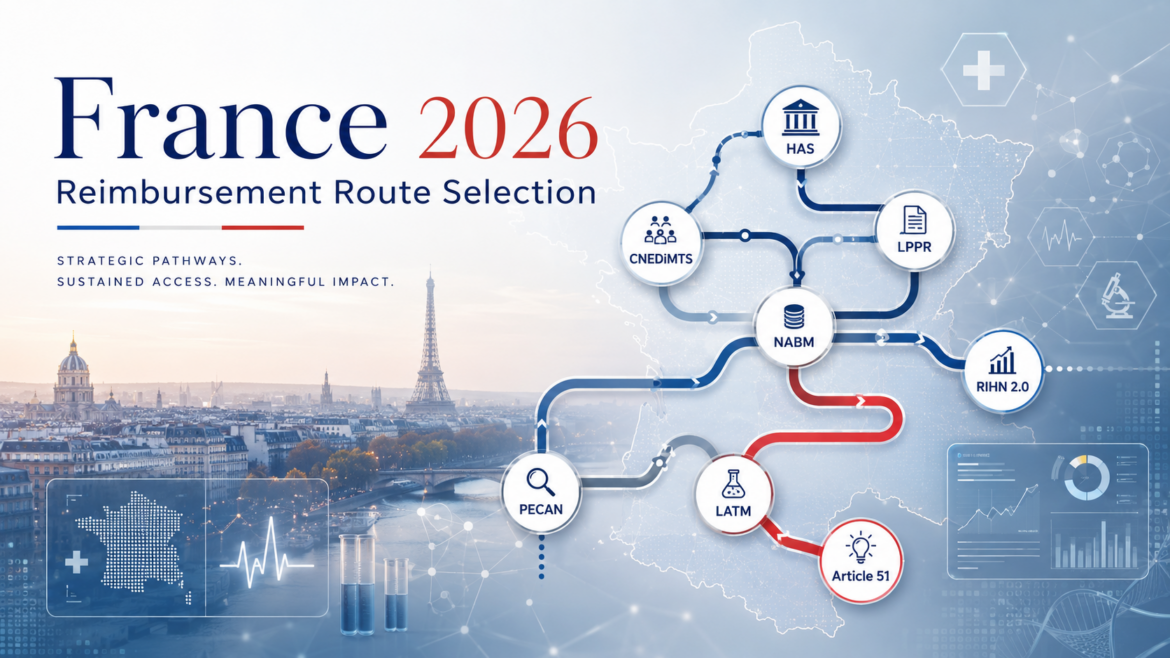
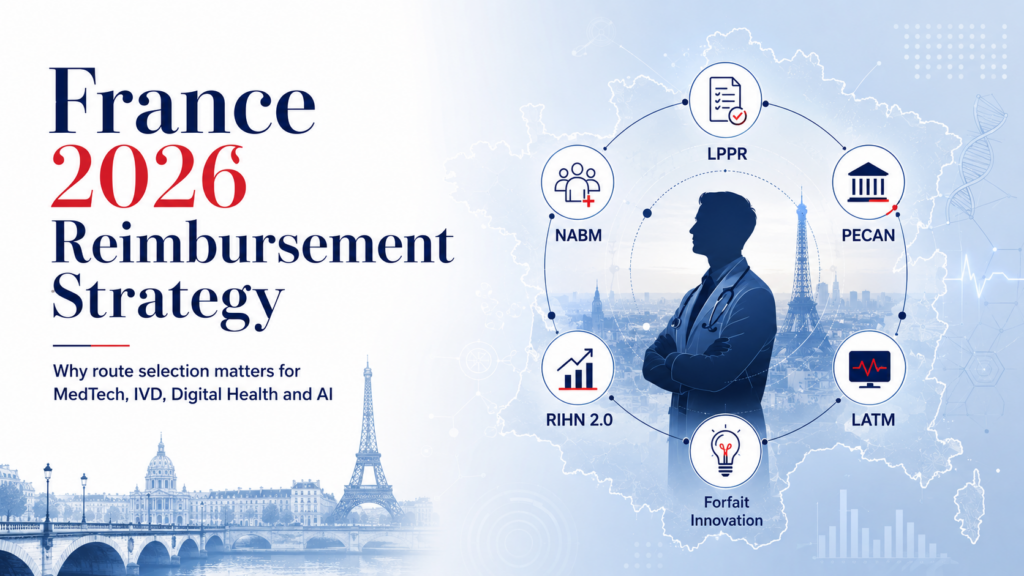
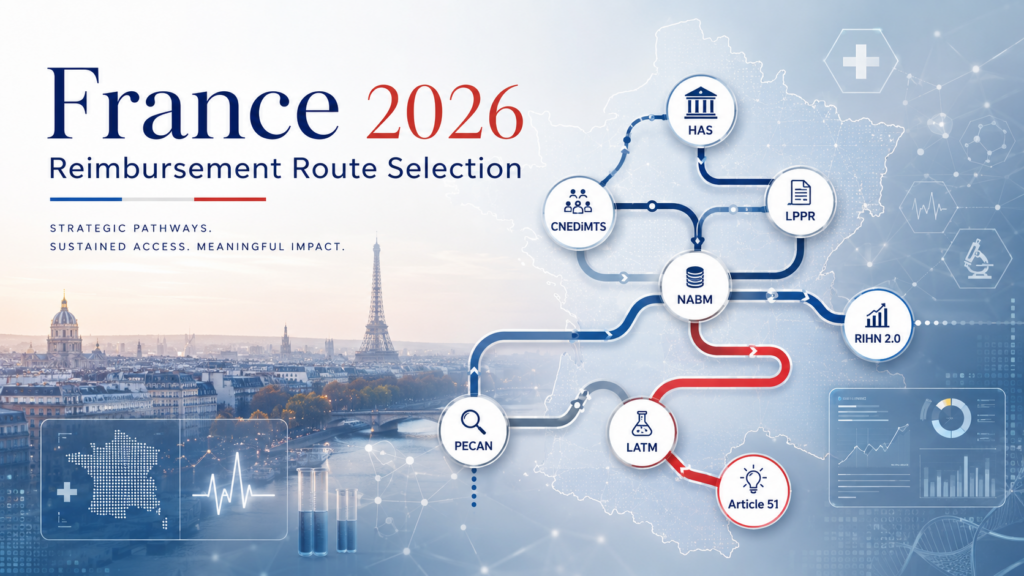
That mistake matters because France is not one reimbursement pathway. It is a series of different decision systems. A diagnostic test, digital therapeutic, AI-supported clinical decision tool, remote monitoring technology, implantable device, hospital procedure, laboratory innovation or pathway redesign may each face a different route. Those routes include NABM, RIHN 2.0, LAHN, LPPR, PECAN, LATM, Intra-GHS hospital funding, Article 51, Forfait Innovation and prise en charge transitoire.
The problem is not only administrative. It is scientific, economic and strategic.
The route determines the evidence question. The evidence question determines the comparator. The comparator determines the endpoint. The endpoint determines the economic model. The economic model determines the budget holder. The budget holder determines whether adoption is realistic.
If the route is wrong, everything downstream becomes misaligned.
France does not reimburse innovation. It reimburses recognised value inside a pathway
A common error among early-stage and growth-stage companies is to assume that France will reward novelty. It may not.
French reimbursement is not designed to reward technologies simply because they are new, digital, AI-enabled, decentralised, faster, more elegant or clinically interesting. The French system asks a more disciplined question: where does this technology sit in the care pathway, who uses it, what decision does it change, what comparator does it replace or modify, and what value can be demonstrated for patients and the health system?
That is why route selection matters. A company entering France must decide whether the technology is primarily a reimbursable medical device, a diagnostic act, a laboratory procedure, a remote monitoring activity, a digital therapeutic, a hospital-funded technology, a clinical pathway innovation, or an experimental service model.
Each answer points to a different reimbursement logic.
For medical devices, the CNEDiMTS evaluates evidence for reimbursement decisions, including whether a device should be listed on the LPPR. HAS explains that CNEDiMTS opinions inform public reimbursement decisions, and that access to reimbursement requires submission of a dossier after CE marking, with clinical assessment by CNEDiMTS and economic assessment by CEESP where required.
For individual-use medical devices, the LPPR is central. HAS describes the LPPR as the list enabling reimbursement of individual-use medical devices in community care and, in some cases, devices funded outside hospital GHS tariffs.
For biological diagnostic tests, the issue may instead be whether the act is already listed in the NABM, the French nomenclature for medical biology acts. Assurance Maladie describes NABM as the classification used to code and classify biological acts, grouped within the national biology coding table.
For innovative biological or anatomopathology acts not yet in the routine nomenclature, the relevant route may be RIHN 2.0. HAS describes RIHN as a derogatory and transitional financing mechanism for innovative medical biology and anatomocytopathology acts, conditional on data collection. HAS also notes that RIHN 2.0 may support innovative biological or anatomopathology acts in clinical development, as well as companion tests linked to medicines benefiting from early access.
For digital medical devices, the route may be different again. HAS explains that since 2023 there have been two dedicated reimbursement routes for certain digital medical devices: ordinary reimbursement through the LATM for remote monitoring activities, and PECAN, the early access route for digital medical devices used for therapeutic purposes or medical remote monitoring. PECAN is explicitly a one-year, non-renewable derogatory route while awaiting ordinary reimbursement via the LPPR or LATM, depending on the type of digital medical device.
For service redesign, multidisciplinary care, payment innovation or pathway transformation, Article 51 may be relevant. The French Ministry of Health describes Article 51, created by the 2018 Social Security Financing Act, as a mechanism to support organisational innovation and transformation of the health system.
For early clinical development of innovative technologies, Forfait Innovation or prise en charge transitoire may be relevant, but these should not be treated as lazy substitutes for a proper route-selection strategy. HAS describes Forfait Innovation as a derogatory and transitional funding route for innovative health technologies in an early phase of clinical development. HAS also describes prise en charge transitoire as a mechanism for certain products and services in view of LPPR listing.
The strategic implication is simple: a company cannot design one generic “France evidence package” and expect it to work across all these routes.
The route-selection problem is an evidence-design problem
The most important question is not:
Can we get reimbursed in France?
The better question is:
Which French decision-maker will assess this technology, through which route, against which comparator, using which evidence standard, with which budget holder expected to pay?
This is where many companies fail. They build evidence around the product story. France asks for the pathway story.
A digital therapeutic may generate engagement data, user satisfaction, retention metrics and clinical improvement signals. But if the intended route is LPPR or PECAN, the company may need to show clinical benefit, safety, therapeutic purpose, expected place in care, and a plausible transition into ordinary reimbursement. HAS’s PECAN guide, updated in March 2026, sets out dossier elements required for review by CNEDiMTS and the relevant authorities.
An AI diagnostic company may demonstrate accuracy, sensitivity, specificity or technical performance. But if the route is RIHN 2.0, LAHN or NABM, the French system may ask whether the test changes diagnostic decision-making, clinical management, therapeutic selection, patient outcomes, resource use or pathway efficiency.
A hospital technology may show improved workflow, speed or productivity. But if the technology is absorbed into existing hospital funding through GHS or procurement, the key question may be whether the hospital can afford it within existing budgets, whether it reduces length of stay, avoids complications, releases staff time, or prevents expensive downstream events.
A remote monitoring technology may appear to be a digital medical device, but the route may depend on whether it is a therapeutic digital device, a remote monitoring activity, a professional-use tool, a workflow technology, or a service component. HAS has separately been working on evaluation principles for digital medical devices, including professional-use digital medical devices, reflecting the growing need to structure assessment in this area.
The risk is not simply choosing the wrong form. It is generating the wrong evidence.
Why MedTech, IVD and AI companies are especially vulnerable
Technologies that cross categories are the most exposed.
A classical implant may fit more naturally into LPPR logic. A routine biological test may fit into NABM. But many modern technologies do not behave so neatly.
An AI-supported urine cytology tool may look like software, a diagnostic aid, a laboratory act, a professional tool and a cancer pathway technology. A remote cardiac platform may look like a digital medical device, a monitoring service, a cardiology pathway tool and a hospital capacity intervention. A sepsis diagnostic platform may look like an IVD, an emergency department workflow tool, a microbiology act, an antimicrobial stewardship intervention and an ICU cost-avoidance technology. A digital therapeutic may look like software, behavioural support, clinical treatment, remote management and patient self-care infrastructure.
This ambiguity is commercially dangerous.
If the company treats the product as “software”, it may under-build the clinical evidence. If it treats it as a “diagnostic”, it may under-build the pathway and economic case. If it treats it as a “hospital productivity tool”, it may miss national reimbursement opportunities. If it treats it as a “national reimbursement product”, it may ignore the hospital procurement route that could generate first adoption.
In France, category ambiguity becomes reimbursement risk.
The wrong route can damage pricing
Route selection also shapes price expectations.
A technology entering through national reimbursement may face a different pricing conversation from one entering through hospital procurement, early access, RIHN 2.0, PECAN, LATM, LPPR or an Article 51 experiment. The payer may ask whether the product is replacing an existing act, adding a new act, shifting activity between settings, reducing hospital admissions, changing medication use, improving monitoring, or creating an entirely new service model.
That distinction matters.
If a company frames itself as an add-on cost, it may be treated as a budget pressure. If it frames itself as a pathway intervention, it may be able to show avoided complications, avoided downstream procedures, reduced admissions, faster diagnosis, better targeting of therapy, or lower total cost of care.
But those claims must be route-specific. The economic case for LPPR is not the same as the economic case for RIHN 2.0, Article 51, LATM or hospital procurement.
The wrong route can damage clinical adoption
In France, clinical champions are essential, but they are not enough.
A surgeon, cardiologist, diabetologist, oncologist, radiologist, microbiologist or hospital director may be enthusiastic. But enthusiasm does not automatically identify the payer, the reimbursement code, the responsible committee, the evidence standard or the budget line.
This is particularly important for diagnostics and AI. A test may be clinically attractive to one specialist but paid for by another part of the system. A diagnostic may create value in oncology but be performed in pathology. An antimicrobial resistance test may support emergency medicine but be owned operationally by microbiology. An AI triage tool may benefit clinicians but be purchased by hospital management. A remote monitoring system may reduce admissions but require professional time that is not yet funded appropriately.
The clinical owner and the budget owner are often not the same person.
That is why route selection must be performed before evidence generation, not after clinical enthusiasm has already been secured.
The wrong route can damage investor confidence
Investors increasingly understand that reimbursement is not a late-stage administrative task. It is a value-creation issue.
A company that cannot explain its French route may struggle to explain its adoption timeline, evidence budget, pricing assumptions, revenue model or market entry sequence. A company that chooses the wrong route may spend two years producing evidence that is scientifically interesting but commercially weak.
The investor risk is not only failure. It is uncertainty.
Unclear route means unclear evidence.
Unclear evidence means unclear pricing.
Unclear pricing means unclear adoption.
Unclear adoption means unclear revenue.
That is why reimbursement route selection should be treated as a strategic risk factor in medtech, IVD, digital health and AI investment diligence.
A practical route-selection test for France
Before building a French dossier, companies should answer ten questions.
- What is the technology in French reimbursement terms?
Is it a device, act, test, procedure, digital therapeutic, remote monitoring activity, professional-use digital tool, hospital technology or organisational innovation? - Who is the French decision-maker?
Is the relevant route linked to HAS, CNEDiMTS, CEESP, Assurance Maladie, the Ministry of Health, CNAM, regional structures, hospitals, laboratories or Article 51 governance? - What is the likely reimbursement route?
NABM, RIHN 2.0, LAHN, LPPR, LATM, PECAN, Intra-GHS, Article 51, Forfait Innovation or prise en charge transitoire? - What is the comparator?
Standard care, an existing act, an existing device, no test, delayed diagnosis, hospital admission, manual workflow, usual monitoring, or another technology? - What decision does the technology change?
Diagnosis, treatment selection, monitoring, escalation, referral, admission, discharge, medication use, surgery, surveillance or patient self-management? - Who owns the clinical pathway?
Specialist, GP, hospital department, laboratory, pharmacy, home-care provider, insurer, regional structure or multidisciplinary team? - Who pays or absorbs the cost?
National insurance, hospital budget, laboratory tariff, remote monitoring tariff, device list, experimental funding, complementary insurance or patient/self-pay? - What evidence does the route require?
Technical performance, clinical validity, clinical utility, comparative effectiveness, economic impact, data collection, real-world evidence, implementation evidence or safety governance? - What is the route after early access?
PECAN, RIHN 2.0, Forfait Innovation and transitional routes are not the final destination. The company needs a credible exit into ordinary reimbursement or sustained procurement. - Can the claim survive French scrutiny?
France will not accept vague innovation claims. The company must show where the technology sits, what it changes, and why the health system should pay.
The Odelle view
France remains one of the most important European markets for medtech, diagnostics, digital health and AI. But it should not be approached as a single reimbursement destination.It should be approached as a route-selection problem.
The central strategic question is not whether the company has evidence. It is whether the company has evidence for the right French route.
A company may have excellent clinical data and still fail if the evidence does not match the reimbursement pathway. A company may have strong technical validation and still fail if it has not demonstrated clinical utility. A company may have hospital enthusiasm and still fail if it has not identified the budget holder. A company may have a promising AI tool and still fail if it cannot explain whether it is a diagnostic act, a professional-use digital medical device, a workflow tool or a pathway intervention.This is the new reimbursement risk in France.
Not absence of evidence.
Misaligned evidence.
Not lack of innovation.
Misclassified innovation.
Not lack of clinical interest.
Lack of route fit.
For MedTech, IVD, digital health, and AI companies, French market access in 2026 begins with one disciplined question:
Which route will France recognise and are we building the evidence that route actually requires?
Frequently asked questions
What is the biggest reimbursement mistake medtech companies make in France?
The biggest mistake is assuming that French reimbursement is a single process. In reality, the correct route depends on how the technology is classified in the French system: medical device, diagnostic act, digital medical device, remote monitoring activity, hospital technology, pathway innovation or experimental service model. Choosing the wrong route can lead to the wrong evidence, comparator, economic case and budget-holder strategy.
Is CE marking enough to obtain reimbursement in France?
No. CE marking is necessary for market access, but it does not automatically create reimbursement. For many technologies, French reimbursement requires route-specific assessment, evidence of clinical value, pathway positioning and, in some cases, economic or real-world evidence. HAS explains that CNEDiMTS recommendations support public reimbursement decision-making for medical devices and health technologies.
What is the difference between LPPR and NABM?
LPPR is the French list used for reimbursement of certain medical devices and products or services. NABM is the nomenclature used for medical biology acts. A device, digital medical device or implant may fall into LPPR logic, whereas a biological diagnostic test may require NABM listing or, if innovative and not yet listed, a transitional route such as RIHN 2.0.
What is RIHN 2.0?
RIHN 2.0 is France’s renewed framework for innovative acts outside the standard nomenclature. It is intended to support early and transitional access for innovative medical biology and anatomopathology acts while evidence is generated. The French Ministry of Health describes RIHN as enabling early and transitional coverage for innovation outside the nomenclature.
What is PECAN in France?
PECAN is France’s early access route for certain digital medical devices. HAS describes PECAN as a one-year, non-renewable derogatory coverage route for eligible digital medical devices used for therapeutic purposes or medical remote monitoring, while awaiting ordinary reimbursement through LPPR or LATM.
What is LATM?
LATM is the French list of medical remote monitoring activities. It is relevant for digital medical devices used in remote monitoring. HAS published an updated LATM guide in March 2026 for manufacturers seeking review by CNEDiMTS.
When is Article 51 relevant?
Article 51 is relevant when the innovation is not simply a product, test or device, but a new care organisation, pathway, payment model or service configuration. The French Ministry of Health describes Article 51 as a mechanism created by the 2018 Social Security Financing Act to support organisational innovation and health system transformation.
Is Forfait Innovation the answer for every innovative technology?
No. Forfait Innovation is a specific exceptional funding route for certain innovative health technologies in early clinical development. It should not be used as a default answer when the real issue is poor route selection, weak evidence design or unclear pathway fit. HAS describes innovation funding as being assessed against defined eligibility criteria.
Why does route selection affect evidence generation?
Because each route asks a different question. LPPR evidence is not the same as RIHN 2.0 evidence. PECAN evidence is not the same as Article 51 evidence. Hospital procurement evidence is not the same as national reimbursement evidence. The route determines the comparator, endpoints, budget impact logic and decision-maker.
Why does this matter to investors?
Investors need to know whether the company has a credible path to adoption, pricing and revenue. If the French route is unclear, the evidence plan, timelines, pricing assumptions and adoption strategy may also be unclear. Route-selection risk is therefore a commercial and investor-risk issue, not only a regulatory or reimbursement issue.
References and further reading
Official French sources
- Haute Autorité de Santé. National Committee for the Evaluation of Medical Devices and Health Technologies — CNEDiMTS.
https://www.has-sante.fr/jcms/c_2036238/en/national-committee-for-the-evaluation-of-medical-devices-and-health-technologies-cnedimts
This is the core HAS page explaining CNEDiMTS and its role in supporting reimbursement decision-making for medical devices and health technologies. - Haute Autorité de Santé. Assessment of medical devices.
https://www.has-sante.fr/jcms/c_2035661/fr/assessment-of-medical-devices
Useful background page on HAS/CNEDiMTS medical device assessment and reimbursement recommendations. - Haute Autorité de Santé. LPPR — Guide pour le dépôt de dossier, actualisation mars 2026.
https://www.has-sante.fr/jcms/c_419016/fr/lppr-guide-pour-le-depot-de-dossier-actualisation-mars-2026
This is the key 2026 HAS guide for companies preparing an LPPR dossier. - Haute Autorité de Santé. Déposer un dossier d’évaluation d’un dispositif médical.
https://www.has-sante.fr/jcms/c_464498/fr/deposer-un-dossier-d-evaluation-d-un-dispositif-medical
Useful HAS landing page covering medical device dossier submission routes, including LPPR, PECAN, PECT and LATM references. - Haute Autorité de Santé. PECAN — Guide de dépôt de dossier.
https://has-sante.fr/jcms/p_3424747/fr/pecan-guide-de-depot-de-dossier
This is the practical HAS guide for early digital coverage under PECAN, updated 30 March 2026. - G_NIUS. Prise en charge anticipée numérique — PECAN.
https://gnius.esante.gouv.fr/fr/financements/fiches-remboursement/prise-en-charge-anticipee-numerique-pecan
G_NIUS explains PECAN as a one-year derogatory coverage route through Assurance Maladie for sufficiently mature digital medical devices while benefit evidence is finalised. - Haute Autorité de Santé. LATM — Guide pour le dépôt de dossier.
https://www.has-sante.fr/jcms/p_3425489/fr/latm-guide-pour-le-depot-de-dossier
This is the HAS guide for digital medical devices used in medical remote monitoring and seeking LATM assessment. - Agence du Numérique en Santé. Certification des dispositifs médicaux numériques.
https://esante.gouv.fr/ens/offre/dispositifs-medicaux-numeriques
Important for digital medical devices seeking LPPR or LATM reimbursement, because ANS explains the digital conformity/certification requirements. - Haute Autorité de Santé. RIHN 2.0 — Déposer une demande d’inscription au référentiel des actes innovants hors nomenclature.
https://www.has-sante.fr/jcms/p_3566839/fr/deposer-une-demande-d-inscription-au-referentiel-des-actes-innovants-hors-nomenclature-rihn-2-0
This is the core HAS source for the RIHN 2.0 procedure, including the requirement for clinical and/or medico-economic data collection. - Ministère du Travail, de la Santé et des Solidarités. RIHN 2.0 — Un soutien renouvelé à l’innovation pour les actes innovants.
https://sante.gouv.fr/soins-et-maladies/qualite-securite-et-pertinence-des-soins/biologie-medicale/rihn
This is the Ministry page on RIHN 2.0, updated in April 2026. - Légifrance. Décret n° 2024-290 du 29 mars 2024 relatif aux conditions de prise en charge des actes innovants de biologie ou d’anatomopathologie hors nomenclatures.
https://www.legifrance.gouv.fr/jorf/id/JORFTEXT000049345711
This is the legal basis for the renewed framework for innovative biological and anatomopathology acts outside standard nomenclatures. - Légifrance. Décret n° 2025-1425 du 24 décembre 2025 modifiant le décret n° 2024-290.
https://www.legifrance.gouv.fr/jorf/id/JORFTEXT000053228782
This 2025 decree modifies conditions for derogatory coverage of innovative biology and anatomocytopathology acts, including funding and duration changes. - Ministère du Travail, de la Santé et des Solidarités. Article 51 LFSS 2018 — Innovations organisationnelles pour la transformation du système de santé.
https://sante.gouv.fr/systeme-de-sante/parcours-des-patients-et-des-usagers/article-51-lfss-2018-innovations-organisationnelles-pour-la-transformation-du/
This is the main official Article 51 page, describing the framework for organisational innovation and health-system transformation. - Ministère du Travail, de la Santé et des Solidarités. Article 51 — Foire aux questions.
https://sante.gouv.fr/systeme-de-sante/parcours-des-patients-et-des-usagers/article-51-lfss-2018-innovations-organisationnelles-pour-la-transformation-du/article/article-51-foire-aux-questions
Useful for explaining Article 51 derogations from ordinary rules, including billing and funding rules. - Haute Autorité de Santé. Forfait Innovation — Guide pour le dépôt de dossier.
https://www.has-sante.fr/jcms/c_2792679/fr/forfait-innovation-guide-pour-le-depot-de-dossier
This is the HAS guide for Forfait Innovation applications. - Haute Autorité de Santé. Forfait Innovation — Principes d’évaluation de la HAS.
https://www.has-sante.fr/jcms/p_3269384/fr/forfait-innovation-principes-d-evaluation-de-la-has
This explains HAS evaluation principles for Forfait Innovation. - Haute Autorité de Santé. Accès à l’innovation — la HAS encourage les industriels à utiliser le forfait innovation.
https://www.has-sante.fr/jcms/p_3191909/fr/acces-a-l-innovation-la-has-encourage-les-industriels-a-utiliser-le-forfait-innovation
Useful supporting source describing Forfait Innovation as temporary financing for an innovative medical device or act during early clinical development. - Haute Autorité de Santé. Dispositifs médicaux innovants — le dispositif de prise en charge transitoire opérationnel.
https://www.has-sante.fr/jcms/p_3268128/fr/dispositifs-medicaux-innovants-le-dispositif-de-prise-en-charge-transitoire-operationnel
Useful for explaining PECT / transitional coverage for innovative medical devices.
Academic and peer-reviewed sources
- Carbonneil C, et al. French reimbursement of health technologies: assessment and appraisal process. Therapie. 2025.
https://www.sciencedirect.com/science/article/abs/pii/S0755498225000120
Highly relevant because it explains that French reimbursement of health technologies involves several steps and that not all technologies are eligible. - Martin T, et al. Early access programs for medical devices in France. Health Policy. 2024.
https://www.sciencedirect.com/science/article/pii/S0168851024001568
This is one of the most useful academic papers for your article because it reviews French early access programmes for medical devices, including Forfait Innovation, PECT and PECAN. - Crochet PD, et al. Évaluation des dispositifs médicaux par la Haute Autorité de Santé. Bulletin de l’Académie Nationale de Médecine. 2019.
https://www.sciencedirect.com/science/article/pii/S0001407919301116
Useful French-language academic source explaining how HAS evaluates medical devices through CNEDiMTS, including indication, comparator, target population and LPPR logic. - Morize N, Bourgeois I, Fournier C. Renewing Public Policy on Healthcare: Experimenting with Healthcare Organisations under the Article 51 Scheme. IRDES, Issues in Health Economics, 2021.
https://www.irdes.fr/english/issues-in-health-economics/261-renewing-public-policy-on-healthcare-experimenting-with-healthcare-organisations-under-article-51-scheme.pdf
Good analytical source for Article 51 as a healthcare organisation and payment experimentation framework. - Tarricone R, Petracca F, Weller H-M. Towards harmonizing assessment and reimbursement of digital medical devices in the EU through mutual learning. npj Digital Medicine. 2024;7:268.
https://www.nature.com/articles/s41746-024-01263-w
Useful for framing France’s PECAN/LATM digital medical device routes in the wider European digital reimbursement context. - Loge P, et al. Factors influencing reimbursement of medical devices in France. International Journal of Technology Assessment in Health Care. 2015.
https://www.cambridge.org/core/journals/international-journal-of-technology-assessment-in-health-care/article/factors-influencing-reimbursement-of-medical-devices-in-france/13BFE8741202AAD54FA070D4A3E9E681
Older, but still useful for understanding factors that influence French medical device reimbursement decisions. - Huot L, Decullier E, Maes-Beny K, Chapuis FR. Medical device assessment: scientific evidence examined by the French National Authority for Health. BMC Public Health. 2012;12:585.
https://bmcpublichealth.biomedcentral.com/articles/10.1186/1471-2458-12-585
Older but useful background on the kind of scientific evidence examined by HAS in medical device assessments.
European context sources
- OECD. Towards identifying good practices in the assessment of digital medical devices. 2025.
https://www.oecd.org/content/dam/oecd/en/publications/reports/2025/04/towards-identifying-good-practices-in-the-assessment-of-digital-medical-devices_e35198b0/b485ee1f-en.pdf
Useful for wider context on assessment of digital medical devices. - Alshaikh RA, et al. Mapping current decision-making pathways and evidence requirements for high-risk medical devices and in vitro diagnostics across Europe. 2025.
https://pmc.ncbi.nlm.nih.gov/articles/PMC12592967/
Useful broader European context for variation in evidence and reimbursement pathways across countries.