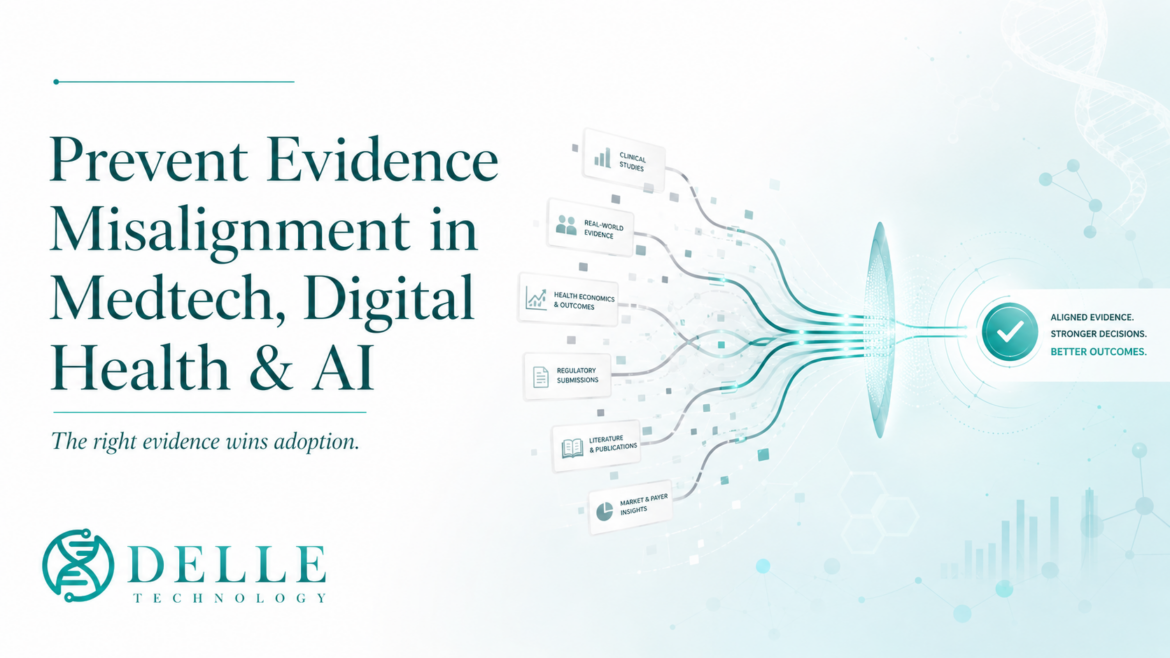
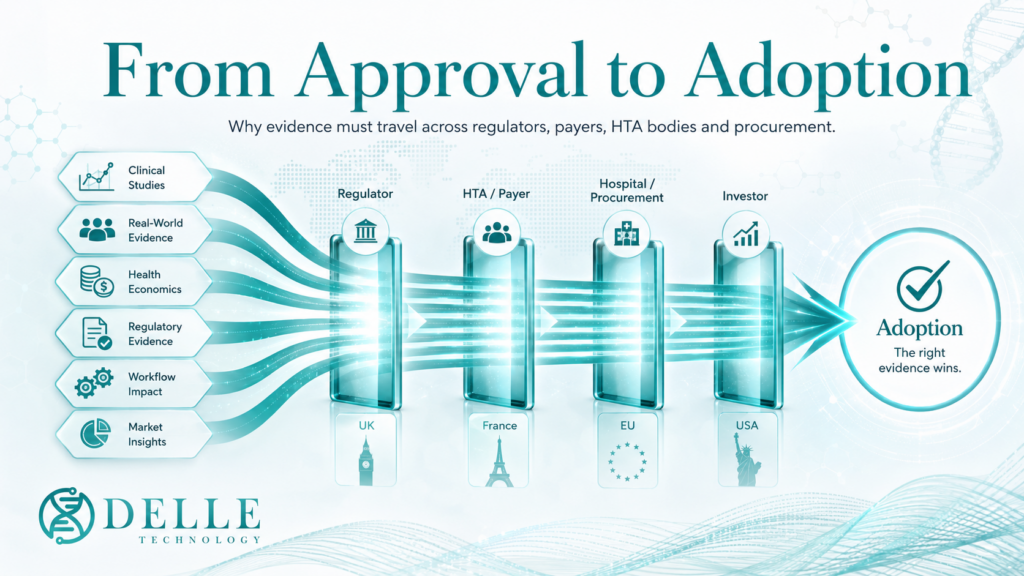
In healthcare, evidence only creates value when it answers the question the payer, HTA body, commissioner, hospital, regulator or investor is actually asking. Many healthtech companies do not fail because they lack evidence. They fail because their evidence answers the wrong question.
That is the evidence misalignment problem.
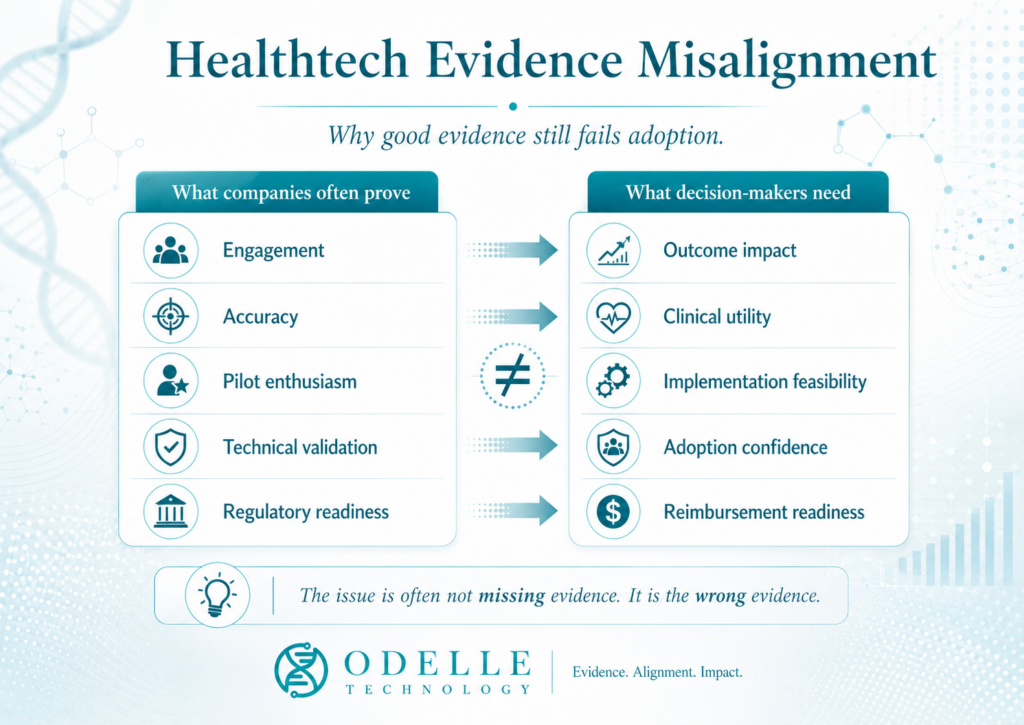
A company may have a clinical study, a pilot, engagement data, user satisfaction metrics, technical validation, regulatory clearance, accuracy statistics, testimonials or a strong product story. Yet when it reaches reimbursement, procurement, HTA, commissioning or investor diligence, the evidence may not match the decision being made.
The result is familiar.
The technology may be promising.
The evidence may be real.
The adoption case may still be weak.
At Odelle Technology, we believe the next failure point for healthtech, medtech, diagnostics and AI companies will not be invention. It will be evidence alignment.
The problem is often not missing evidence. It is misaligned evidence.
Odelle definition
Evidence misalignment occurs when a health technology company generates evidence that supports the product story, but does not answer the decision-maker’s access question.That decision-maker may be NICE, HAS, CMS, an NHS trust, an integrated care board, a local authority, a hospital procurement committee, a private insurer, a national payer, an HTA body or an investor.
Each asks a different question.
A regulator may ask whether the product is safe and performs as intended.
A payer may ask whether it improves outcomes enough to justify payment.
A hospital may ask whether it saves time, reduces admissions or fits workflow.
A commissioner may ask whether it reduces avoidable utilisation.
A social care provider may ask whether it improves safety, independence or workforce resilience.
An investor may ask whether the evidence package can unlock reimbursement, procurement and scale.
One evidence package rarely answers all these questions automatically.
That is why evidence needs to be designed around the decision, not merely accumulated around the product.
How this differs from evidence-market fit
Evidence-market fit is the goal.
Evidence misalignment is the failure mechanism.
A company has evidence-market fit when its evidence package matches the expectations of the decision-maker who must approve, reimburse, procure, recommend, commission or scale it.
Evidence misalignment occurs when the evidence is real, but aimed at the wrong question.
In simple terms:
Evidence-market fit asks: does the evidence match the market decision?
Evidence misalignment asks: why does apparently good evidence fail to unlock adoption?
This distinction matters because many companies think they have reduced access risk when they have only reduced technical or regulatory risk.
They may have proved that the technology works.
They may not have proved that the system should adopt it.
Key takeaways
- Evidence only creates commercial value when it fits the decision being made.
- Regulatory clearance is not the same as reimbursement readiness.
- Accuracy is not the same as clinical utility.
- Engagement is not the same as outcome impact.
- Pilot enthusiasm is not the same as implementation feasibility.
- Technical validation is not the same as adoption confidence.
- A high-quality study can still be commercially weak if it answers the wrong question.
- AI, digital health and medtech companies must prove workflow impact, governance, safety, economics and real-world value.
- The evidence problem is becoming global: UK, France, EU and US policy signals all point towards earlier, better-aligned evidence.
Why evidence misalignment matters now
Health systems are becoming less tolerant of weak, incomplete or poorly aligned evidence.
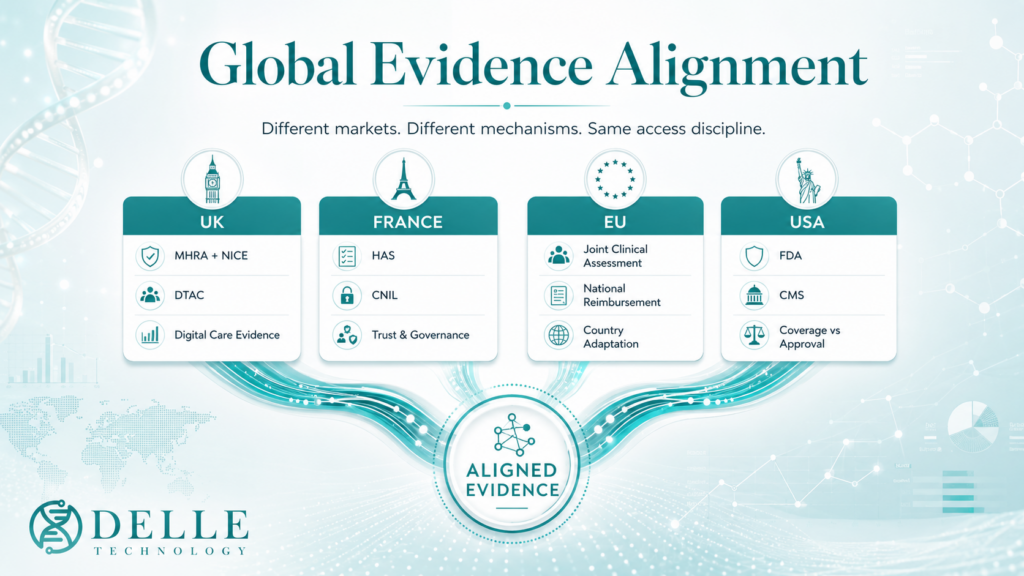
In the UK, the MHRA–NICE aligned pathway is designed to bring regulatory and value-assessment decisions closer together. NICE describes the pathway as aiming to get medicines to patients 3 to 6 months sooner by delivering same-time decisions on licensing and value, while the GOV.UK explains that the pathway brings NICE decisions forward to align with MHRA decisions. That matters because it pulls market access questions upstream.
Companies can no longer assume that regulatory approval is the end of the evidence journey. Increasingly, the payer question must be anticipated before approval, not after it.
The same pattern is visible in digital health. NICE’s Evidence Standards Framework for Digital Health Technologies is designed to help evaluators and decision-makers identify digital technologies likely to benefit users and the health and care system. The academic paper describing the NICE ESF says it was designed to guide developers and commissioners on the clinical and economic evidence needed for digital health and care technologies.
Adult social care is moving in the same direction. In May 2026, the UK Government said NICE had been commissioned to develop an Evidence Standards Framework for Digital Care Technologies in adult social care. The Government identified inconsistent outcomes, supplier-led evidence and the absence of a shared approach for assessing quality, impact and value as key barriers.In England, the Digital Technology Assessment Criteria also shows that digital health evidence is not just about clinical effect. NHS England says DTAC covers five areas: clinical safety, data protection, technical security, interoperability, and usability/accessibility.This is exactly where evidence misalignment appears.
A company may prove that users like a product, while NHS buyers still need evidence of clinical safety, security, interoperability, accessibility and governance.
France: evidence must create trust
France is moving in a parallel direction.
HAS has developed a cadre de confiance — a trust framework — for digital technologies and AI systems used in care. HAS describes this as a framework to support the integration of useful and performant digital technologies into the healthcare system, structured around selection, proper use and evaluation.
The HAS and CNIL partnership, signed in March 2026, strengthens the French trust angle. CNIL says the partnership aims to reinforce good practices, including those related to personal data protection and fundamental rights linked to digital tools in the health, social care and medico-social sectors. For companies, this matters because France is not only asking whether a digital or AI tool works; it is also asking whether it is ethical. It is asking whether it can be selected appropriately, used properly, evaluated credibly, governed safely and trusted in practice.
That is not just a product question.It is an evidence alignment question.
EU: Joint Clinical Assessment does not remove national evidence needs
The EU is also changing the evidence environment.
The EU Health Technology Assessment Regulation applies from 12 January 2025 and creates a framework for EU-level cooperation, including Joint Clinical Assessments. The European Commission states that the Regulation entered into force in 2022 and applies from 12 January 2025.
Joint Clinical Assessments are important because they introduce a more coordinated clinical evidence layer across Europe. From January 2025, new cancer medicines and advanced therapy medicinal products are among the first technologies subject to this process. But companies should not misunderstand this.
EU Joint Clinical Assessment may harmonise parts of the clinical evidence conversation, but it does not harmonise willingness to pay, budget impact, coding, procurement, pathway design or implementation capacity. A company may prepare for EU-level clinical assessment and still need very different access stories for France, Germany, Belgium, the Netherlands, Italy, Spain, the Nordics or the UK.The Odelle interpretation is simple:
EU Joint Clinical Assessment may reduce duplication in clinical evidence review, but it will not eliminate the need for national evidence alignment.
Companies still need to ask:
Which comparator matters in this country?
Which pathway will change?
Which budget will be affected?
Which payer or procurement body decides?
Which economic argument will be believed?
Which implementation barriers will slow adoption?
That is evidence-market fit at country level.
USA: FDA authorisation is not Medicare coverage
The United States shows the same problem in a different form.
FDA authorisation and CMS coverage are separate decisions. A device may be authorised by FDA but still face coverage, payment and adoption barriers. CMS finalised the Transitional Coverage for Emerging Technologies pathway in August 2024, describing it as a Medicare coverage pathway intended to provide more timely and predictable access to certain new medical technologies for people with Medicare.
That is another convergence signal. The US is also trying to reduce the gap between regulatory authorisation and payment. But the key message for companies is not that coverage has become automatic.
It has not.
Even where coverage accelerates, payment and adoption may still depend on coding, pricing, local coverage policies, provider incentives, site-of-care economics and real-world evidence development. The message is that companies must understand the difference between regulatory evidence, coverage evidence, coding evidence, payment evidence, clinical adoption evidence and real-world value evidence.
For AI-enabled medical devices, this becomes even more important. In 2025, FDA requested public comment on measuring and evaluating AI-enabled medical device performance in the real world, including approaches for identifying and managing performance drift.
That is a crucial signal.
For AI, evidence misalignment can be dangerous because model performance at approval may differ from that after deployment. Accuracy at one point in time is not enough. Health systems increasingly need evidence of drift monitoring, lifecycle governance, subgroup performance, safety, workflow integration and accountability.
The international digital medical device problem
The evidence alignment issue is not only national. It is structural.
The OECD’s 2025 work on assessing digital medical devices highlights that countries are adapting HTA approaches to improve the assessment and integration of digital medical devices into healthcare systems. It identifies the need for clearer pathways from market entry to implementation, adaptive and iterative HTA, transparency, real-world data and international collaboration.
This is highly relevant to digital health, AI and software-driven medical devices.
Traditional HTA questions were often designed around medicines, devices or procedures with relatively stable characteristics.
Digital technologies are different.
They can change over time.
They depend on data flows.
They require workflow integration.
They may need user behaviour change.
They can create alert burden.
They may perform differently across populations.
They often require ongoing monitoring.
That means the evidence question is not only:
Does it work?
It is also:
Can it be implemented, monitored, updated, governed and trusted in the system expected to use it?
What companies often prove and what decision-makers need
This is the heart of the evidence misalignment problem.
| What companies often prove | What decision-makers often need |
|---|---|
| Engagement | Outcome impact |
| Accuracy | Clinical utility |
| User satisfaction | Budget impact |
| Pilot enthusiasm | Implementation feasibility |
| Technical validation | Adoption confidence |
| Regulatory readiness | Reimbursement readiness |
| Innovation | Pathway value |
| Algorithm performance | Governance, drift monitoring and safety |
| Usability | Workflow integration |
| Clinical interest | Procurement justification |
This is why companies can have evidence and still struggle.
The evidence may be real, but it may not answer the access question.
Common evidence misalignments
Digital health: engagement data instead of outcome impact.
AI: AUC instead of clinical actionability.
Diagnostics: analytical validity instead of clinical utility.
Medtech: clinician enthusiasm instead of procurement affordability.
Adult social care: user satisfaction instead of reduced risk, escalation or carer burden.
Investor diligence: product traction instead of reimbursement readiness.
This is why evidence hierarchy alone is not enough.
Evidence misalignment is not solved simply by moving up the evidence hierarchy. A randomised trial, real-world study or economic model can still be commercially weak if it does not match the access decision.
The question is not only:
How strong is the evidence?
The better question is:
Strong for whom, and for what decision?
Evidence misalignment by sector
Digital health
Digital health companies often collect engagement, retention, satisfaction and usability data.
Those data matter.
But commissioners and payers may need more: clinical outcomes, care pathway impact, resource use, safety, inequalities, staff time, budget impact and implementation burden. A digital health company may show that users like the product.
The health system may ask whether the product reduces avoidable appointments, prevents escalation, improves adherence, reduces admissions or delivers measurable value.
That is a different question.
Diagnostics and IVDs
Diagnostic companies often prove analytical performance: sensitivity, specificity, reproducibility and accuracy.
Those are essential.
But reimbursement bodies often ask about clinical utility.
Does the test change treatment?
Does it change the diagnostic pathway?
Does it reduce unnecessary procedures?
Does it improve antimicrobial stewardship?
Does it shorten time to appropriate therapy?
Does it reduce admissions, complications or downstream costs?
A diagnostic that detects something accurately may still fail to prove that detecting it changes management in a way the system values.
Medtech
Medtech companies often rely on clinical enthusiasm, technical performance and surgeon or clinician advocacy. That can help adoption, but procurement often asks different questions. What is the cost of the device? What does it replace? Does it reduce theatre time, length of stay, revision, readmission, complications or staff burden? Does it require new training, consumables, service contracts or capital equipment? Does it fit into existing tariffs, DRGs, procedure codes or procurement frameworks? Clinical enthusiasm is not the same as a budget impact case.
AI in healthcare
AI companies often prove accuracy, AUC, sensitivity, specificity or benchmark performance.Those metrics are important but incomplete.
Health systems need to know whether the AI output is actionable, safe, explainable, equitable, governed and useful in workflow.WHO guidance on AI ethics and governance for health addresses large multi-modal models and notes their potential use in healthcare, scientific research, public health and drug development.
For AI companies, the lesson is clear.
A model score is not an adoption case. AI evidence must address technical performance, real-world performance, bias, drift, explainability, professional oversight, accountability, workflow, safety and economic value.
Adult social care technology
Digital care technologies may support falls prevention, medication adherence, home monitoring, carer support, safeguarding and independent living.But adult social care evidence is not simply clinical evidence.Decision-makers may need to understand dignity, consent, safety, independence, carer burden, care package intensity, escalation events, staff workload, digital exclusion and the ability to remain safely at home.The emerging NICE framework for digital care technologies matters because it recognises that adult social care needs evidence standards designed for the realities of care, not just adapted medical evidence.
The Odelle Evidence Alignment Test™
At Odelle Technology, we use a simple test before assuming that a company’s evidence is market-ready.
Decision-maker → Decision → Comparator → Outcome → Economics → Implementation → Adoption
1. Decision-maker
Who is the evidence for?
Regulator, HTA body, payer, hospital, commissioner, local authority, insurer, clinician, procurement team, investor or patient organisation?
2. Decision
What decision must they make?
Approve, reimburse, procure, recommend, commission, scale, invest, list, code, price or implement?
3. Comparator
Compared with what?
Standard care, current diagnostic pathway, manual workflow, existing device, no treatment, watchful waiting, hospital admission, clinician judgement or another digital tool?
4. Outcome
What outcome matters?
Clinical outcome, care outcome, resource use, staff time, quality of life, safety, independence, adherence, admissions, complications, escalation, workflow or cost?
5. Economics
What economic argument is credible?
Budget impact, cost-consequence, cost-effectiveness, avoided utilisation, productivity, hospital episode cost, social care capacity or downstream savings?
6. Implementation
Can the technology work in routine conditions?
Staffing pressure, weekends, interoperability, training, alert fatigue, escalation, governance, data quality and real-world user behaviour all matter.
7. Adoption
What route leads to scale?NICE, HAS, CMS, national reimbursement, local procurement, hospital budget, digital formulary, insurer contracting, local authority purchasing, private sector adoption or investor-backed rollout?
If the evidence does not answer these questions, the company may have evidence — but not aligned evidence.
Why CEOs should care
For CEOs, evidence misalignment is expensive because it often appears late.
It appears after capital has been spent.
After trials have been designed.
After pilots have been launched.
After commercial expectations have been set.
After a board has been told that reimbursement is the next step.
Correcting the evidence strategy after launch is slower, more expensive and less credible than designing the right evidence from the beginning.
The hardest sentence for a company to hear is not:
You have no evidence.
It is:
You have evidence, but not the evidence this decision requires.
Why investors should care
Evidence misalignment is not just a reimbursement problem.
It is a valuation problem.
A company may appear derisked because it has regulatory progress, pilot sites, user growth or technical validation. But if the evidence does not support reimbursement, procurement or adoption, the commercial risk remains unresolved.
Investors should ask:
Does the company know which access decision it must win?
Has it identified the right comparator?
Has it captured outcomes that matter to payers and commissioners?
Has it modelled budget impact?
Has it tested implementation burden?
Has it generated evidence that can support adoption beyond a pilot?
Has it considered UK, EU, French and US access expectations early enough?
A company can have product-market fit and still lack evidence-market fit.
That difference affects time to revenue, pricing, country sequencing, partnering, reimbursement risk and exit value.
The commercial warning
The commercial warning is simple.
A pilot is not adoption.
A publication is not reimbursement.
Accuracy is not utility.
Engagement is not outcome impact.
Regulatory clearance is not payment.
Technical validation is not trust.
And evidence is not valuable simply because it exists.
Evidence becomes valuable when it is aligned with the decision that unlocks adoption.
How Odelle Technology can help
Odelle Technology helps healthtech, medtech, diagnostic, AI and digital care companies identify and correct evidence misalignment before launch, market entry, reimbursement submission, investor diligence or procurement engagement.This includes:
- mapping decision-makers;
- defining the access question;
- identifying evidence gaps;
- selecting comparators;
- clarifying pathway impact;
- building health economic logic;
- preparing budget impact and cost-consequence models;
- testing implementation validity;
- sequencing reimbursement and adoption routes across the UK, Europe and the USA.
The aim is not to generate more evidence for its own sake.
The aim is to generate the right evidence for the right decision.
Before you fund the next study, launch the next pilot or enter the next country, ask whether your evidence answers the decision-maker’s real question.
Odelle Technology helps companies test that alignment before the market does.
Conclusion: the right evidence wins
Health systems are not rejecting innovation.They are demanding evidence that matches the decision.
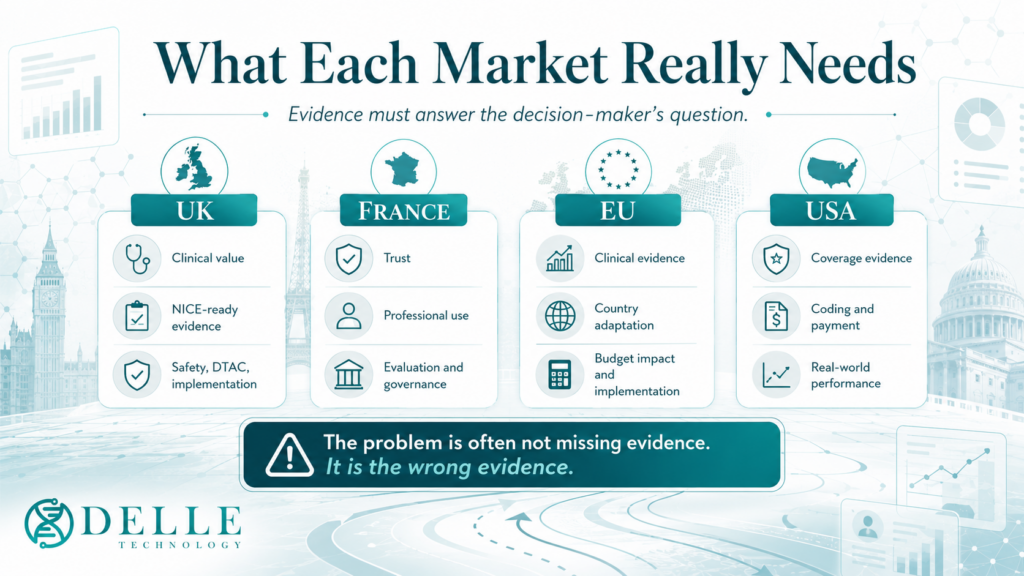
In the UK, NICE, MHRA, DHSC and NHS England are pushing evidence earlier into access, digital health and adult social care.
In France, HAS and CNIL are building trust, evaluation and governance expectations around digital technologies and AI.
In the EU, Joint Clinical Assessment is changing the clinical evidence layer, while national reimbursement and adoption still require country-specific evidence alignment.
In the USA, FDA authorisation and CMS coverage remain distinct, while AI-enabled devices face growing expectations around real-world performance and lifecycle monitoring.
Different countries. Different mechanisms. Same message.
The issue is often not missing evidence.
It is misaligned evidence.
For healthtech, medtech, diagnostics, digital health and AI companies, the next competitive advantage will not come from proving more.
It will come from proving the right thing.
Product-market fit gets attention. Evidence-market fit gets adoption. Evidence alignment determines whether the system believes the story.
References and further reading
- NICE. MHRA–NICE pathway opens for business – everything you need to know to get started. Published 1 April 2026.
https://www.nice.org.uk/news/blogs/mhra-nice-pathway-opens-for-business-everything-you-need-to-know-to-get-started - GOV.UK. Get medicines to NHS patients earlier via the MHRA–NICE aligned pathway. Published 1 April 2026; updated 9 April 2026.
https://www.gov.uk/government/publications/get-medicines-to-nhs-patients-earlier-via-the-mhra-nice-aligned-pathway/get-medicines-to-nhs-patients-earlier-via-the-mhra-nice-aligned-pathway - NICE. Evidence Standards Framework for Digital Health Technologies.
https://www.nice.org.uk/what-nice-does/digital-health/evidence-standards-framework-esf-for-digital-health-technologies - Unsworth H, Dillon B, Collinson L, et al. The NICE Evidence Standards Framework for digital health and care technologies. Digital Health. 2021.
https://pmc.ncbi.nlm.nih.gov/articles/PMC8236783/ - Department of Health and Social Care / GOV.UK Social Care Blog. Deborah Sturdy. Developing evidence standards for digital technologies in adult social care. Published 19 May 2026.
https://socialcare.blog.gov.uk/2026/05/19/developing-evidence-standards-for-digital-technologies-in-adult-social-care/ - NHS England. Digital Technology Assessment Criteria — DTAC.
https://transform.england.nhs.uk/key-tools-and-info/digital-technology-assessment-criteria-dtac/ - Haute Autorité de Santé. Technologies numériques et systèmes d’IA à usage professionnel.
https://www.has-sante.fr/jcms/p_3363066/fr/technologies-numeriques-et-systemes-d-ia-a-usage-professionnel - CNIL. Numérique en santé : la CNIL et la HAS s’engagent pour renforcer les bonnes pratiques. Published 11 March 2026.
https://www.cnil.fr/fr/numerique-en-sante-la-cnil-et-la-has-sengagent - European Commission. Implementation of the Regulation on health technology assessment.
https://health.ec.europa.eu/health-technology-assessment/implementation-regulation-health-technology-assessment_en - European Commission. Joint Clinical Assessments.
https://health.ec.europa.eu/health-technology-assessment/implementation-regulation-health-technology-assessment/joint-clinical-assessments_en - CMS. Final Notice — Transitional Coverage for Emerging Technologies.
https://www.cms.gov/newsroom/fact-sheets/final-notice-transitional-coverage-emerging-technologies-cms-3421-fn - Federal Register. Medicare Program; Transitional Coverage for Emerging Technologies. Published 12 August 2024.
https://www.federalregister.gov/documents/2024/08/12/2024-17603/medicare-program-transitional-coverage-for-emerging-technologies - FDA. Request for public comment: measuring and evaluating AI-enabled medical device performance in the real world. Published 30 September 2025.
https://www.fda.gov/medical-devices/digital-health-center-excellence/request-public-comment-measuring-and-evaluating-artificial-intelligence-enabled-medical-device - WHO. Ethics and governance of artificial intelligence for health: large multi-modal models.
https://www.who.int/publications/i/item/9789240084759 - OECD. Towards identifying good practices in the assessment of digital medical devices. Published 2025.
https://www.oecd.org/en/publications/towards-identifying-good-practices-in-the-assessment-of-digital-medical-devices_b485ee1f-en.html