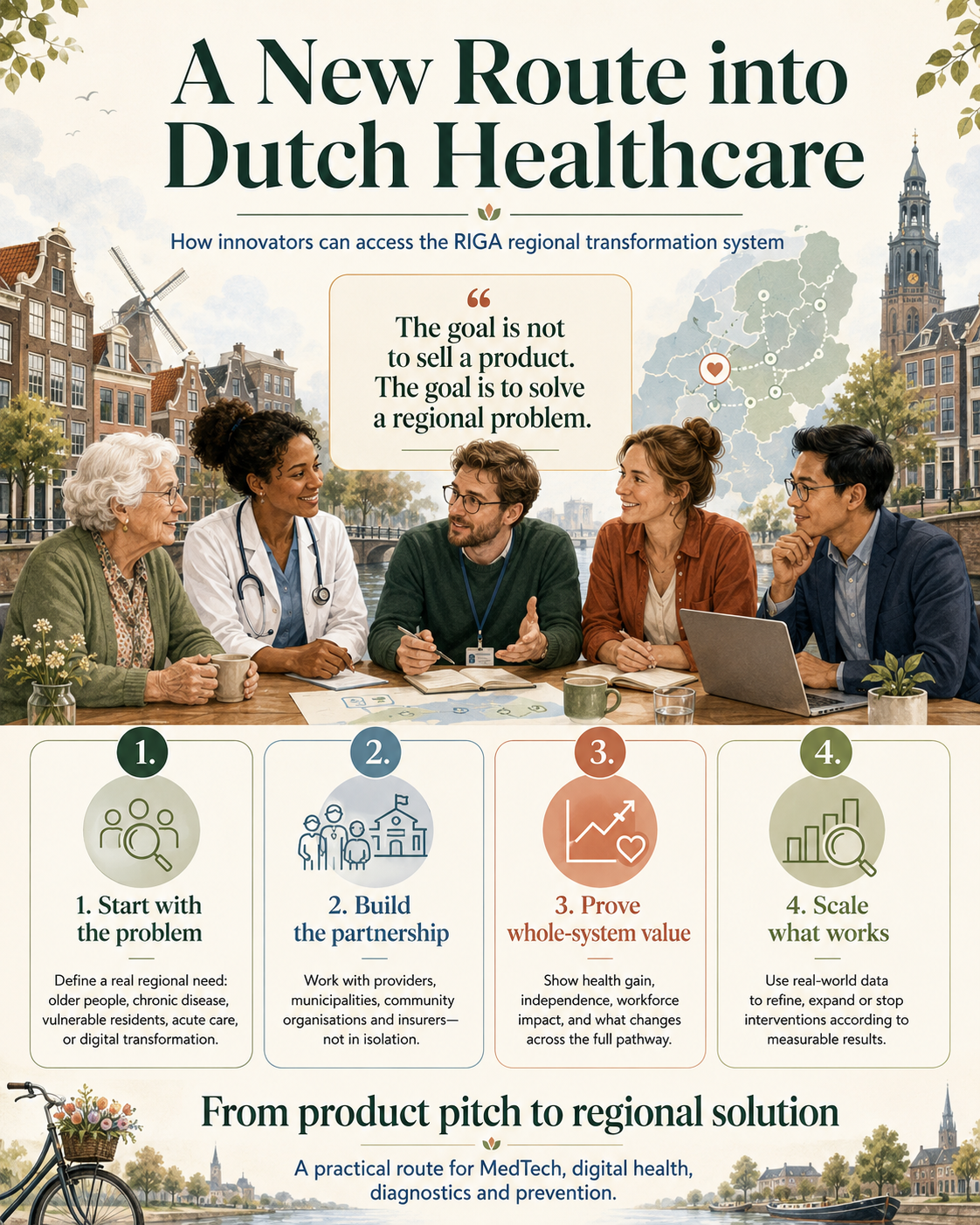
How innovators can enter RIGA, build a credible regional proposition,
and move from product evidence to system-level adoption
The next market-access question is not simply whether a technology can be reimbursed. It is whether a region can become healthier, more resilient and less dependent on scarce clinical labour because the technology has been placed intelligently within it.
Contents
1. The opening created by regional transformation
2. What RIGA is—and what it is not
3. How the system works
4. The route into the system
5. What a credible proposition must contain
6. How evidence, economics and implementation are judged
7. Where technologies can enter
8. The practical role for Odelle
9. A disciplined first approach
10. References
Accessing the Dutch Regional Transformation System
ODELLE TECHNOLOGY | HEALTH SYSTEM ACCESS
1. The opening created by regional transformation
For years, healthcare companies have been taught to approach market access as a sequence of gates: regulatory clearance, clinical evidence, coding, reimbursement, procurement and scale. That sequence still matters. Yet it is increasingly incomplete.
Many of the technologies now entering healthcare do not fit comfortably inside a single tariff, profession or institution. A digital service may reduce hospital attendance but increase activity in primary care. A home-monitoring pathway may preserve independence while transferring work to community teams. A preventive intervention may create costs for an insurer while its greatest benefits appear in municipal support, long-term care or the labour market.
The problem is not necessarily that the innovation lacks value. It is that the value is distributed across a system whose budgets, accountabilities and evidence requirements remain divided.
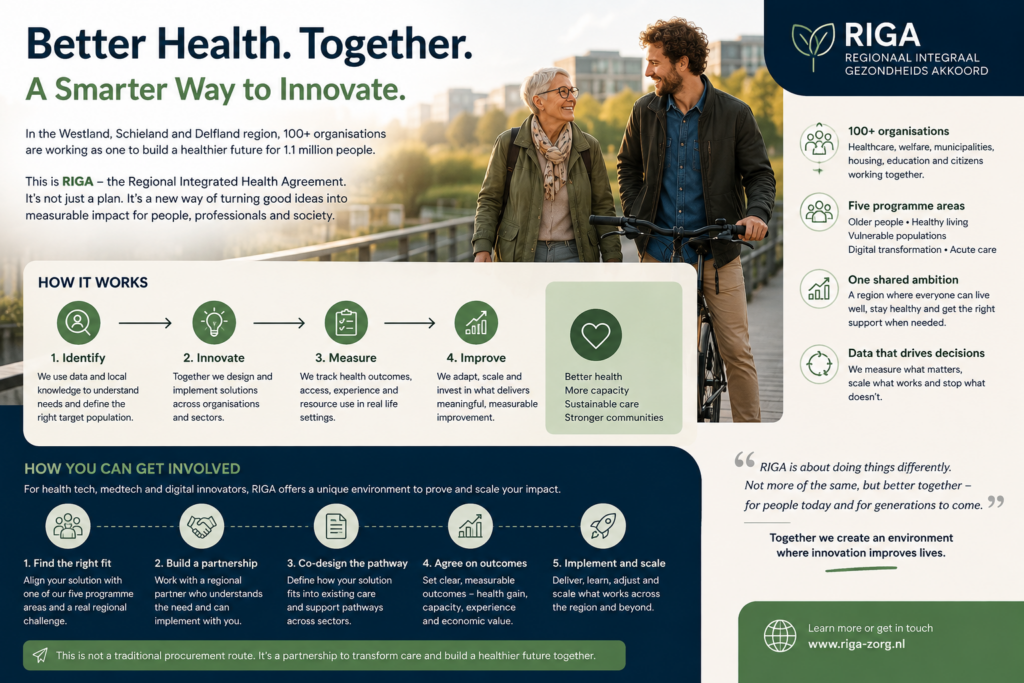
In Westland, Schieland and Delfland, a Dutch region west of Rotterdam and The Hague, a different architecture is taking shape. The Regionaal Integraal Gezondheidsakkoord—RIGA—brings together healthcare, social support, municipalities, welfare organisations, housing bodies and insurers around a shared regional purpose: to improve health, strengthen self-reliance, reduce avoidable demand and preserve professional capacity for those who genuinely need care.[1–3]
This is not a new national reimbursement code. It is more consequential than that. It is an organised environment in which a regional problem can be defined, a pathway redesigned, an intervention implemented, its consequences measured across organisational boundaries and its future determined by results.
RIGA is best understood not as a fund waiting for products, but as a regional operating system waiting for credible solutions.
2. What RIGA is—and what it is not
RIGA began in 2023 with 37 partners. It has since developed into a broad regional movement involving approximately 650 people and around sixty participating organisations in the implementation of the transformation plan. Its programme office has grown into an independent organisation with roughly forty staff, responsible for initiating, facilitating, monitoring and steering delivery.[1]
The partnership spans the domains that ordinarily encounter one another only at their boundaries: hospitals, primary and community care, mental health, long-term care, disability services, public health, municipalities, welfare organisations and patient or resident interests. Its work is organised through five programme lines: healthy living, older people, residents in vulnerable circumstances, acute care and digital transformation.[1–3]
The governing idea is deliberately larger than healthcare delivery. RIGA seeks to move from a fragmented system centred on medical treatment towards a regional ecosystem rooted in a healthy living environment, earlier multidisciplinary support and greater self- and community-reliance.[2]
That distinction matters for innovators. A company does not enter by proving that its product is novel. It enters by showing that its technology can become a useful component of a regional response to a defined health, access or workforce problem.
RIGA should also not be described as an open technology accelerator, a procurement marketplace or a guaranteed route to reimbursement. No public source establishes a standing invitation through which manufacturers can submit products directly to Stichting RIGA and obtain funding. The formal IZA transformation route is designed for care parties and requires alignment with regional plans, collaboration among relevant organisations and assessment by the two leading insurers in the region.[4–6]
The opportunity is therefore real, but conditional. External innovators need to arrive through a credible local pathway, not around it.
3. How the system works
The population problem comes first
The starting point is not a product catalogue. It is a regional need demonstrated through population data, service pressure and the lived experience of residents and professionals.
The WSD region faces the same forces confronting much of Europe: population ageing, rising chronic disease, pressure on informal carers and a workforce that cannot grow at the pace of demand. The regional response is to ask which needs can be prevented, redirected or met earlier—and which specialist capacity must be protected for people who cannot safely be supported elsewhere.[1,3]
This creates a three-layer logic. A healthy society forms the base. Where a person cannot resolve a need within that base, multidisciplinary support should identify the most appropriate response. Scarce specialist care sits at the top and should remain available for those who truly need it.[1]
Transformation is built across domains
A serious transformation plan must account for what happens on both sides of every organisational boundary. A reduction in hospital activity is not a system improvement if the same burden is merely transferred to general practice, municipal support or unpaid family carers.
RIGA therefore treats cross-domain consequences as central rather than peripheral. Its leaders openly recognise that costs may arise in one domain while benefits appear in another, and that the success of regional transformation depends upon trust, shared goals and the willingness of organisations to move beyond narrow institutional interests.[1]
Funding is tied to implementation and impact
RIGA’s integrated transformation plan was approved with the involvement of DSW, Zilveren Kruis and the participating municipalities. It operates within the national framework created by the Dutch Integraal Zorgakkoord, under which €2.8 billion was made available for impact-oriented healthcare transformations.[4,5]
The national process is not simply a grant application. The two leading insurers in the relevant region assess whether a proposal is sufficiently impactful, feasible and aligned with the regional agenda. The process has historically moved from an initial rapid assessment to collaborative plan development, formal assessment and implementation with monitoring.[5,6]
The practical implication is clear: funding follows a transformation proposition, not a technology description.
Data decide what survives
The most important feature of the RIGA model is not the existence of projects. It is the intention to learn from them.
RIGA is developing data infrastructure that can support information exchange across domains while keeping data at source and sharing it in encrypted form. The purpose is both clinical and strategic: to help professionals see the wider circumstances of a resident and to determine whether an intervention produces its intended effect.[1]
When an intervention fails to create the expected benefit, the model allows it to be changed or removed. Where it succeeds, it can be strengthened or expanded. This turns evidence from a retrospective justification into a continuing instrument of governance.
In a learning health system, evidence is not the document that opens the door. It is the mechanism that decides whether the door remains open.
4. The route into the system
For an external MedTech, digital-health or diagnostic company, the credible route into RIGA can be expressed as six linked moves.
| Step | The move | What it must establish |
| 1 | Define the regional problem | A measurable pressure on health, access, independence, workforce capacity or avoidable utilisation. |
| 2 | Identify the programme home | A clear fit with healthy living, older people, vulnerable residents, acute care or digital transformation. |
| 3 | Secure a local sponsor | A provider, municipality, network or other participating organisation that owns the problem and can reshape the pathway. |
| 4 | Design the transformation | A new pathway showing roles, referrals, workflows, implementation responsibilities and consequences across domains. |
| 5 | Build the evidence and economic case | Outcomes, data, resource effects, budget impact, workforce consequences, thresholds and uncertainties. |
| 6 | Agree the route to adoption | The appropriate regional dialogue, contracting mechanism, transformation process and plan for monitored implementation. |
1. Define the regional problem
The opening proposition should describe a problem that the region already recognises. It should quantify the affected population, explain the present pathway and identify where the system loses health, time or capacity.
A company developing a technology for osteoarthritis, for example, should not begin with device specifications. It should begin with the number and characteristics of people whose function is deteriorating, the limitations of current conservative care, the risk of progression, the burden on primary and specialist services and the possibility of preserving mobility or delaying more intensive treatment.
The product appears only after the problem has been made visible.
2. Identify the programme home
RIGA’s five programme lines provide the organising logic. The same technology may plausibly fit more than one, but a proposal needs a primary home.
A remote-monitoring platform for frail older people might sit within the older-person programme, with digital transformation acting as an enabling layer. A chronic-disease intervention may belong under healthy living. A triage or escalation technology may connect most naturally with acute care.
This choice determines the relevant partners, implementation setting and outcome language.
3. Secure a local sponsor
A manufacturer approaching the region alone is likely to be perceived as a vendor. A manufacturer accompanied by a hospital, primary-care group, municipality or established regional network can become part of a solution.
The sponsor should have more than clinical enthusiasm. It should possess responsibility for the target population, access to the present pathway and sufficient organisational authority to test a different model of care.
For formal IZA transformation proposals, national guidance directs parties to engage the coordinating insurer in the relevant region and to develop plans with care providers, professionals, patient organisations and, where appropriate, municipalities and care offices.[5,6]
4. Design the transformation
The proposal must show how care changes. This is where many technology submissions become too shallow.
A serious design explains who identifies the patient, who introduces the intervention, who monitors the resulting information, what triggers escalation, how responsibilities are shared, what existing activity is reduced and what new activity is created.
It should also describe failure: what happens when the technology is not used, when data are missing, when the patient deteriorates or when a professional disagrees with an algorithmic recommendation.
5. Build the evidence and economic case
DSW’s published contracting policies provide a useful indication of the questions it asks of innovation proposals: the intended objective and concrete results, the size and characteristics of the population, scalability, budget neutrality or a business case with a proposed funding model, and relevance to a substantial DSW population or a linked project involving another insurer.[7]
Those requirements should be treated as a minimum rather than a complete dossier.
The strongest case combines clinical outcomes with access, quality of life, patient independence, professional time, service utilisation, implementation cost and the distribution of consequences across organisations.
It should distinguish evidence already established from evidence that the regional implementation must generate.
6. Agree the route to adoption
Not every useful intervention requires a new national transformation plan. Some may be incorporated within an existing RIGA project, addressed through provider contracting, tested through a locally commissioned service or developed as part of a broader regional workstream.
The correct route therefore needs to be agreed early with the sponsoring organisation and the relevant insurer or programme leadership.
The essential mistake to avoid is spending months producing an elaborate dossier before establishing who can receive it, which budget could support it and whether it fits an active regional priority.
5. What a credible proposition must contain
A precise population definition. Inclusion and exclusion criteria, estimated numbers, present unmet need and the means by which eligible residents will be identified.
A pathway map. The present route through care and support, the point of entry for the intervention and the roles of every participating organisation.
A theory of change. A defensible chain connecting the technology to behaviour, clinical decisions, service use, health outcomes and capacity effects.
An implementation architecture. Sites, workforce, training, digital integration, governance, data protection, safety oversight and operational ownership.
A whole-system economic model. Costs and consequences across health insurance, providers, municipalities, long-term care, welfare and households where relevant.
A real-world evidence protocol. Baseline measures, outcomes, comparators, follow-up periods, analytic methods, equity measures and data-quality safeguards.
Decision rules. Pre-agreed thresholds for continuation, modification, extension or withdrawal.
A route to sustainability. The contracting or payment approach that could replace temporary transformation support if the intervention succeeds.
6. How evidence, economics and implementation are judged
Health gain
The intervention must produce a benefit that matters to residents and professionals. Depending on the pathway, this may be fewer exacerbations, improved function, reduced symptoms, safer living at home, earlier resolution of need or improved quality of life.
Surrogate measures may be useful, but they should be connected explicitly to outcomes that the region values.
Workforce capacity
Claims of labour saving require unusually careful analysis. Time is not truly saved when work is transferred invisibly to another professional, to a family member or to the patient without adequate support.
The model should identify whose time changes, by how much, in which setting and at what stage of implementation. It should also account for training, data review, technical support and exception management.
Distributional impact
A region committed to reducing health inequalities will ask who benefits and who may be left behind.
Digital access, language, health literacy, cognitive impairment, housing conditions and income can alter whether an intervention reaches the people most likely to need it. Equity must therefore be designed into recruitment, delivery and evaluation—not added as a final paragraph.
Economic consequence
The economic case should not collapse complex value into a single promise of savings. Some interventions will increase expenditure while improving outcomes or preserving capacity. Others will create savings only after several years.
The model must show where costs fall, where benefits appear, when they arise and what uncertainty surrounds them. It should also identify the organisational incentives that could obstruct adoption even when the regional case is favourable.
Scalability
A successful pilot is not automatically a scalable service. Expansion may depend on workforce, interoperability, clinical leadership, procurement, patient behaviour and local delivery capacity.
Scalability should therefore be tested as an operational hypothesis. What must remain constant? What can be adapted? Which components depend on exceptional individuals? Which costs fall with scale, and which rise?
7. Where technologies can enter
The RIGA structure creates several natural points of entry, provided that the technology is framed as part of a service transformation rather than as an isolated object.
Older people and independent living
Remote monitoring, falls prevention, medication support, frailty assessment, rehabilitation, mobility, home diagnostics and technologies supporting the Gezond en Wel Thuis model.
Healthy living and chronic disease
Interventions for osteoarthritis, cardiovascular disease, COPD, diabetes and behaviour change, particularly where they connect local lifestyle services with clinical pathways.
Vulnerable residents
Navigation, mental-health support, social prescribing, multilingual access, integrated case management and tools that help services respond before problems escalate.
Acute care
Triage, urgent-care coordination, virtual assessment, decision support, diagnostics and technologies that direct residents safely to the most appropriate level of care.
Digital transformation
Interoperability, consented cross-domain data use, analytics, remote care, citizen-facing tools and infrastructure that allows regional learning rather than isolated digital deployment.
Two cautions follow. First, digital transformation is not a destination for every software product; digital capability must serve a defined health-system purpose. Second, a technology that merely adds a new layer of activity without removing, simplifying or improving something elsewhere will struggle to establish transformational value.
8. The practical role for Odelle
Odelle’s role is not to promise access to a programme or imply that reimbursement has already been created. It is to make an innovation legible to the regional system.
That work begins by translating a technology into the language of population need, pathway design, measurable impact and sustainable commissioning. It then connects scientific evidence with the practical questions that determine whether a regional partnership can act.
For a client seeking entry into RIGA or a comparable Dutch transformation environment, Odelle could undertake five integrated tasks:
• Map the relevant RIGA programme, regional priority, population and potential sponsoring organisations.
• Reconstruct the current pathway and identify the clinical, operational and budgetary points at which change is possible.
• Build the evidence architecture, including claims, uncertainties, real-world outcomes, comparator logic and decision thresholds.
• Develop the whole-system value model, showing consequences for workforce, utilisation, budgets and patient independence.
• Prepare the engagement package: a concise regional proposition, partner brief, implementation concept and evidence-development plan suitable for discussion with providers, programme leadership and insurers.
The result should not resemble a conventional sales deck. It should read like the opening chapter of a shared regional plan—clear about the need, honest about the uncertainty and specific about how success will be recognised.
9. A disciplined first approach
A first approach to the region should be brief enough to be read and substantial enough to demonstrate seriousness.
It should contain no more than five pages and answer seven questions:
1. Which defined regional population is affected?
2. What is failing or becoming unsustainable in the present pathway?
3. How would the proposed pathway operate in practice?
4. Which local organisation is willing to sponsor or co-develop it?
5. What measurable health, access and capacity effects are expected?
6. What evidence already exists, and what must be learned locally?
7. What contracting or funding question needs to be explored with DSW, Zilveren Kruis or the relevant programme body?
Only after those questions have been answered should the parties decide whether the opportunity belongs inside an existing RIGA project, a contracting discussion, a local implementation partnership or a formal transformation route.
This discipline protects both sides. It prevents the region from being approached with technology in search of a problem, and it prevents innovators from investing heavily in a process whose sponsor, budget and decision route have never been established.
The way into the system is not to ask, ‘Will you buy our technology?’ It is to ask, ‘Can we help you solve a problem you have already decided must be solved—and can we agree how to know whether we have succeeded?’
RIGA offers no shortcut around evidence, economics or implementation. Its promise is more serious: the possibility of bringing those disciplines together inside a regional system capable of learning.
For the right technology, supported by the right partners and framed around the right population, that may be one of the most important new routes into Dutch healthcare.
Accessing the Dutch Regional Transformation System
ODELLE TECHNOLOGY | HEALTH SYSTEM ACCESS
10. References
1. Zorgakkoorden.nl. RIGA works with a transformation plan to redirect healthcare demand. https://www.zorgakkoorden.nl/praktijkvoorbeelden/riga-werkt-met-transformatieplan-aan-ombuigen-zorgvraag/
2. Stichting RIGA. About RIGA and its regional model. https://riga.nl/over-ons/
3. Municipality of Midden-Delfland. WSD-RIGA Transformation Plan 2025–2027. https://middendelfland.bestuurlijkeinformatie.nl/Document/View/522a7f84-6e87-4bbb-81cc-9ea214009a7c
4. Government of the Netherlands. Integrated Care Agreement (Integraal Zorgakkoord): Working together for sustainable healthcare. https://www.rijksoverheid.nl/documenten/2022/09/16/integraal-zorgakkoord-samen-werken-aan-gezonde-zorg
5. Zorgakkoorden.nl. Transformation plans: framework, funding and assessment. https://www.zorgakkoorden.nl/programmas/integraal-zorgakkoord/iza-onderdelen/transformatieplannen/
6. Zorgverzekeraars Nederland. Transformation plans: submitting proposals for impactful healthcare transformation. https://www.zn.nl/dossier/transformatieplannen/
7. DSW Zorgverzekeraar. Contracting policy for fall prevention 2026: innovation-proposal requirements and RIGA contracting context. https://www.dsw.nl/-/media/Documenten/DSW/Zorg/Valpreventie/2026/Contracteerbeleid-Valpreventie-2026-DSW.pdf
8. Zilveren Kruis. Transformation plans: procedure and forms. https://www.zilverenkruis.nl/zorgaanbieders/visie-en-transformatie/financiering-van-innovatie/procedure-formulieren
Source note. The factual description of RIGA is grounded in the official and public-sector sources listed above and in DSW Zorgverzekeraar’s 2025 societal report. The access pathway described in this paper is a strategic interpretation of those sources, not a representation that RIGA operates a standing open call for technology companies.