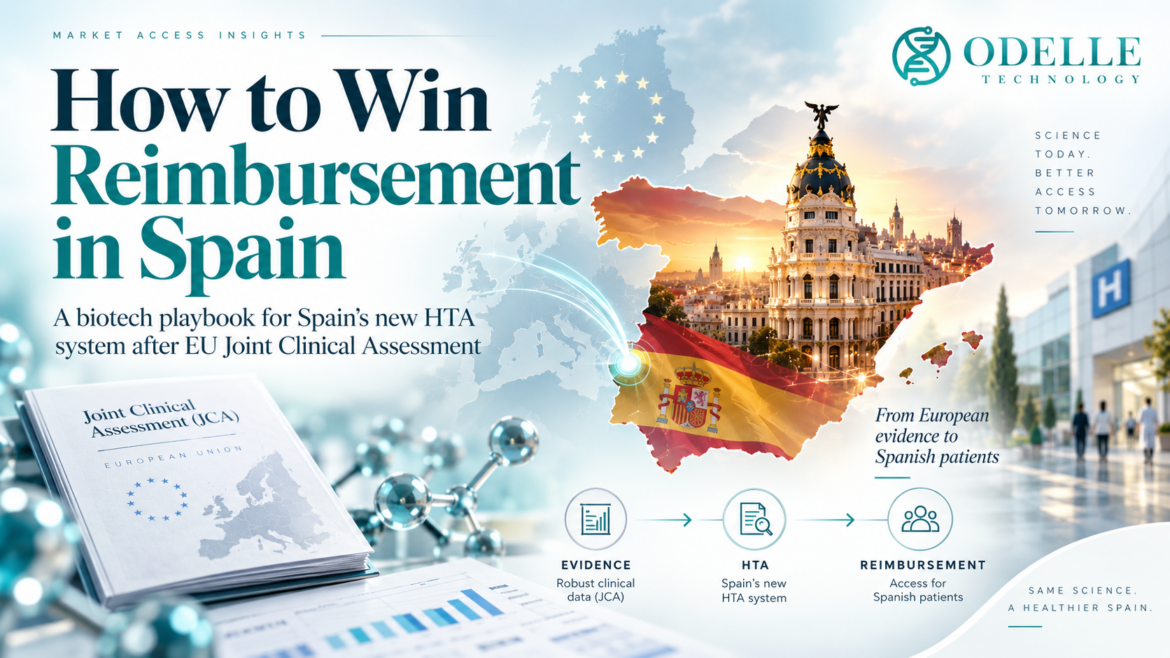
What Spain’s new HTA system means for biotech reimbursement after European Joint Clinical Assessment
Europe has harmonised part of the clinical assessment. It has not harmonised reimbursement. Spain’s Real Decreto 415/2026 creates a new national HTA architecture designed to use EU Joint Clinical Assessments without duplicating them, then add the work that still matters locally: clinical-value categorisation, economic evaluation, budget impact, implementation context and lifecycle evidence. For biotech, the consequence is simple: the Spanish reimbursement strategy must be designed before the JCA lands, not after.
| The five points that matter: Spain’s new HTA system is law, but implementation is progressive. The previous regime continues during the transition, as long as it does not conflict with the new decree. EU JCA evidence is not repeated nationally, but Spain can add analyses needed for the Spanish SNS and will categorise added clinical value. The enacted statutory architecture is 70 days for the medicines clinical report, 70 days for the non-clinical report, and no more than 15 days after the EU report where applicable; these clocks should not be described as fully operational until the phased implementation is activated. Economic evaluation, budget impact, organisational fit, and real-world evidence are moving closer to the centre of the Spanish value story. Current JCA products such as Ojemda, Imdylltra and Zepzelca are transition cases, not completed demonstrations of the final new Spanish pathway. |
Spain has changed the architecture, not the responsibility for reimbursement
Real Decreto 415/2026, published in the Boletín Oficial del Estado on 29 May 2026 and in force from 18 June, establishes Spain’s formal system for health technology assessment across medicines and non-pharmaceutical technologies. The decree is unusually explicit about the purpose of HTA: to inform decisions on incorporation, financing, price, reimbursement, conditions of use and disinvestment. It is equally explicit that HTA informs the decision; it is not the decision itself. [1]
That distinction matters. Under the EU HTA Regulation, the Joint Clinical Assessment is deliberately limited to a scientific analysis of relative effects and their certainty. Member States retain responsibility for value judgements, non-clinical assessment, pricing, reimbursement and the organisation of care. [2] Spain has now built its national architecture around that division of labour.
For a biotech company, therefore, “the JCA is done” is not synonymous with “Spain is done”. It is the hand-off point.
What Spain adds after the JCA
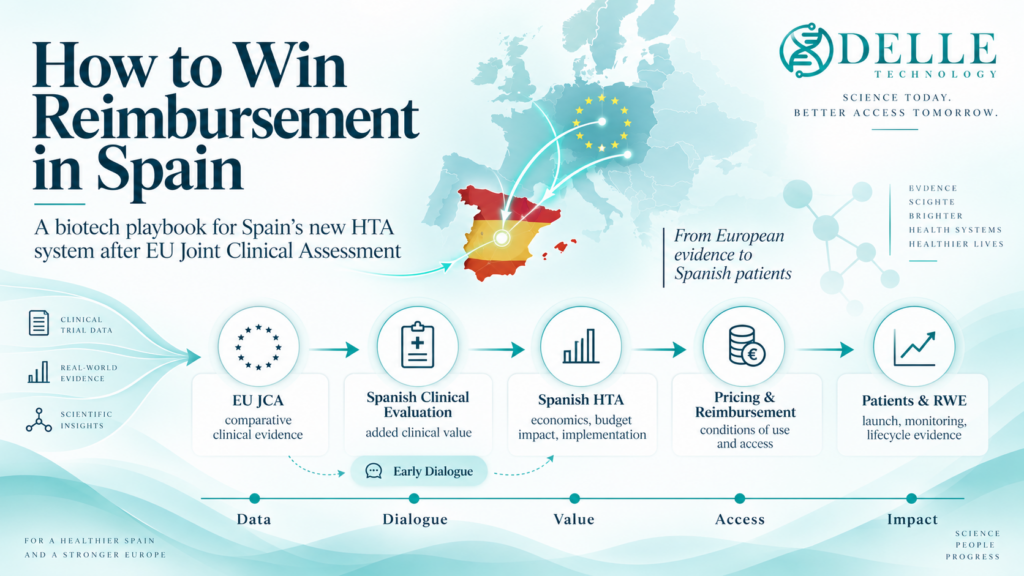
The Royal Decree says national clinical evaluations must not duplicate assessments performed at European level. Where a European JCA exists, that report becomes the basis of the Spanish clinical evaluation. Spain may nevertheless conduct additional analysis needed to apply the evidence to the SNS, particularly where population, intervention, comparator or outcome questions require national interpretation. Spain then completes the clinical work by categorising added clinical value. [1]
The non-clinical evaluation goes further. It includes economic and budgetary analysis and also considers ethical, organisational, social, legal, gender and environmental dimensions. Economic evaluation is expected to relate additional health outcomes to additional resources, principally from the perspective of the SNS; budget-impact analysis is required for medicines. [1]
The new evidence chain
| 1. EMA / regulatory evidence | Quality, safety and efficacy; marketing authorisation. |
| 2. EU Joint Clinical Assessment | Relative clinical effects and certainty across Member State PICO needs; no national price or reimbursement judgement. |
| 3. Spanish clinical evaluation | Uses the JCA without duplication; may add Spanish-context analysis; categorises added clinical value. |
| 4. Spanish non-clinical evaluation | Economic evaluation, budget impact and organisational, ethical, social, legal, gender and environmental factors. |
| 5. Adoption / pricing / reimbursement | HTA informs the competent decision-makers; the assessment itself is non-binding. |
| 6. Lifecycle evidence | Reassessment, monitoring, registries, pilot studies and real-world data can be used to resolve uncertainty over time. |
The timing point many commentaries missed
Early commentary around the reform often repeated a 180-day headline from the government announcement. The final law published in the BOE is different. Article 14 sets 70 days for the clinical report for medicines, no more than 15 days after publication of the European report where applicable, and 70 days for the non-clinical report after receipt of the clinical report; the stages may overlap. Non-pharmaceutical technologies have a 140-day assessment period, and reassessments 50 days. A 25-day extension can apply when additional evidence or clarification is required. [1]
But there is a crucial implementation caveat. The decree allows one year from entry into force for the first implementing instructions and methodological guidance, after which application is to proceed progressively by phases. During transition, the prior legal regime remains applicable where it does not conflict with the decree. [1] A biotech should therefore use the new clocks as the architecture Spain has legislated, not assume that every live 2026 case is already being processed under the final end-state workflow.
Case study 1 — Ojemda: Europe’s first JCA exposes the real reimbursement problem
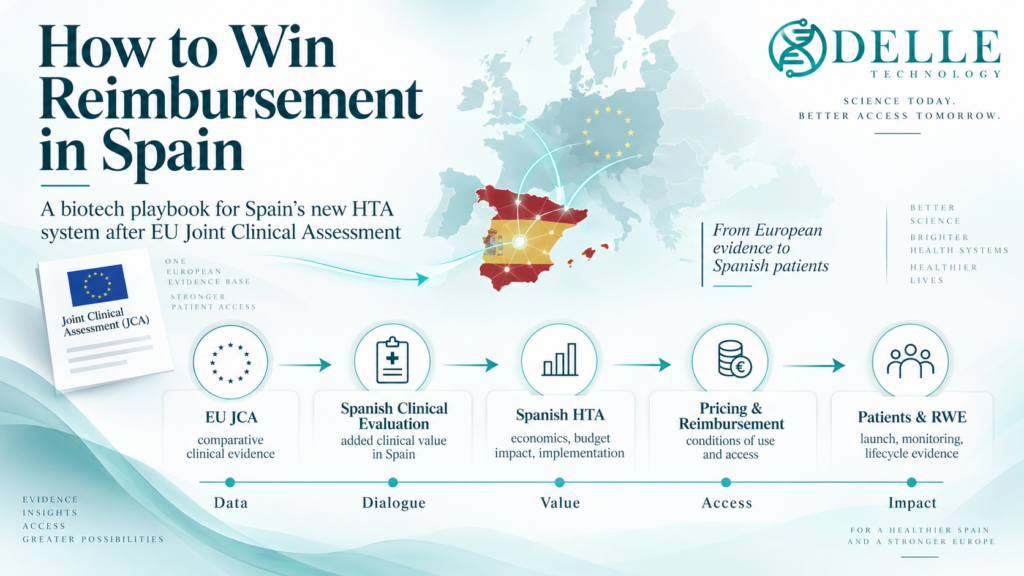
Ojemda (tovorafenib, Ipsen) is the clearest case for understanding the new environment. The European Commission published the first JCA report under Regulation (EU) 2021/2282 on 9 June 2026. [3] EMA granted Ojemda a conditional marketing authorisation on 20 April 2026 for BRAF-altered paediatric low-grade glioma after prior systemic therapy. [4]
Spain was already moving in parallel. AEMPS announced on 23 March 2026 that Ojemda was among the medicines for which an Informe de Posicionamiento Terapéutico (IPT) process would begin once the company communicated its intention to commercialise in Spain and requested the national code. [5]
This is why Ojemda is such a useful biotech case. The EU can complete the comparative clinical assessment, yet the company still needs a Spanish answer to questions that the JCA is not designed to settle: which local comparators drive value, which patients create the most credible reimbursed population, what additional clinical value Spain attributes to the evidence, what uncertainty remains, and what the budget and implementation consequences are for the SNS.
| Odelle lesson from OjemdaDo not wait for the JCA conclusion before building the national reimbursement package. The national economic model, resource-use assumptions, epidemiology, comparator mapping and uncertainty plan need to be ready to take over where the European clinical assessment stops. |
Case study 2 — Breyanzi: Spain already knows how to turn uncertainty into a reimbursement contract
Breyanzi (lisocabtagene maraleucel, Bristol Myers Squibb) is not a case completed under Real Decreto 415/2026. It is more useful as a reimbursement precedent: it shows what Spain can do when a high-cost, complex therapy carries residual clinical and financial uncertainty.
The Ministry of Health’s current BIFIMED entry shows Breyanzi funded for defined indications and records special financing conditions, including a high-complexity protocol, a pharmacoclinical protocol, risk-sharing/payment by results, Seguimed and VALTERMED. The financing entry has been active since March 2026. [6]
The strategic message is not that every uncertain medicine will receive an outcomes-based agreement. It is that “uncertainty” need not be treated as a binary reimbursement failure. It can be translated into patient eligibility, measurement, data capture and payment architecture, provided those elements are operationally credible.
Case study 3 — Itovebi: clinical value still has to be converted into budget control
Itovebi (inavolisib, Roche) offers a different precedent. BIFIMED shows national financing from July 2026 and special financing conditions including a price/volume agreement, differential repayment between the financed ex-factory price and the agreed managed-entry price, Seguimed and a sales threshold. [7]
This is important because it demonstrates another form of payer logic: even where the clinical case is accepted, reimbursement can still depend on mechanisms that control financial exposure. In a new HTA architecture that explicitly requires budget-impact analysis, that discipline is likely to become more important, not less.
Transition cases worth watching: Imdylltra and Zepzelca
The European Commission published JCAs for Imdylltra (tarlatamab, Amgen) and Zepzelca (lurbinectedin, PharmaMar) on 8 July 2026. [8,9] AEMPS had already listed both among the medicines entering the Spanish IPT workflow following the March CHMP meeting. [10] These are therefore valuable live transition cases: European JCA reports now exist while Spain is still moving from the previous IPT regime toward the new statutory HTA system. They should be followed closely, but they should not yet be presented as proof that the full Real Decreto 415/2026 pathway has completed end-to-end.
The academic evidence says the reform is solving a real problem
Spain’s reform is not merely administrative tidying. A 2025 analysis of 477 Spanish medicine indications found that only 253 could be matched to an HTA report and that just 9.49% of reimbursement reports mentioned the HTA in their conclusions. Positive decisions were associated with severity and therapeutic value; negative decisions were strongly associated with budget impact and cheaper alternatives. The authors concluded that reimbursement decision criteria were poorly aligned with information in HTA reports. [11]
The first JCA has also generated immediate academic scrutiny. Ramagopalan and Jullien Pannelay used Ojemda to examine what the inaugural JCA reveals for manufacturers. [12] Kloc and colleagues, studying single-arm-trial products across France, Germany, Poland and Spain, found that national systems often reimburse products built on single-arm evidence, yet expert simulation suggested that most such evidence packages would struggle to answer JCA relative-effectiveness requirements. [13]
The methodological implication is obvious: the comparator problem must be anticipated before pivotal evidence generation is fixed. A 2026 paper including authors from AEMPS’s therapeutic positioning and HTA area specifically addresses indirect treatment comparisons in the JCA framework. [14] Separately, qualitative research with reimbursement authorities in Spain, England and the Netherlands found that managed-entry agreements for advanced therapies are constrained by administrative burden, outcome measurement and data infrastructure, with early dialogue and interoperable real-world data identified as important solutions. [15]
How biotech can win in Spain under the new model
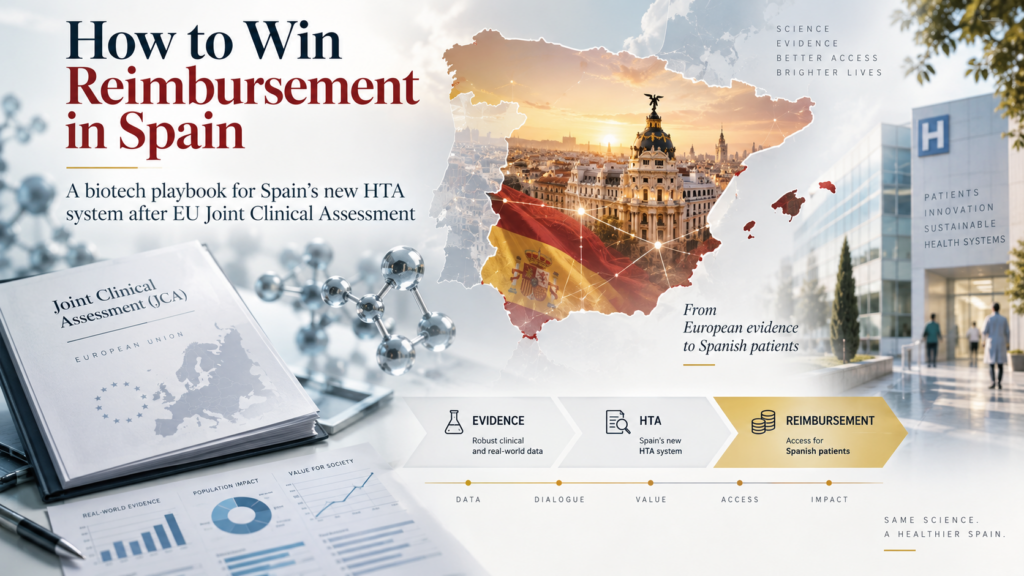
The winning strategy is not a larger dossier. It is a better-connected evidence architecture.
1. Build one evidence strategy for JCA and Spain
Do not create a European clinical story first and a Spanish reimbursement story later. Map the likely JCA PICOs and, at the same time, define the Spanish comparator, target reimbursed population, treatment pathway, resource consequences and economic model.
2. Stress-test the comparator before the pivotal programme is locked
The JCA scope is designed to capture Member State needs. If the relevant Spanish comparator is absent from the pivotal programme, the company may be forced into indirect comparison later. Decide early whether the evidence network will support that analysis.
3. Put Spanish economics on the critical path
The Royal Decree explicitly brings economic evaluation and budget impact into the non-clinical assessment. Build Spanish epidemiology, eligible-patient estimates, resource use, treatment duration, administration costs, adverse-event costs and downstream offsets early enough to influence evidence collection.
4. Design the uncertainty contract before negotiation
If long-term outcomes, durability, responder heterogeneity or budget impact are uncertain, decide what could actually be measured in Spain. A proposed outcomes-based arrangement is only useful if the outcome is observable, attributable, timely and collectable without excessive burden.
5. Treat real-world evidence as a reimbursement asset
The decree enables monitoring studies, registries and pilot programmes to resolve uncertainty and explicitly promotes real-world data. That makes endpoint definition, data availability and registry feasibility part of launch readiness.
6. Use early dialogue while the evidence can still change
Article 19 provides for scientific consultations requested by developers, while the EU HTA framework also provides for joint scientific consultations. The value of advice is highest before the protocol, comparator strategy and evidence-generation plan become irreversible. [1,16]
7. Prepare for the adoption decision, not just the assessment
The assessment is non-binding. Translate the evidence into the questions the decision-maker must answer: who should receive the technology, why it is better than available care, what it will cost the SNS, what will change operationally, and how residual risk will be managed.
What should be ready before CHMP opinion?
A draft JCA PICO map with likely national comparator variants.
A Spanish treatment-pathway map and a clinically defensible target reimbursement population.
Spanish epidemiology and eligible-patient estimates with transparent assumptions.
A cost-effectiveness model structure and budget-impact model capable of rapid population/scenario updates.
A resource-use plan covering drug administration, diagnostics, monitoring, adverse events, hospital capacity and downstream offsets.
An indirect-comparison strategy if head-to-head evidence will not answer the relevant PICO.
A real-world evidence plan linked to the uncertainties most likely to matter for reimbursement.
A managed-entry concept only where the outcome, data source, time horizon and payment consequence are operationally feasible.
A submission/engagement calendar spanning EMA, EU HTA, AEMPS and Spanish pricing/reimbursement milestones.
The strategic conclusion
Europe has reduced duplication. It has not removed national reimbursement.
Spain’s new model makes that distinction unusually clear. The EU JCA becomes the clinical foundation; Spain then adds the local value judgement, economics, budget consequences, implementation context and uncertainty-management plan that determine whether an innovation can be used sustainably in the SNS.
For biotech, the opportunity isn’t to get better at reacting to HTA. It is to move reimbursement evidence design upstream, while the comparator, endpoints, follow-up, data capture, and economic story can still change.
The companies that do that will arrive in Spain with more than a JCA report. They will arrive with an answer to the question the payer actually has to decide: not simply whether the technology works, but whether Spain can adopt it, for whom, at what value, and with what residual risk.
| September 2026: Real Decreto 415/2026 is in force, but the law provides for one year to approve the first implementing instructions and methodological guidelines, followed by progressive implementation. Ojemda, Imdylltra and Zepzelca are therefore described here as transition cases, not as completed end-to-end cases under the final new pathway. |
References and official sources
[1] Boletín Oficial del Estado. Real Decreto 415/2026, de 27 de mayo, por el que se regula la evaluación de tecnologías sanitarias. Official / source link
[2] EUR-Lex. Regulation (EU) 2021/2282 on health technology assessment. Official / source link
[3] European Commission. Joint Clinical Assessment report on tovorafenib (Ojemda), published 9 June 2026. Official / source link
[4] European Medicines Agency. Ojemda (tovorafenib) EPAR; conditional marketing authorisation issued 20 April 2026. Official / source link
[5] AEMPS. IPT initiation notice for medicines receiving a positive CHMP opinion in February 2026 (includes Ojemda). Official / source link
[6] Ministerio de Sanidad. BIFIMED financing entry for Breyanzi (lisocabtagene maraleucel). Official / source link
[7] Ministerio de Sanidad. BIFIMED financing entry for Itovebi (inavolisib). Official / source link
[8] European Commission. Joint Clinical Assessment report on tarlatamab (Imdylltra), published 8 July 2026. Official / source link
[9] European Commission. Joint Clinical Assessment report on lurbinectedin (Zepzelca), published 8 July 2026. Official / source link
[10] AEMPS. IPT initiation notice for medicines receiving a positive CHMP opinion in March 2026 (includes Imdylltra and Zepzelca). Official / source link
[11] Pinilla-Dominguez P, Pinilla-Dominguez J. Challenges and reforms in Spain’s health technology assessment system: analysis of criteria influencing medicines’ reimbursement decisions between 2019 and 2022 in Spain. Eur J Health Econ. 2025. Official / source link
[12] Ramagopalan SV, Jullien Pannelay A. Access in all areas? A round-up of developments in market access and health technology assessment: first Joint Clinical Assessment report released. J Comp Eff Res. 2026. Official / source link
[13] Kloc K, Toumi M, Łukomska E, et al. Joint Clinical Assessment in the EU HTA Regulation—Would Drugs Supported by Single-Arm Trials Fit Under Evaluation? J Mark Access Health Policy. 2026. Official / source link
[14] de la Cuadra-Grande A, Arruñada M, García-Solís A, Rossignoli-Montero A, Casado MA. Evidence Synthesis via Indirect Treatment Comparisons in the European Framework of Joint Clinical Assessment. Epidemiologia. 2026. Official / source link
[15] Greco A, Frederix GWJ, Hooft L, ten Ham RMT. Adoption of Managed Entry Agreements for Advanced Therapy Medicinal Products: Semistructured Interviews With Health Technology Assessment Bodies and Decision Makers in England, The Netherlands, and Spain. Value Health. 2026. Official / source link
[16] European Commission. Joint Scientific Consultations under the EU HTA Regulation. Official / source link
[17] AEMPS. New Spanish Health Technology Assessment System following Real Decreto 415/2026, 17 July 2026. Official / source link
[18] Trapero-Bertran M, Oliva J, Catalá-López F, et al. Guideline for the economic evaluation of medicines: a proposal by the Spanish National Health System’s Advisory Committee for Pharmaceutical Financing. Gac Sanit. 2025. Official / source link
About this article: Prepared for Odelle Technology as a market-access