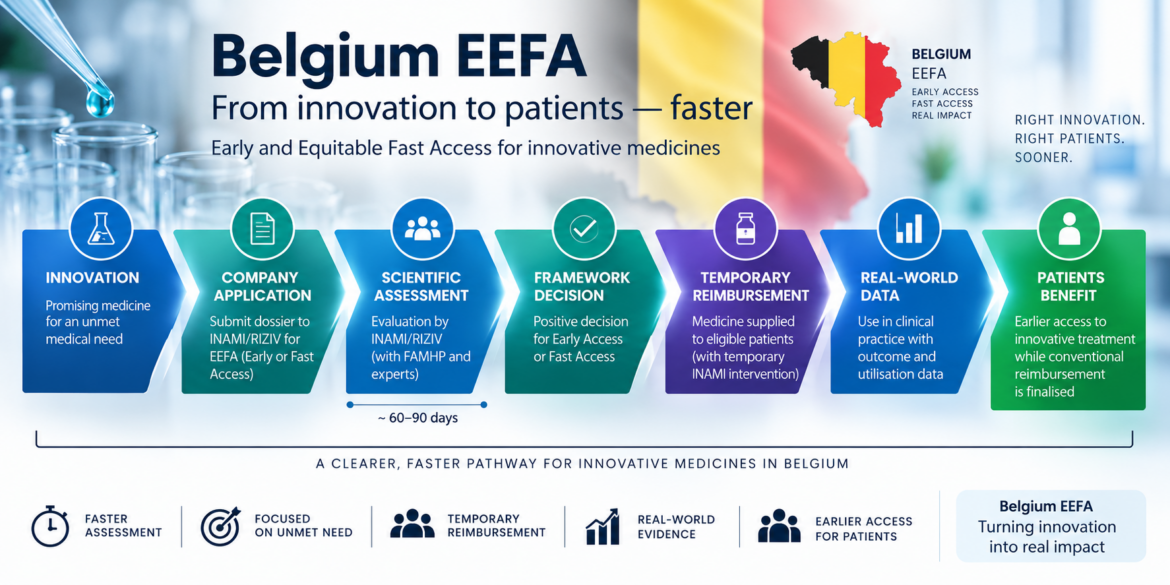
For a small biotech, the most expensive word in European market access is often not “no”. It is “later”. Belgium’s new Early and Equitable Fast Access (EEFA) pathway aims to shorten that interval shorter and, for selected medicines, fund it.
| 573 days. That is the problem EEFA is trying to bridge.INAMI’s 2026 analysis puts the average interval from EU marketing authorisation to first reimbursement in Belgium at 573 days for the innovative medicines it analysed. The figure includes company filing time, assessment, suspensions and implementation. EEFA does not abolish that process. It creates a temporary access-and-payment bridge for selected medicines while the conventional pathway catches up. |
The most expensive delay may sit after the science has worked
A biotech can spend a decade proving that a molecule works and still discover that the commercially decisive interval begins after the regulator is convinced. Belgium makes that tension unusually visible. In its June 2026 reimbursement analysis, INAMI/RIZIV reported an average of 196 days between marketing authorisation and the first reimbursement application, an average 299-day reimbursement procedure, and 573 days from authorisation to first reimbursement.
Those numbers are not an argument that Belgian assessment should disappear. They are an argument that a high-need medicine should not always have to wait for every sequential step to finish before an eligible patient can receive it.
That is the logic behind Early and Equitable Fast Access EEFA. The legal framework entered into force on 1 March 2026. It combines an Early Access route with a Fast Access route and places a temporary health insurance intervention between clinical/regulatory progress and ordinary reimbursement.
Belgium has not removed reimbursement. It has built a bridge to it.
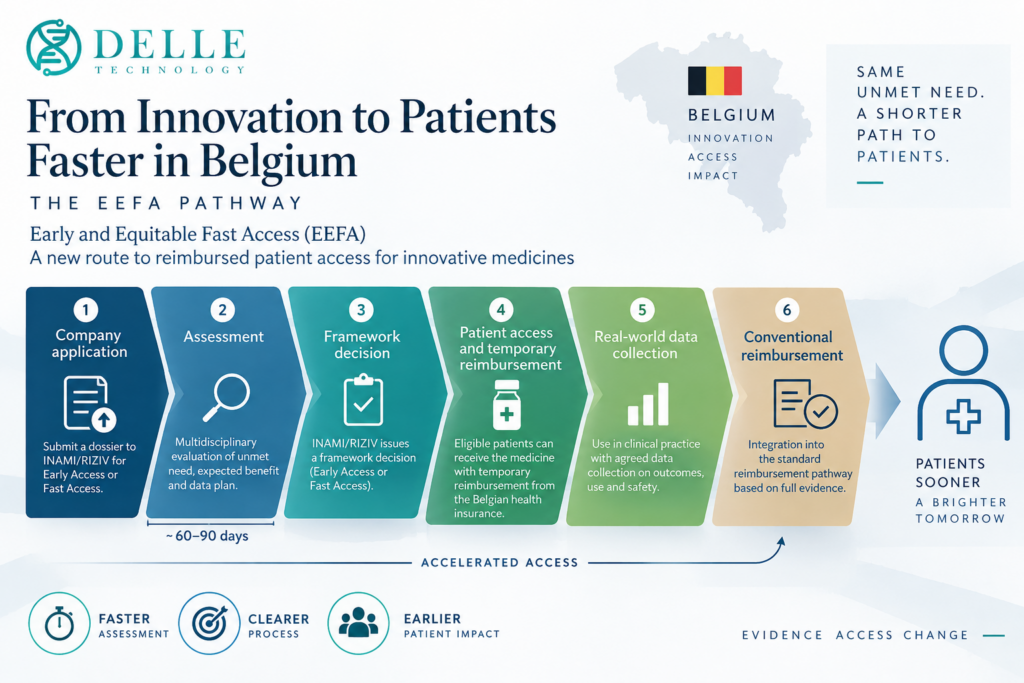
EEFA in one sentence
| A temporary reimbursement architecture, not a free commercial launchEEFA allows defined patients to receive an eligible innovative medicine before ordinary reimbursement is complete. The company supplies the medicine without charge to the patient; compulsory health insurance pays a defined temporary flat-rate intervention to the company. The conventional reimbursement pathway still has to be completed. |
The operational rules are set out in the Royal Decree of 14 February 2026 and in the INAMI industry submission guidance.
Two doors into the same reimbursement bridge
| EARLY ACCESSBefore marketing authorisation for the indicationSufficient presumption of efficacy for an indication on Belgium’s unmet-medical-need list.A relevant Compassionate Use Programme (CUP) or Medical Need Programme (MNP) approved or in process with FAMHP/AFMPS.Framework decision taken by CAIT/CATT.Company must define the target group, justify it and estimate budget impact. | FAST ACCESSAfter regulatory progress, before routine reimbursementAutomatic transition where marketing authorisation is obtained while the medicine is in Early Access; orEligibility linked to EMA recognition of unmet need through PRIME or accelerated assessment.Framework decision made by the Minister for Social Affairs, with CAIT/CATT advising.The company again defines the eligible group and estimates budget impact. |
For Early Access, the Belgian medicines agency FAMHP/AFMPS remains an essential part of the architecture because the medicine must sit within an approved or pending CUP/MNP. For Fast Access, the EMA signal becomes more important.
Odelle Technology • Belgium EEFA • September 2026 •
ODELLE TECHNOLOGY | BIOTECH REIMBURSEMENT
Belgium has put a clock on access and the clock has teeth
This is the part an SME leadership team should notice. The Royal Decree does not merely describe a pathway. It imposes decision clocks.
| Route | Admissibility | Decision clock | What happens if the clock expires? |
| Early Access | 15 working days to request missing elements; otherwise treated as admissible | 55 working days from admissibility, excluding suspensions | The decree provides for notification of a positive decision on the applicant’s proposed conditions if no decision has been taken by the next working day. |
| Fast Access | 8 days | 90 days from receipt/day 0, excluding suspensions | The decree likewise provides a positive decision on the latest proposed conditions if no ministerial decision has been taken by day 91. |
These are statutory clocks, not promises of an uninterrupted calendar: formal suspensions can stop the clock. But the architecture is unusual because the deadline is tied to a defined consequence.
What does Belgium actually pay?
EEFA is not ordinary commercial reimbursement and should not be modelled as if it were. The intervention is deliberately formulaic. For Early Access, INAMI publishes a €25,000 flat amount per positive framework decision plus a per-patient amount. Fast Access uses the per-patient amount without the €25,000 framework component.
| Active substance / status | Temporary intervention | Why an SME should care |
| Chemical, non-orphan | €140 per started month | This is access support, not a commercial price. |
| Chemical, orphan | €700 per started month | Orphan status materially changes the bridge payment. |
| Biologic, non-orphan | €300 per started month | Budget planning still has to absorb the gap to routine reimbursement. |
| Biologic, orphan | €1,500 per started month | Useful, but still far from the acquisition value of many biologics. |
| Gene or cell therapy | €120,000 per treatment | Potentially much more consequential for an ATMP SME. |
INAMI calculates and pays the intervention twice yearly on the basis of approved individual patient requests and treatment duration. If an individual request is approved, the patient pays nothing for the medicine.
It is already being used: four published framework decisions
As of 5 September 2026, the live RIZIV/INAMI register lists three Early Access framework decisions and one Fast Access decision. The scheme is therefore no longer a policy concept.
Three lessons hidden inside those first cases
1. Atrasentan shows that the data protocol is not decorative. The published framework decision specifies inclusion criteria, specialist eligibility, treatment duration and a therapeutic follow-up protocol. It captures disease measures including proteinuria/UPCR, eGFR, treatment use, adverse events and a patient quality-of-life rating. In other words: reimbursement access arrives with an evidence architecture attached to it.
Official RIZIV framework decision — atrasentan
2. Zepzelca is the closest thing to an SME-biotech commercial case. PharmaMar is not a tiny start-up, but it is a focused European biotech rather than a diversified pharmaceutical giant. Belgium’s register places lurbinectedin in Early Access for first-line maintenance ES-SCLC. That makes the programme worth studying for smaller oncology companies contemplating how Belgian access can sit alongside a European launch sequence.
Official RIZIV framework decision — lurbinectedin / Zepzelca | PharmaMar European approval information
3. Imdylltra proves the bridge can continue across authorisation. The first published Fast Access decision for tarlatamab is explicit: it is a transition from Early Access to Fast Access following marketing authorisation. That is precisely the strategic problem EEFA was designed to solve — avoiding a cliff edge between pre-authorisation access and routine reimbursement.
Official RIZIV Fast Access framework decision — tarlatamab / Imdylltra | EMA — Imdylltra
Could a UK or US SME biotech actually use EEFA?
Potentially, yes. The published legal criteria are product- and indication-led, not company-size-led, and a company itself can submit a framework application. But small biotechs should not mistake eligibility for operational readiness.
For an SME, that means the market-access work begins before the form. It begins with corporate set-up, the regulatory-access route, the eligible Belgian patient cohort, the evidence protocol and the economics of supplying the medicine during temporary intervention.
An SME biotech playbook: what to do before you need the pathway
Test the indication, not merely the molecule. Early Access depends on the unmet-medical-need architecture and a defined eligible population. A product can be scientifically exciting and still be poorly framed for the Belgian cohort.
Choose the regulatory-access route early. If Early Access is the target, align the FAMHP/AFMPS CUP or MNP work with the INAMI reimbursement work rather than treating them as two unrelated filings.
Work backwards from the framework decision. Define inclusion/exclusion criteria, prescriber specialism, centre requirements, duration and stop rules before the Belgian authorities have to define them for you.
Design the data protocol around the reimbursement uncertainty. The company is required to propose elements for the therapeutic-use and data-collection protocol. Capture the outcomes that may later matter to value — not every variable that is technically available.
Build a Belgian budget-impact view. The Royal Decree explicitly requires an estimate of budget impact and the expected patient population. For an SME, that is also the internal cash-flow model for temporary supply.
Do not confuse temporary intervention with final price. Model the published EEFA payment against COGS, distribution, hospital handling and the likely duration to conventional reimbursement.
Run conventional reimbursement in parallel. The framework can require the company to state when it will file for marketing authorisation and reimbursement, with statutory limits on those commitments. EEFA is a bridge; it is not the destination.
Resolve Belgian operational access early. SSP access requires a BCE/KBO number. The treating specialist later submits individual patient requests electronically once the framework decision is positive.
Where reimbursement strategy becomes evidence strategy
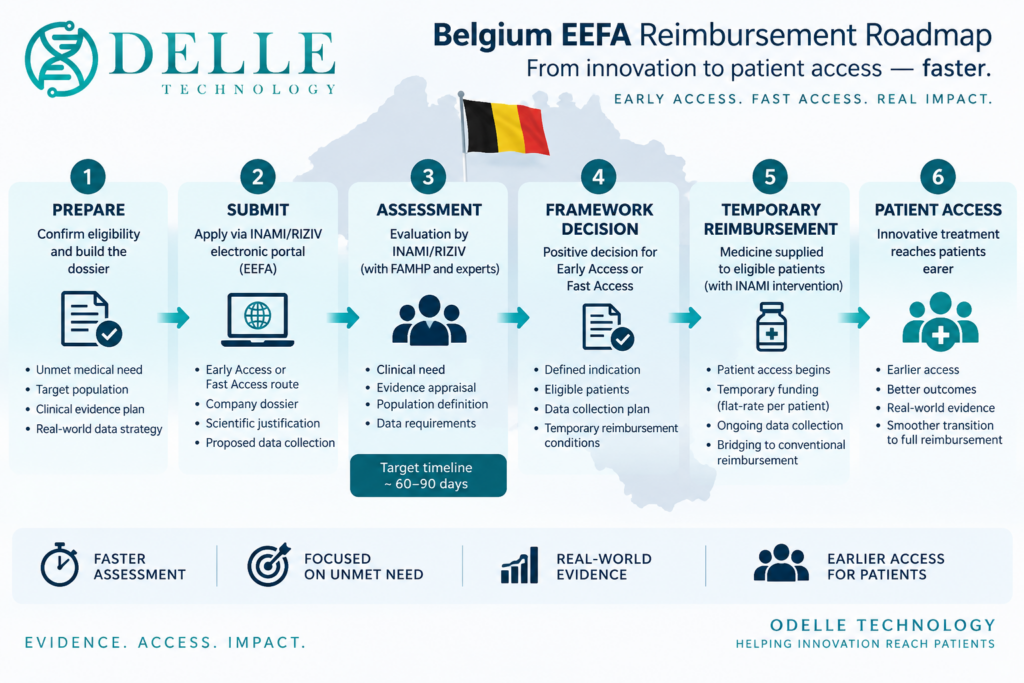
EEFA’s most interesting feature is not the payment schedule. It is that Belgium forces the company to connect access to a defined patient group, clinical conditions and prospective information. That is exactly where an SME can either create future reimbursement value — or collect data that never answers the payer’s question.
The better sequence is not:
Trial → EMA → EEFA → reimbursement
It is:
Payer uncertainty → target cohort → access criteria → evidence protocol → EEFA → conventional reimbursement
For rare disease and advanced therapies, this matters even more. Small populations amplify every design choice. A biomarker, responder definition, line-of-therapy rule, comparator or resource-use variable that is omitted at the beginning may be impossible to reconstruct later.
What EEFA does not solve
An exceptional access mechanism deserves a sober reading. EEFA does not make Belgium an automatic launch market. It does not guarantee a conventional reimbursement decision. It does not replace the need for price strategy, comparative evidence or a credible budget impact. And for most non-ATMP medicines, the temporary intervention is modest relative to commercial acquisition cost.
Those limitations are not weaknesses in the article; they are the reason the mechanism is strategically interesting. EEFA asks the company to decide whether earlier patient access, evidence generation and continuity are valuable enough to justify the temporary economics.
The question SME biotechs should ask now
Not: “Will Belgium reimburse us?”
But: “Is there a point in our European development programme where Belgium can start funding access and generating reimbursement-relevant evidence before the ordinary process is finished?”
For a biotech twelve months from CHMP, six months from a CUP/MNP, or planning an orphan or ATMP launch, that question is worth answering before the pivotal evidence package becomes fixed.
| Odelle Technology works with biotech companies by starting at the reimbursement decision and working backwards: eligible population, comparator, evidence gap, health-economic consequence, access route and the minimum prospective dataset needed to make the later payer argument credible. Belgium’s EEFA pathway is exactly the kind of mechanism where reimbursement strategy should begin before reimbursement submission. |
Official sources and working links
INAMI/RIZIV — Industry guide to Early Access and Fast Access
Eligibility, submission steps, SSP access, decision makers and data-protocol templates.
Belgian Royal Decree of 14 February 2026
Primary legal text for procedures, deadlines, conditions, decision clocks and payment framework; effective 1 March 2026.
RIZIV/INAMI — Live unmet-need / EEFA framework decisions
Current Early Access and Fast Access decisions plus published intervention amounts.
INAMI — 2026 analysis of time to reimbursement
Official Belgian analysis of MA-to-reimbursement timing and the role of EEFA.
FAMHP/AFMPS — Compassionate Use and Medical Need programmes
Official regulatory route and current authorised CUP/MNP programmes.
Official framework decision — atrasentan
First published Early Access case; includes eligibility, reimbursement contribution and follow-up protocol.
Official framework decision — lurbinectedin / Zepzelca
Published Early Access framework decision for ES-SCLC maintenance.
Official framework decision — datopotamab deruxtecan / Datroway
Published Early Access framework decision for first-line TNBC subgroup.
Official framework decision — tarlatamab / Imdylltra