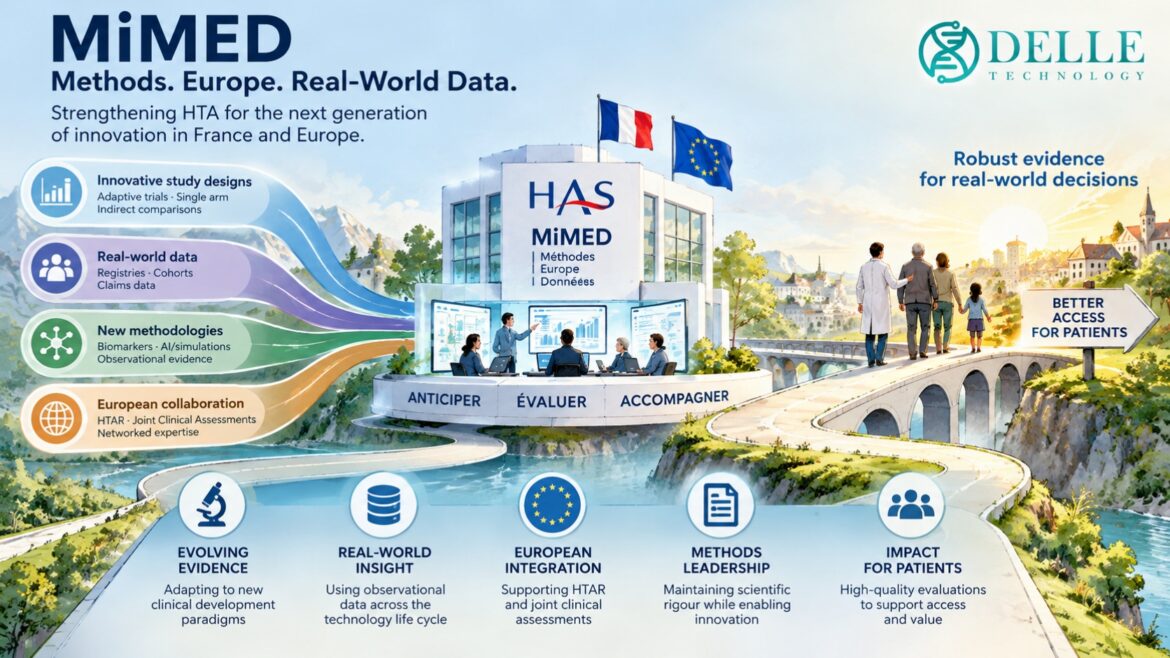
On 23 July 2026, France’s Haute Autorité de Santé announced the creation of MiMED — Mission Méthodes, Europe, Données.
MiMED is an expansion of the Cellule de coordination des données en vie réelle, the real-world data coordination function created by HAS in 2021. It now brings together three increasingly connected areas of health technology assessment:
- emerging evaluation methods;
- real-world data and real-world evidence; and
- European HTA cooperation.
Although this may initially look like an internal reorganisation, it is a meaningful signal about how France intends to assess increasingly complex medicines, medical devices, diagnostics and digital technologies.
Official HAS announcement:
https://www.has-sante.fr/jcms/p_4231652/fr/la-has-cree-la-mimed-pour-accompagner-les-transformations-de-l-evaluation-des-technologies-de-sante
Why HAS created MiMED
The traditional model of evidence generation is changing.
Randomised controlled trials remain central to health technology assessment, but many modern technologies are developed using evidence programmes that may also include:
- adaptive trial designs;
- single-arm studies;
- indirect comparisons;
- external or historical control groups;
- disease registries;
- routine-care databases;
- pragmatic studies;
- post-market evidence;
- and, in some contexts, simulated or synthetic data.
MiMED gives HAS a dedicated methodological capability to examine these approaches and determine when they are sufficiently credible to inform an assessment.
This does not mean that France is lowering its evidentiary standards. The more accurate interpretation is that HAS is developing the expertise needed to assess evidence that does not always fit neatly within the conventional pivotal-trial model.
The importance of real-world evidence
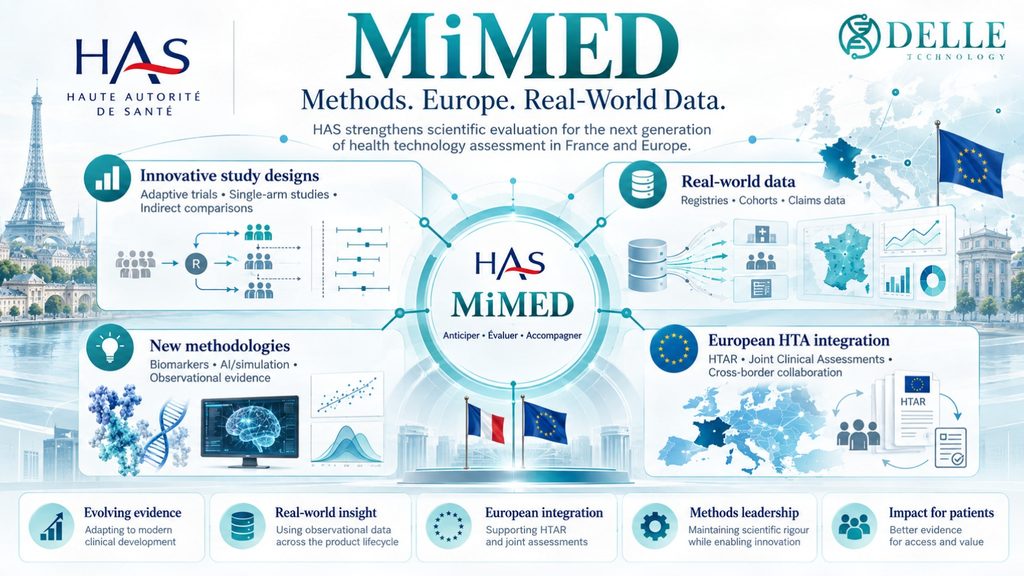
HAS has been developing its approach to real-world evidence for several years.
Its 2021 methodological guide describes real-world data as information generated through observational studies and routine clinical practice. The guide is intended to help companies, researchers, professional organisations and academic groups design studies that can support HAS assessments of medicines and medical devices.
HAS methodological guide on real-world studies:
https://www.has-sante.fr/jcms/p_3284524/fr/etudes-en-vie-reelle-pour-l-evaluation-des-medicaments-et-dispositifs-medicaux
Real-world evidence may help answer questions that are not fully resolved by the pivotal study, including:
- how a technology is used in routine practice;
- whether trial outcomes are reproduced in broader populations;
- the natural history and burden of a disease;
- long-term effectiveness and safety;
- treatment switching or repeat intervention;
- rare complications;
- healthcare-resource use;
- the durability of benefit;
- and the organisational consequences of introducing the technology.
It may also support external comparisons and provide inputs for health-economic models.
The important principle is that real-world evidence should not be treated as a collection of convenient additional data. Each dataset should have a clear purpose within the overall evidence programme.
MiMED is not a new reimbursement route
MiMED will not itself determine whether a medicine receives an ASMR rating, whether a medical device is placed on the LPPR, or what price or tariff should apply.
It is not a substitute for the Commission de la Transparence, the CNEDiMTS, the CEESP or the other bodies involved in French assessment and access.
Its role is methodological and strategic.
MiMED will help HAS determine whether complex evidence has been generated and analysed in a sufficiently reliable way to support decision-making.
A future submission might therefore be assessed as a connected evidence architecture comprising:
- a prospective clinical study;
- a suitable comparator or external control;
- a registry or structured cohort;
- routine hospital or reimbursement data;
- post-market safety and effectiveness evidence;
- patient-reported outcomes;
- resource-use information; and
- health-economic analysis.
The number of datasets will not determine the strength of the submission. What matters is whether they collectively answer the questions facing the French decision-maker.
How companies should use this development
The practical lesson is not simply that companies should collect more real-world data.
The real opportunity is to design the evidence strategy backwards from the future French assessment.
1. Define the French decision problem early
Before finalising the clinical-development programme, a company should understand:
- the population most likely to be considered for reimbursement;
- the relevant French comparator;
- where the technology would sit within the care pathway;
- the outcomes that matter to patients and clinicians;
- the resource and organisational consequences for French hospitals;
- and the uncertainties likely to remain after the pivotal trial.
The comparator accepted by a regulator may not be the comparator considered most relevant by HAS.
A study can therefore be scientifically successful but commercially inadequate if it does not answer the comparative question that matters in France.
2. Give each evidence source a defined role
Every element of the evidence programme should address a specific uncertainty.
For example:
- a clinical trial may establish comparative efficacy and safety;
- a registry may examine long-term durability and rare events;
- hospital data may measure theatre time, length of stay and resource use;
- reimbursement data may identify repeat procedures or downstream utilisation;
- a prospective cohort may test whether trial results are reproduced in routine care;
- patient-reported outcomes may document changes in symptoms, function and quality of life.
Real-world evidence is most convincing when its purpose, outcomes and analytical methods have been specified before the results are known.
3. Design external comparisons carefully
Single-arm trials and external comparators may be necessary in rare diseases, advanced therapies, implantable devices or fields where randomisation is difficult.
However, the credibility of an external comparison depends on whether the groups are genuinely comparable.
A company may need to demonstrate:
- alignment of eligibility criteria;
- comparable disease severity;
- consistent endpoint definitions;
- similar follow-up periods;
- appropriate adjustment for prognostic factors;
- transparent treatment of missing data;
- and pre-specified statistical methods.
A very large database cannot compensate for a poorly constructed comparator.
4. Build French evidence generation into launch planning
French real-world evidence should not begin only after an access problem has appeared.
Companies should consider identifying relevant French centres, investigators, registries, coding teams and data holders before launch.
For medical devices, useful evidence may include:
- the exact procedure performed;
- patient-selection criteria;
- learning curves;
- insertion and removal procedures;
- revision or explant rates;
- complications;
- length of stay;
- operating-room use;
- subsequent interventions;
- and long-term patient outcomes.
For diagnostics, digital health and AI, the evidence may need to address:
- accuracy in the intended French population;
- external validation;
- clinical workflow integration;
- adherence and adoption;
- changes in treatment decisions;
- subgroup performance;
- algorithm updates and version control;
- and whether use of the technology improves outcomes rather than merely generating information.
5. Connect European and French evidence planning
The European HTA Regulation creates a framework for Joint Clinical Assessments, which provide a scientific analysis of the relative clinical effects of certain medicines and medical devices.
The Regulation applies from 12 January 2025, initially covering new oncology medicines and advanced therapy medicinal products, with its scope expanding over time.
European Commission — implementation of the HTA Regulation:
https://health.ec.europa.eu/health-technology-assessment/implementation-regulation-health-technology-assessment_en
European Commission — Joint Clinical Assessments:
https://health.ec.europa.eu/health-technology-assessment/implementation-regulation-health-technology-assessment/joint-clinical-assessments_en
A European Joint Clinical Assessment will not itself determine French price or reimbursement.
France will still need to consider issues such as:
- the national care pathway;
- the French comparator;
- organisational impact;
- economic value;
- resource use;
- pricing;
- and conditions of reimbursement.
Companies should therefore avoid building separate and disconnected “European” and “French” evidence plans. The stronger approach is a single evidence strategy with two connected layers:
- comparative clinical evidence suitable for European assessment; and
- French evidence demonstrating how the technology should be used and valued within the national health system.
Which technologies are most likely to be affected?
MiMED is likely to be particularly relevant to technologies for which the evidence cannot be captured fully through one conventional study, including:
- rare-disease and paediatric treatments;
- advanced therapy medicinal products;
- personalised and biomarker-led medicines;
- implantable and procedure-dependent medical devices;
- diagnostics and companion diagnostics;
- artificial intelligence;
- digital therapeutics;
- and technologies requiring staged or conditional evidence generation.
These technologies often face the same difficulty: the pivotal study may demonstrate that the product works, but it may not completely establish:
- which patients should receive it;
- how it compares with the most relevant national alternative;
- how durable the benefit is;
- how it performs in broader clinical practice;
- what resources it consumes or releases;
- and whether its value justifies routine adoption.
MiMED gives HAS a stronger platform for examining those questions.
What MiMED means in practice
MiMED should not be described as a relaxation of French HTA.
It is more accurately understood as an attempt to make French assessment more methodologically capable, more data-literate and better connected to European evidence generation.
For companies, the opportunity is significant, but it comes with greater discipline.
The organisations most likely to benefit will be those that:
- plan their French evidence requirements early;
- select comparators relevant to French practice;
- pre-specify their real-world evidence studies;
- use French hospital and reimbursement data intelligently;
- link clinical outcomes with resource and organisational consequences;
- and treat evidence generation as a lifecycle programme rather than a one-time submission exercise.
The future French assessment will not ask only whether the pivotal trial was positive.
It will increasingly ask whether the complete evidence programme explains:
Who should receive the technology, how it compares with current care, what happens when it is used in routine practice, what uncertainty remains, and how that uncertainty will be resolved over time.
That is the practical importance of MiMED.
Official references
- Haute Autorité de Santé. La HAS crée la MiMED pour accompagner les transformations de l’évaluation des technologies de santé. 23 July 2026.
https://www.has-sante.fr/jcms/p_4231652/fr/la-has-cree-la-mimed-pour-accompagner-les-transformations-de-l-evaluation-des-technologies-de-sante - Haute Autorité de Santé. Études en vie réelle pour l’évaluation des médicaments et dispositifs médicaux. Guide méthodologique. 30 June 2021, updated 2 September 2021.
https://www.has-sante.fr/jcms/p_3284524/fr/etudes-en-vie-reelle-pour-l-evaluation-des-medicaments-et-dispositifs-medicaux - Haute Autorité de Santé. La HAS se réorganise pour accompagner les évolutions de la santé. 17 November 2021.
https://www.has-sante.fr/jcms/p_3299018/fr/la-has-se-reorganise-pour-accompagner-les-evolutions-de-la-sante - Haute Autorité de Santé. Parcours du dispositif médical en France — Guide pratique.
https://www.has-sante.fr/jcms/c_891379/fr/parcours-du-dispositif-medical-en-france-guide-pratique-actualisation-juillet-2021 - European Commission. Implementation of Regulation (EU) 2021/2282 on health technology assessment.
https://health.ec.europa.eu/health-technology-assessment/implementation-regulation-health-technology-assessment_en - European Commission. Joint Clinical Assessments.
https://health.ec.europa.eu/health-technology-assessment/implementation-regulation-health-technology-assessment/joint-clinical-assessments_en