What metastatic pancreatic cancer reveals about patient choice, real-world evidence and the denominator
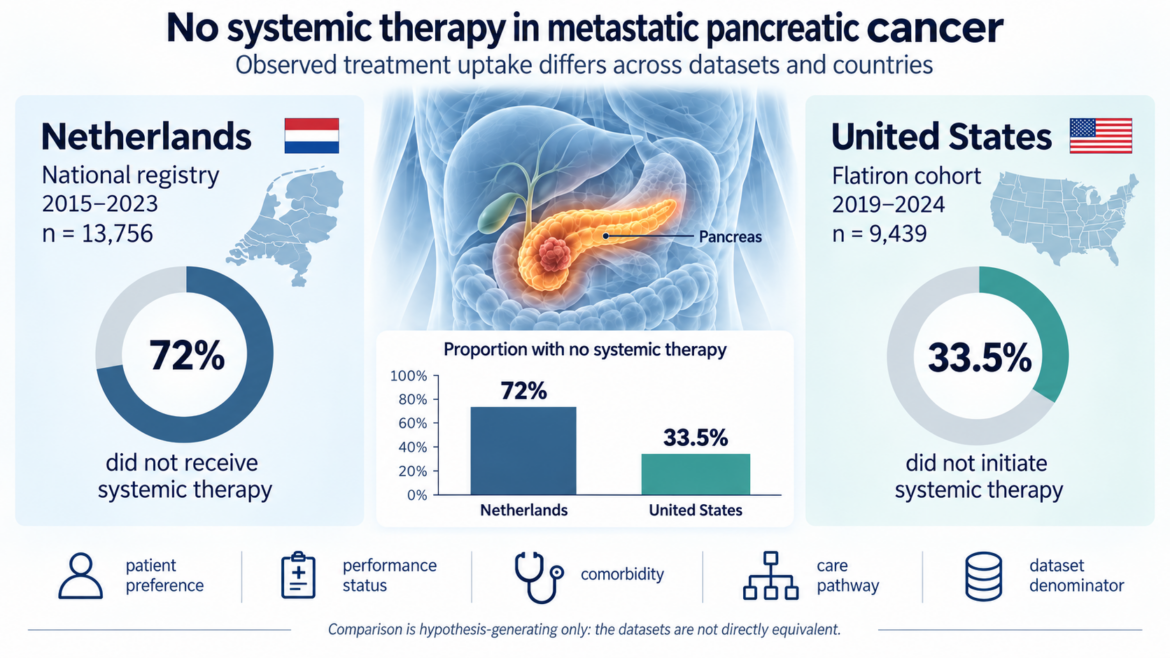
Two contemporary datasets appear to describe radically different treatment uptake in metastatic pancreatic cancer: 72% untreated in a Dutch national registry and 33.5% untreated in a US oncology EHR cohort. The tempting explanation is culture. The more important explanation may be methodological: who enters the denominator, what counts as treatment, and which decisions become visible to the dataset.
The statistic that should make us cautious
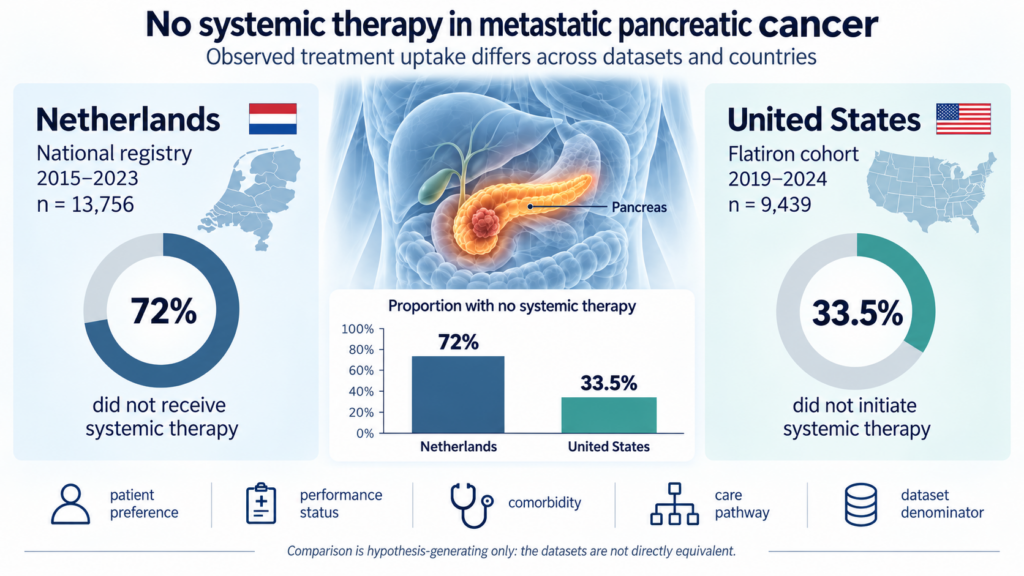
Broekman and colleagues examined 13,756 people with synchronous metastatic pancreatic cancer recorded in the Netherlands Cancer Registry between 2015 and 2023. Seventy-two per cent did not receive systemic treatment. Among the untreated population, the most commonly recorded reason was patient or family preference; clinical factors such as comorbidity and impaired performance status were also prominent.[1]
Now place that beside a contemporary US analysis. Fuldeore and colleagues used the Flatiron Health Research Database to study 9,439 people diagnosed with metastatic pancreatic adenocarcinoma between 2019 and 2024. In that cohort, 3,160 patients – 33.5% – did not initiate systemic anticancer therapy within 180 days of metastatic diagnosis.[2]
The contrast is striking: 72% versus 33.5%. It is also precisely the sort of comparison that can become misleading when a memorable number outruns its denominator.
Before calling it culture, look at who was counted
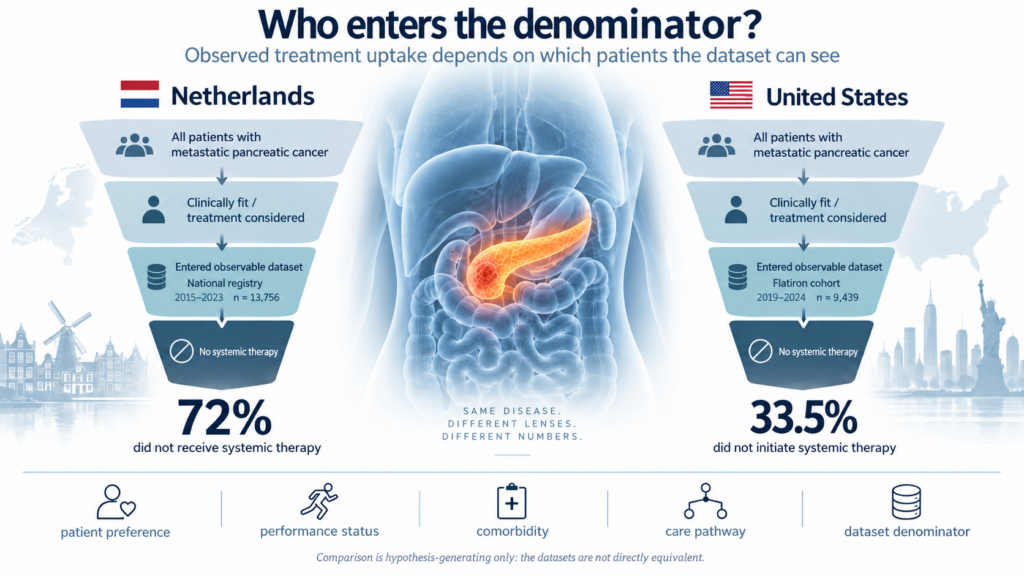
The Dutch study is population based. A national cancer registry can capture a person who is diagnosed, deteriorates quickly, receives supportive care, declines chemotherapy, or never becomes a sustained participant in an oncology treatment pathway. The US study is different. It is built from oncology electronic health records, and its inclusion criteria required continuing clinical documentation after diagnosis.[1,2]
Those are not interchangeable populations. A dataset derived from oncology practices is likely to be particularly good at describing people who reach oncology care. It is not necessarily designed to estimate, with equal completeness, every person in the country who is diagnosed and then does not enter that care pathway.
Older US population-level evidence illustrates the point. An analysis of 140,210 patients with stage IV pancreatic cancer in the National Cancer Data Base found that only 49.1% received systemic therapy. In other words, roughly half did not. Treatment receipt varied with age, comorbidity, insurance, socioeconomic factors, race and treatment setting.[3]
That study is older and should not be substituted for contemporary practice. But it matters because it shows that there is no single self-evident ‘US untreated rate’. The answer changes with calendar time, data source, inclusion criteria, clinical setting and the behaviour a database can observe.
The denominator is part of the evidence
In health economics and market access, the denominator is often treated as an administrative detail. It is not. It can determine what we believe about uptake, unmet need, treatment eligibility, budget impact and population health gain.
Consider the apparently simple forecast: incidence multiplied by labelled eligibility multiplied by expected market share. That chain assumes we understand the transition from diagnosis to treatment. But in a disease such as metastatic pancreatic cancer there may be several distinct transitions: clinical eligibility, treatment being offered, a recommendation being accepted, and treatment actually being initiated.
If a database observes only the later stages of that sequence, non-initiation can be underestimated. If a model assumes that every clinically eligible patient becomes a treated patient, expenditure can be overestimated. If patients who never start treatment differ systematically from those who do, trial and real-world outcomes may also be less generalisable than they first appear.
Patient preference is real – but it is not a synonym for ‘untreated’
The Dutch paper is particularly interesting because patient or family preference was frequently recorded as the reason for non-treatment. That finding should be taken seriously. It should not, however, be converted into a national stereotype.
A separate Dutch multicentre discrete-choice experiment, PERSEUS, asked people with pancreatic cancer to choose between treatment profiles that varied in adverse events, impact on daily functioning, gastrointestinal symptoms, life expectancy and hospital-visit frequency. Among both early- and late-stage participants, active anticancer treatment was generally preferred to best supportive care, although there was substantial heterogeneity. Life expectancy was the most important attribute overall.[4]
That does not contradict the registry study. It reveals something more interesting: stated preference in a structured experiment and observed behaviour at the point of advanced illness are not the same construct.
A patient may value treatment in principle and still decline it in practice. Performance status can change quickly. A modest survival gain may look different after a hospital admission. Travel burden can become decisive. Family circumstances matter. The recommendation made by the clinician matters. So does the way uncertainty is described. ‘Preference’ is therefore an outcome of context as well as an individual attribute.
Survival is not the only way treatment consumes time
One reason this matters in advanced cancer is that treatment itself uses a scarce resource: the patient’s remaining time.
Gupta, Eisenhauer and Booth described this as the ‘time toxicity’ of cancer treatment – the days and hours consumed by travel, laboratory testing, scans, infusions, waiting, adverse-event management, emergency care and hospitalisation.[5] In incurable disease, the relevant comparison is not simply survival gained versus toxicity experienced. It is also survival gained versus time returned to, or taken away from, ordinary life.
This does not imply that chemotherapy is undesirable. For many people, additional survival is the dominant goal, and modern systemic treatment is clinically meaningful. The point is narrower: evidence systems should be capable of describing the trade-off that patients are actually making.
Clinical guidance already recognises that ‘no treatment’ is an option
NICE’s shared decision-making guidance explicitly requires discussion of the risks, benefits and consequences of available options and makes clear that those options include choosing no treatment.[6] The US National Cancer Institute likewise describes chemotherapy as a principal treatment for metastatic pancreatic cancer while recognising palliative therapies throughout the disease course.[7]
Current ESMO guidance continues to stratify systemic-treatment recommendations by clinical fitness, performance status and comorbidity rather than treating metastatic disease as a single therapeutic population.[8]
These are not peripheral ethical considerations. They are part of the clinical pathway. If the real pathway contains a genuine decision between treatment and no treatment, then evidence generation that begins only after treatment has started is necessarily observing a selected population.
What this means for clinical development

For drug developers, the implication is not that every programme requires a preference study. It is that the decision to start treatment should be considered explicitly whenever treatment burden, modest expected survival gains, route of administration, monitoring requirements or substantial heterogeneity in uptake could affect value.
Questions worth answering earlier include: Which treatment attributes influence willingness to initiate therapy? How much do hospital visits and treatment-free time matter? Does an oral or less intensive regimen expand the population willing to be treated? Are the patients who decline therapy clinically different from those who accept it? Which outcomes should therefore be collected prospectively?
FDA’s patient-focused drug-development programme is built around precisely this principle: patient experiences, needs and priorities should be systematically captured and incorporated into medical-product development. Its methodological guidance describes how to identify what is important to patients and how patient-experience information can inform development and regulatory decision-making.[9]
EMA is moving in the same direction. Its draft reflection paper on patient experience data encourages early discussion with regulators about patient-reported outcomes, patient-preference studies and other patient-experience evidence in development programmes.[10]
What this means for HTA and HEOR
The market-access consequence is easy to miss. A cost-effectiveness model may be internally impeccable and still misrepresent practice if its treatment pathway begins too late.
Budget-impact models need realistic treatment uptake, not simply epidemiological eligibility. Cost-effectiveness models may need to distinguish the effect of a therapy among patients who initiate it from the population-level consequence of making treatment more acceptable, less burdensome or more accessible. Real-world evidence plans should examine non-initiation as a phenomenon rather than quietly excluding it.
This is also consistent with current HTA methodology. NICE’s technology-evaluation manual requires health-related quality of life, where possible, to be reported directly by patients, and defines the decision problem around the relevant patient groups and comparators.[11] At EU level, the Health Technology Assessment Regulation now applies to new cancer medicines and explicitly provides for patient, carer and clinical-expert involvement in joint HTA work.[12]
This is particularly relevant when a technology’s value proposition includes fewer hospital visits, shorter infusion time, lower toxicity, reduced monitoring, oral administration or more time at home. Those attributes may do more than improve utility once treatment begins. They may change whether treatment begins at all.
That is a different value claim, and it needs different evidence.
The question underneath the headline
The Dutch and US studies should not be reduced to a contest between national attitudes to chemotherapy. The data do not justify that conclusion.
They do justify a more useful question.
When a patient does not start treatment, what exactly are we measuring – preference, eligibility, access, physician recommendation, rapid deterioration, or the healthcare system itself?
Once those mechanisms are separated, several apparently simple assumptions become testable: the size of the treated population, the generalisability of trial evidence, the budget actually exposed to a new medicine, and the value patients place on treatment burden.
The important lesson is therefore methodological rather than cultural. In metastatic pancreatic cancer, treatment initiation is not merely a prelude to the evidence. It is part of the evidence.
A practical evidence agenda
Define the denominator before comparing treatment uptake across countries or datasets.
Separate clinical eligibility, treatment offer, patient acceptance and actual initiation wherever the data allow.
Treat non-initiation as an outcome to be explained, not simply a missing treatment record.
Capture treatment burden and time spent in healthcare where these attributes could influence choice.
Test whether patient preferences observed in stated-preference research align with real-world decisions.
Build country-specific uptake assumptions into budget-impact and population-health models rather than importing a single rate.
Consider patient-experience evidence early enough to alter trial endpoints, resource-use collection or treatment delivery.
The strongest evidence strategy is not the one with the largest number of endpoints. It is the one that begins with the actual decision pathway and measures the uncertainties that matter at each step.
References
1. Broekman THH, Mackay TM, de Vos-Geelen J, et al.; Dutch Pancreatic Cancer Group. Treatment considerations in patients with metastatic pancreatic cancer who did not receive systemic therapy: A population-based study. European Journal of Cancer. 2026;245:116943. doi:10.1016/j.ejca.2026.116943. Publisher full text (European Journal of Cancer / ScienceDirect) DOI
2. Fuldeore R, Tan CJ, Kimura T, et al. Treatment patterns and outcomes of patients with a diagnosis of metastatic pancreatic adenocarcinoma in the United States, 2019-2024. Frontiers in Oncology. 2026;16:1844261. doi:10.3389/fonc.2026.1844261. Publisher full text (Frontiers in Oncology) DOI
3. Khanal N, Upadhyay S, Dahal S, Bhatt VR, Silberstein PT. Systemic therapy in stage IV pancreatic cancer: a population-based analysis using the National Cancer Data Base. Therapeutic Advances in Medical Oncology. 2015;7(4):198-205. doi:10.1177/1758834015579313. Publisher full text (SAGE Journals) DOI
4. Lansbergen MF, Smith IP, van Alphen EN, et al. Patient preferences for pancreatic cancer treatment (PERSEUS): a multicenter discrete choice experiment. Health and Quality of Life Outcomes. 2025;23:122. doi:10.1186/s12955-025-02440-5. Publisher full text (Springer Nature) PubMed DOI
5. Gupta A, Eisenhauer EA, Booth CM. The Time Toxicity of Cancer Treatment. Journal of Clinical Oncology. 2022;40(15):1611-1615. doi:10.1200/JCO.21.02810. Publisher article (Journal of Clinical Oncology / ASCO) DOI
6. National Institute for Health and Care Excellence (NICE). Shared decision making. NICE guideline NG197. Recommendation 1.2.10. Official NICE guidance
7. National Cancer Institute. Pancreatic Cancer Treatment (PDQ): Treatment of Metastatic or Recurrent Pancreatic Cancer. Official US National Cancer Institute PDQ
8. Conroy T, Ducreux M; ESMO Guidelines Committee. ESMO Clinical Practice Guideline Express Update on the management of metastatic pancreatic cancer. ESMO Open. 2025;10(4):104528. doi:10.1016/j.esmoop.2025.104528. Publisher full text (ESMO Open) PubMed
9. US Food and Drug Administration. Patient-Focused Drug Development: Methods to Identify What Is Important to Patients. Guidance for Industry, FDA Staff, and Other Stakeholders. February 2022. Official FDA final guidance FDA Patient-Focused Drug Development programme
10. European Medicines Agency. Reflection paper on patient experience data. Draft; consultation closed 31 January 2026. Reference EMA/CHMP/PRAC/148869/2025. Official EMA page Official EMA reflection paper PDF
11. National Institute for Health and Care Excellence (NICE). NICE technology appraisal and highly specialised technologies guidance: the manual (PMG36), section 4: Economic evaluation. Updated 31 March 2026. Official NICE HTA methods manual – economic evaluation
12. European Commission, Directorate-General for Health and Food Safety. Regulation on Health Technology Assessment: implementation framework and opportunities for patients, carers and clinicians. Official European Commission HTA portal Official EU HTA patient and clinical-expert involvement page
Odelle Technology | Evidence strategy, HEOR and market access