Why Static Cost-Effectiveness Models Fall Short
A lifecycle approach to evidence, health economics, AI, implementation and market access
29 September 2026
| The economic value of a digital technology is not a number embedded in the product. It emerges from the interaction between the technology, its users, the care pathway and time. |
Digital health has an inconvenient economic property: the intervention we evaluate today may not be the intervention that is operating a year from now. Software versions change. Uptake changes. Users learn. Engagement decays or improves. Algorithms are recalibrated. Clinical pathways are redesigned around the technology. Fixed implementation costs are spread over larger populations, while recurrent cloud, support, cybersecurity and clinical-review costs can rise with use. The comparator may change before the product does.
That does not make conventional health economics obsolete. It makes its assumptions more important. A single cost-effectiveness result can be a valid snapshot and still be a poor description of a lifecycle. The question is therefore not whether digital health needs a separate economics, but whether the model is explicit about what is allowed to move.
A 2026 scoping review by Bazuin et al. makes the mismatch visible. The authors examined 21 guidance documents from 10 HTA organisations across nine countries using the NICE Evidence Standards Framework. Safety and quality appeared in all 10 organisations; effectiveness and deployment requirements in nine. Yet the current pathway and scalability appeared in only two, performance measurement in four, and budget impact in four. The architecture of assessment is strongest where digital health resembles a conventional product – and less developed where its digital nature begins to matter most.
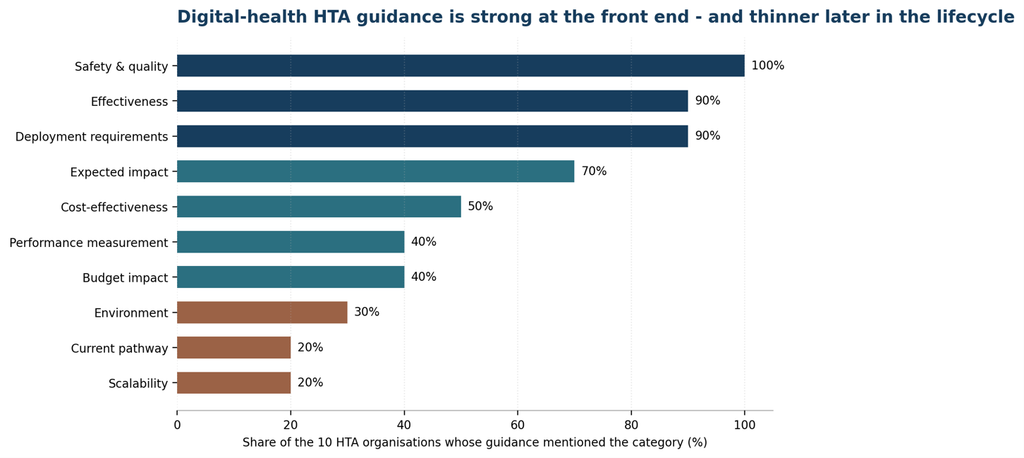
Figure 1. Selected domains reported across the 10 HTA organisations in the Bazuin review.
Recreated from Bazuin et al. (2026), Table 2. Percentages indicate whether a category was mentioned, not the quality of assessment.
A note of caution. Bazuin et al. did not rank national HTA systems. Their 70%/30% cut-offs were explicitly arbitrary; the review was limited to English- and Dutch-language documents from INAHTA/EUnetHTA organisations and searched to April 2025. The findings are best read as a map of emphasis and operational detail, not as a league table.
1. Before the ICER comes the counterfactual

Health economics is incremental. Value is not a property of an intervention in isolation; it is the difference between what happens with the intervention and what would otherwise have happened. That makes one result in the Bazuin review particularly provocative: expected impact was covered by seven of the ten organisations, while the current pathway was covered by only two.
The asymmetry matters because the economic model inherits its logic from the pathway model. If the current pathway is only loosely described, then estimates of avoided visits, clinician time, diagnostic delay, referral volume, false-positive work-up, hospital use or capacity released can acquire spurious precision. A spreadsheet can be exquisitely parameterised and still be anchored to an ill-defined counterfactual.
| A digital-health model should often begin not with the software, but with a quantified account of the status quo. |
For a pathway-changing DHT, a credible baseline should specify who enters the pathway, what happens to them, when it happens, who does the work, how long it takes, what proportion escalate, and which resources are genuinely constrained. This is not process mapping for its own sake. It is the denominator of incremental value. Gomes, Murray and Raftery (2022) similarly emphasise that evolving digital interventions can alter comparator choice, perspective, costs and outcomes in ways that differ from more static technologies.
2. A static ICER can age
The conventional ICER remains useful. The problem is treating it as timeless. Consider a DHT judged cost-effective at launch. Six months later the software has changed, uptake has doubled, onboarding cost has fallen, clinician support time has risen, engagement has shifted, a new subgroup has entered the service and the comparator pathway has improved. The original ICER has not become “wrong”; it has become historically specific.
A useful way to think about this is as four forms of drift. None is unique to digital health, but digital technologies can experience them simultaneously and quickly.
Table 1. Four forms of drift that can make a digital-health value estimate age
| Type of drift | What changes | Why the economic result can move |
| Intervention drift | Software version, algorithm threshold, features, data pipeline | Changes effectiveness, safety, resource use or the identity of the intervention being valued. |
| Implementation drift | Workflow, training, staffing, adherence, support model | Changes realised effectiveness and delivery cost even if the software is unchanged. |
| Population drift | Prevalence, case mix, digital access, subgroup mix | Changes baseline risk, reach, calibration and sometimes the optimal operating threshold. |
| Comparator drift | Standard care, prices, capacity, clinical guidance, competing DHTs | Changes incremental costs and effects because the counterfactual has moved. |
Odelle synthesis. “Drift” is used here as a practical heuristic, not as a validated HTA metric.
This suggests a useful concept: the decision half-life. The term is not a formal metric. It simply asks how long a reimbursement conclusion is likely to remain decision-relevant before material changes in the technology, pathway, population or price make re-analysis worthwhile. For a stable remote-monitoring service the half-life may be long; for rapidly updated AI embedded in a changing diagnostic pathway it may be much shorter.
The methods literature points in the same direction. Santos et al. (2026) mapped 26 economic-evaluation frameworks for DHTs: 81% did not define a time horizon and 73% did not define the evaluation perspective. Campione et al. (2026) examined 51 applied economic evaluations published from 2020-2024. Conventional methods dominated; technology lifecycle and real-world transferability across user groups were rarely addressed.
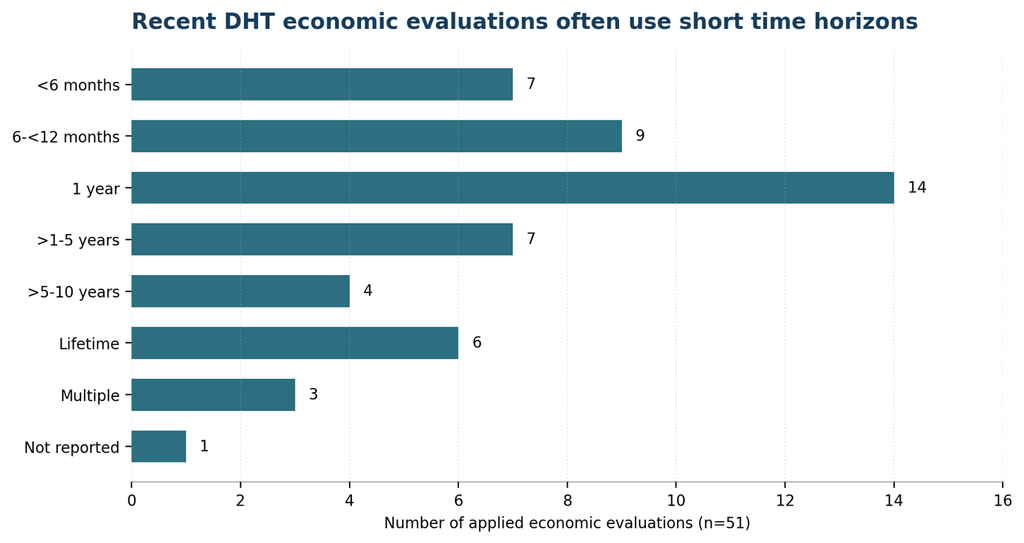
Figure 2. Time horizons used in 51 recent applied economic evaluations of DHTs.
Recreated from Campione et al. (2026), Table 1. A one-year horizon was the single most common choice (14/51).
One year may be entirely appropriate for some decisions. The deeper issue is whether the horizon is long enough to capture the cost and outcome consequences that matter: implementation, learning, churn, delayed downstream events, scale and software change. A short horizon should be a reasoned decision, not an accidental default.
3. Scale changes unit economics and affordability in opposite directions
Digital technologies can combine substantial fixed costs with low marginal distribution costs. This creates an economic paradox: as use rises, average cost per active user may fall while total expenditure rises. A technology can become more efficient per patient and less affordable to the payer at the same time.
Average cost per user = Fixed cost / Active users + Variable cost per user
That is why cost-effectiveness and budget impact cannot be treated as synonyms. If fixed implementation cost is large, scale can improve unit economics. If every extra user also generates cloud, support, monitoring, clinician review or downstream diagnostic costs, total budget exposure can rise quickly. “Scalable” is therefore not a binary adjective. It is a claim about the shape of several curves.
The common story that software has near-zero marginal cost also needs qualification. Gomes et al. (2022) rightly note the low marginal cost of many digital products, but contemporary clinical platforms may have material recurrent service-delivery costs. For AI, the empirical gap is visible: Godoy Junior et al. (2026) reviewed 117 medical-AI economic evaluations and found that only 28% included implementation costs and 57% included operational costs; 63% evaluated systems at Clinical Machine Learning Readiness Levels 4-5, before mature real-world implementation.
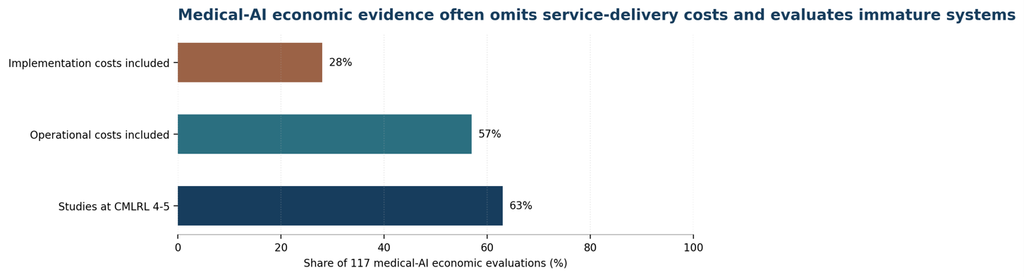
Figure 3. Selected characteristics of 117 health-economic evaluations of medical AI.
Recreated from Godoy Junior et al. (2026). The three bars describe different characteristics and should not be added together.
4. Implementation is a model input, not an afterthought
Digital-health discussions often collapse evidence uncertainty and implementation failure into one problem. They are not the same. A payer may be uncertain whether a technology is cost-effective, in which case additional research can have value. Or the technology may already be cost-effective but poorly adopted, in which case the larger return may come from implementation rather than another trial.
That distinction is well established in decision science. Fenwick, Claxton and Sculpher (2008) developed a joint framework for the value of information and the value of implementation. More recently, Heggie et al. (2024) mapped 42 studies and found a suite of approaches for incorporating implementation within economic evaluation rather than one universal method.
| When a DHT fails to generate expected value, the first question should be: is the uncertainty in the technology, or in the implementation? |
For digital health, uptake and engagement can sit simultaneously inside the clinical and economic models. A therapy that works only among active users has an efficacy question at one level and an implementation question at another. Population value depends on reach, activation, persistence and fidelity – not just efficacy among trial completers.
5. “Saves clinician time” needs an economic translation
Many digital value propositions contain some version of “saves clinician time”. But time saved is not automatically a cash saving, and it is not automatically reusable capacity. Three minutes removed from every consultation may be clinically useful while producing no budget reduction. Conversely, removal of an entire administrative step may release contiguous capacity that can be redeployed immediately.
Table 2. What “saves clinician time” can mean economically
| Workforce effect | What it means | What should be measured |
| Cash-releasing saving | Expenditure can actually fall | Posts, sessions, overtime, outsourced activity or other budget lines that can be removed. |
| Capacity-releasing effect | The same workforce can do more | Minutes released, whether time is contiguous, bottleneck location, and whether capacity is reusable. |
| Work shifting | Tasks move to another role | Minutes by staff grade, supervision, escalation and training requirements. |
| Work creation | New tasks appear | Alerts, exception review, support, data reconciliation, quality assurance and incident handling. |
Odelle synthesis. Workforce claims should distinguish cash, capacity and task redistribution.
Bazuin et al. found professional credibility in only half of the organisations and noted that criteria rarely specified how professionals should be involved or how workforce impact should be assessed. The emerging European work is moving in a more operational direction. de Waure et al. (2026) describe the EDiHTA concept as including organisational effects such as human resources, workload, skills, training, culture and infrastructure.
6. AI makes the technical optimum and the economic optimum diverge
AI makes the distinction between technical performance and economic value unusually visible. A diagnostic model can become more accurate yet create lower net value if the additional accuracy is achieved in the wrong part of the sensitivity-specificity trade-off for the pathway in which it is used.
A striking example comes from Wang et al. (2024). Using data from 251,535 people with diabetes, the authors evaluated 1,100 sensitivity/specificity combinations for AI diabetic-retinopathy screening over 30 years. The most accurate operating point had sensitivity/specificity of 93.3%/87.7%; the most cost-effective operating point shifted to 96.3%/80.4%. Higher prevalence, willingness-to-pay, younger age and urban setting changed the preferred sensitivity.
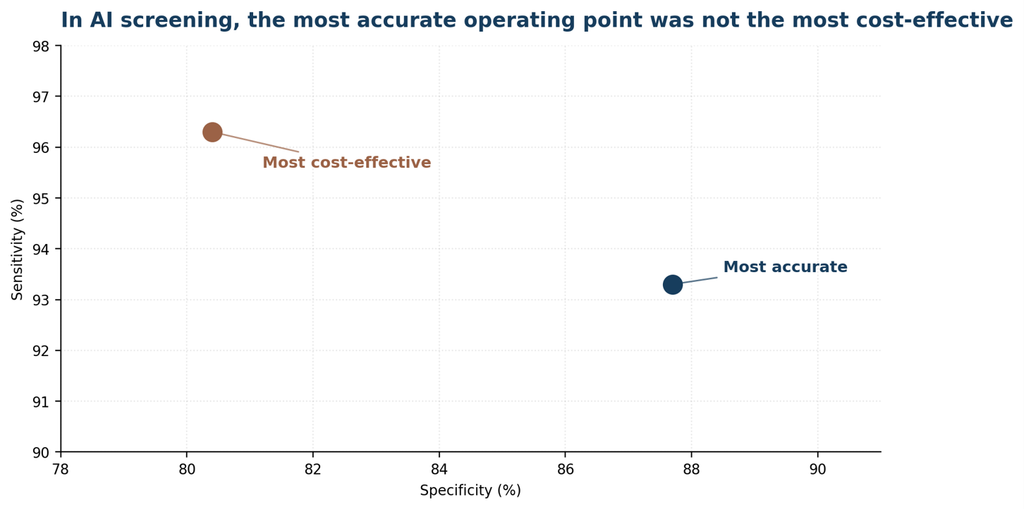
Figure 4. The technically most accurate AI operating point differed from the most cost-effective point in diabetic-retinopathy screening.
Recreated from Wang et al. (2024). The economic optimum depended on the downstream consequences of false positives and false negatives, prevalence and willingness-to-pay.
The technical objective might be “maximise classification accuracy”. The health-economic objective is closer to “maximise expected net health benefit within this pathway”. Those are not necessarily the same optimisation problem. This means an AI operating threshold is not merely a technical setting; in some use cases it is a health-economic parameter.
The governance implication follows immediately. The evaluated technology should be identified by version, data provenance, intended operating threshold and update policy. A change in algorithm performance, target population, workflow or threshold can change value even when the software still carries the same product name.
7. The QALY is not the problem; the boundary of the model may be
It is tempting to argue that QALYs are somehow unsuited to digital health. That is too crude. Cost-utility analysis remains a powerful way to express health opportunity cost. The better question is whether the model boundary captures the important consequences of the technology.
Some DHTs may create modest measurable QALY gains while materially changing patient time, travel, caregiver burden, workforce capacity, productivity or access. Gomes et al. argue that these diffuse effects can change perspective, costing and choice of analysis, and suggest tools such as impact inventories and cost-consequence analysis alongside conventional approaches where appropriate.
The same issue applies to distribution. Badr, Motulsky and Denis (2024) reviewed 41 studies and concluded that DHTs can reinforce inequalities, while evidence on how digital use changes the distribution of health and wellbeing remains limited. A technology can improve average outcomes while widening the distance between groups if access, literacy, connectivity or engagement are unequally distributed.
Environmental effects extend the model boundary again. Di Bidino et al. (2026) argue that DHT assessment should consider energy consumption, data storage, water use and electronic waste, while also accounting for potential reductions in travel and resource use. The point is not that every DHT needs a full environmental lifecycle model; it is that “digital” should not be treated as materially weightless.
8. Evidence portability may be the next European market-access problem
A company can generate a strong evidence package and still discover that it does not travel. Evidence portability is not the same as evidence quality. A result can be internally credible yet fail to answer the question another jurisdiction is asking because the comparator, pathway, costs, decision threshold or implementation setting is different.
The literature now converges on this problem from several directions. Tarricone, Petracca and Weller (2024) describe distinct European assessment and reimbursement approaches; Arca, Heldt and Smith (2025) directly compared DTx assessments in Germany, the UK and France and found material differences in country-specific positioning, comparator choice, usage/usability evidence and economic assessment.
The 2026 EDiHTA literature is particularly important. Tsiasiotis et al. (2026) report broad stakeholder agreement on a flexible, modular, lifecycle framework. Dietz et al. (2026) then mapped 44 documents – 11 studies, 13 HTA-agency methods documents and 20 European DHT HTA reports – and identified 13 domains. Established areas such as clinical effectiveness, safety, economic and organisational aspects were comparatively consistent; environmental, technical, legal/regulatory and some ethical/human aspects were less consistent. The message is subtle: Europe may not need ever more frameworks so much as clearer operationalisation within a shared core.
Table 3. A practical way to design for evidence portability: a portable core with a local shell
| Portable core | Local layer | Why the split matters |
| Technology identity, version, intended use | Local pathway and comparator | The same software can sit in a very different care pathway. |
| Clinical safety and effectiveness | Local epidemiology and eligible population | Baseline risk changes absolute benefit and sometimes AI thresholds. |
| Usability, interoperability, data governance | Local workflow and workforce | Implementation cost and realised effect depend on service design. |
| Core resource-use architecture | Unit costs, tariffs, prices and budget constraints | Economic value and affordability remain jurisdiction-specific. |
| Monitoring plan and update policy | Decision thresholds and reassessment rules | A common evidence spine can travel even when decisions remain national. |
Odelle synthesis informed by Bazuin et al., EDiHTA, Tarricone et al. and Arca et al.
| The same technology can cross a border more easily than its value proposition can. |
9. From a static dossier to a living evidence system
Taken together, the literature suggests a change in the unit of assessment. The object is no longer simply the digital product. It is the product-in-pathway-through-time. That does not require abandoning conventional HTA. It requires making the moving parts explicit and deciding which of them deserve monitoring after adoption.
This is close to the idea of dynamic HTA proposed by Bronneke, Herr, Reif and Stern (2023), who argue for the structured use of real-world data and repeated evidence updates for software-based technologies. A lifecycle approach does not mean continuous reassessment of every minor release. It means pre-specifying which changes are material enough to reopen the economic question.
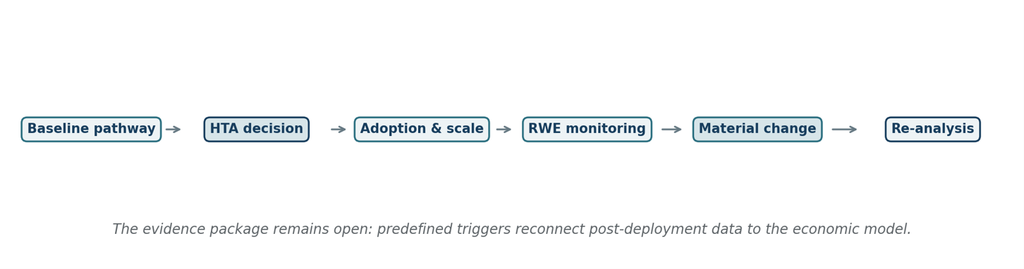
Figure 5. A living evidence system reconnects post-deployment change to the economic model.
Odelle synthesis. Monitoring is purposeful only when linked to predefined decision or re-analysis triggers.
Table 4. A proposed lifecycle health-economic reference case for digital health technologies
| Domain | Minimum evidence to specify | Decision purpose |
| Technology identity | Version/build, intended use, algorithm threshold, update policy | Prevents evidence from silently drifting away from the deployed intervention. |
| Counterfactual pathway | Process map, resource use, waiting, referral and failure points | Defines what incremental value is measured against. |
| Clinical effect | Outcomes, heterogeneity, durability and uncertainty | Anchors health benefit and subgroup effects. |
| Adoption & engagement | Eligible population, uptake curve, activation and persistence | Links trial efficacy to realised population benefit. |
| Cost structure | Fixed, implementation, variable, cloud/compute, support and monitoring | Allows unit cost and budget impact to change with scale. |
| Workforce & capacity | Minutes/tasks by staff grade, tasks added/removed, reusable capacity | Separates cash savings, capacity release and labour shifting. |
| Economic outputs | NMB/ICER, budget impact, scenario and probabilistic uncertainty | Prevents affordability and cost-effectiveness from being conflated. |
| Equity & wider effects | Access, literacy, caregiver/patient time, productivity; environment if material | Makes the model boundary explicit rather than accidental. |
| Post-deployment monitoring | Usage, outcome, safety, performance drift, resource use | Tests whether expected value is being realised. |
| Re-analysis triggers | Material version, threshold, price, pathway, population or performance change | Defines when new evidence should reopen the value decision. |
Odelle synthesis, not a published reference case. It is intended as a practical bridge between current HTA guidance and lifecycle economic methods.
Conclusion: the ICER is a frame, not the whole film
Digital health does not require health economics to abandon its foundations. Incremental analysis, opportunity cost, uncertainty, budget impact and transparent decision modelling become more important when the intervention is changing. What changes is the discipline with which we define the intervention, comparator, cost structure and the point in the lifecycle to which the result applies.
Bazuin et al. show that HTA guidance is comparatively consistent around safety and effectiveness and less consistent around pathways, scalability, workforce, AI-specific governance and post-implementation evaluation. Santos and Campione show that the economic methods beneath assessment are also heterogeneous. Godoy Junior shows how often implementation costs and technological maturity are missing from AI economics. Wang shows that the technical optimum need not be the economic optimum. EDiHTA is now moving towards a European lifecycle framework.
The practical implication for digital firms is not simply “generate more evidence”. It is to design an evidence architecture that can survive scale and travel: quantify the baseline pathway, distinguish fixed from recurrent cost, model uptake and workforce effects, identify the precise technology version, create a portable core with a local economic layer, and decide in advance what changes should trigger re-analysis.
| The future digital-health dossier is less likely to be a file that closes at reimbursement than a living evidence system that knows when its own assumptions have become stale. |
The static ICER remains useful. We simply need to remember what it is: a photograph of a moving target.
Source and synthesis note
This article is an interpretive health-economic synthesis prompted by Bazuin et al. (2026), supplemented by targeted academic literature on DHT economic evaluation, implementation economics, AI, European HTA harmonisation, equity, environmental sustainability and dynamic HTA. It is not a systematic review. Figures and tables are original Odelle syntheses or recreations from numerical results reported in the cited literature; publisher-designed figures and tables have not been reproduced.
References
1. Bazuin T, Kusters MPT, Idema DL, et al. Gaps and variation in evaluation criteria for digital health technologies: a scoping review of HTA organizations’ guidance documents. Health Policy and Technology. 2026;15:101215. https://doi.org/10.1016/j.hlpt.2026.101215
2. Santos AR, von Hafe F, Sampaio F, Londral AR, Perelman J. Mapping Methodologies for Economic Evaluation of Digital Health Technologies: A Scoping Review. Value in Health. 2026;29(2):311-323. https://doi.org/10.1016/j.jval.2025.09.012
3. Campione A, Zetzsche M, Rombey T, Rodiger H, Henschke C. Health economic evaluations of digital health technologies – a rapid review of applied methods. Frontiers in Digital Health. 2026;8:1816757. https://doi.org/10.3389/fdgth.2026.1816757
4. Gomes M, Murray E, Raftery J. Economic Evaluation of Digital Health Interventions: Methodological Issues and Recommendations for Practice. PharmacoEconomics. 2022;40(4):367-378. https://doi.org/10.1007/s40273-022-01130-0
5. Godoy Junior CA, Boverhof B-J, Rutten-van Molken MPMH, et al. Technological Maturity and Cost-Effectiveness of Medical Artificial Intelligence: A Systematic Review of Health Economic Evaluations. Value in Health. 2026;29(5):896-904. https://doi.org/10.1016/j.jval.2026.01.014
6. Wang Y, Liu C, Hu W, et al. Economic evaluation for medical artificial intelligence: accuracy vs. cost-effectiveness in a diabetic retinopathy screening case. npj Digital Medicine. 2024;7:43. https://doi.org/10.1038/s41746-024-01032-9
7. Fenwick E, Claxton K, Sculpher M. The value of implementation and the value of information: combined and uneven development. Medical Decision Making. 2008;28(1):21-32. https://doi.org/10.1177/0272989X07308751
8. Heggie R, Boyd K, Kamaruzaman H, Wu O. What methods are currently available for incorporating implementation considerations within the economic evaluation of health technologies? A scoping review. Health Research Policy and Systems. 2024;22:134. https://doi.org/10.1186/s12961-024-01220-9
9. Tsiasiotis E, Mezei F, Di Bidino R, et al. Toward a Harmonized Health Technology Assessment Framework for Digital Health Technologies in Europe. Value in Health. 2026;29(4):560-566. https://doi.org/10.1016/j.jval.2025.12.004
10. de Waure C, Valentini I, Scarsi N, et al. A European framework for the assessment of digital health technologies: conceptual advances, challenges, and future directions. Frontiers in Digital Health. 2026;8:1809237. https://doi.org/10.3389/fdgth.2026.1809237
11. Dietz J, Garrett Z, Ayiku L, et al. Domains in Health Technology Assessment of Digital Health Technologies: A Mapping Review. Value in Health. 2026; online ahead of print. https://doi.org/10.1016/j.jval.2026.06.017
12. Tarricone R, Petracca F, Weller H-M. Towards harmonizing assessment and reimbursement of digital medical devices in the EU through mutual learning. npj Digital Medicine. 2024;7:268. https://doi.org/10.1038/s41746-024-01263-w
13. Arca E, Heldt D, Smith M. Comparison of health technology assessments for digital therapeutics in Germany, the United Kingdom and France. Digital Health. 2025;11:20552076241308704. https://doi.org/10.1177/20552076241308704
14. Di Bidino R, Daugbjerg S, Papavero SC, Haraldsen IH, Cicchetti A, Sacchini D. Health technology assessment framework for artificial intelligence-based technologies. International Journal of Technology Assessment in Health Care. 2024;40(1):e61. https://doi.org/10.1017/S0266462324000308
15. Di Bidino R, Dutta Majumdar A, Pegg M, Mahon R, Papavero SC, Mueller D. Implications of Incorporating Environmental Sustainability Into Health Technology Assessment for Digital Health Technologies. Value in Health. 2026;29(4):595-599. https://doi.org/10.1016/j.jval.2026.01.019
16. Badr J, Motulsky A, Denis J-L. Digital health technologies and inequalities: A scoping review of potential impacts and policy recommendations. Health Policy. 2024;146:105122. https://doi.org/10.1016/j.healthpol.2024.105122
17. Bronneke JB, Herr A, Reif S, Stern AD. Dynamic HTA for digital health solutions: opportunities and challenges for patient-centered evaluation. International Journal of Technology Assessment in Health Care. 2023;39(1):e72. https://doi.org/10.1017/S0266462323002726