The MHRA–NICE Aligned Pathway, Integrated Scientific Advice and ILAP in practice
The strategic change is simple but profound: in the UK, regulatory authorisation and health technology assessment no longer have to be planned as sequential events. For suitable medicines, the evidence strategy can be built so that MHRA licensing, NICE value assessment and NHS access move in parallel.
For pharmaceutical developers, “market access” has often been treated as the stage that starts after regulatory approval. That model is increasingly outdated in England. The Medicines and Healthcare products Regulatory Agency (MHRA) and the National Institute for Health and Care Excellence (NICE) have now created a practical route for companies to align regulatory and health technology assessment (HTA) planning earlier, with the stated objective of bringing some medicines to NHS patients 3–6 months sooner. The key tools are the MHRA–NICE Aligned Pathway, Integrated Scientific Advice and, for eligible earlier-stage products, the Innovative Licensing and Access Pathway (ILAP). [1–5]
This matters because healthcare professionals need clarity on how MHRA and NICE answer different questions. MHRA asks whether a medicine has an acceptable balance of quality, safety and efficacy for its proposed indication. NICE asks whether the medicine is clinically and cost-effective for NHS use compared with relevant alternatives, and how it should be positioned within the health system. A programme can therefore be regulator-ready but HTA-poor if the pivotal trial, comparator, population, outcomes, resource-use data or economic model were not designed with reimbursement in mind.
What has changed: the MHRA–NICE Aligned Pathway
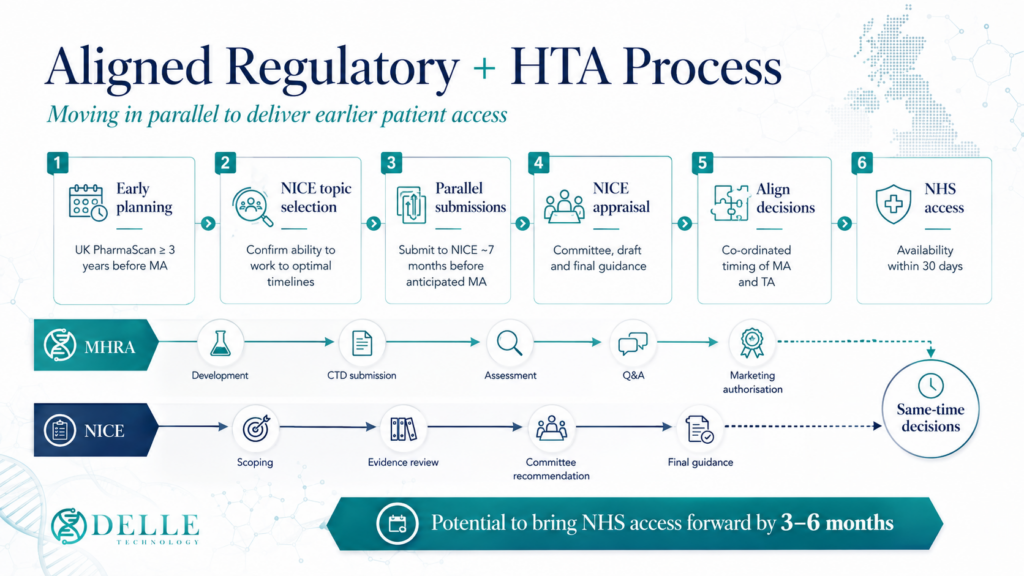
The Aligned Pathway launched on 1 April 2026. It is intended to bring NICE technology appraisal guidance forward so that it can be published at the same time as the MHRA marketing authorisation for products that can meet the coordinated timetable. The two organisations do not merge their assessments: each still reviews the evidence and reaches its own decision independently. This initiative aims to streamline processes and improve alignment, fostering greater confidence in the technology approval pathway among all stakeholders.[1]
The pathway is open across therapeutic areas and there is no published cap on the number of companies that can use it. Products coming through ILAP, the national licensing route, the ACCESS Consortium or Project Orbis are prioritised for scheduling. [1]
The four operational steps
| Step | What the company does | Why it matters for market access |
| 1. UK PharmaScan | Register the medicine at least 3 years before the expected MHRA marketing authorisation. | Creates the horizon-scanning signal NICE needs to plan topic selection and an aligned appraisal timetable. |
| 2. Commit to NICE timing | At NICE topic selection, confirm that the company can meet the optimal coordinated timelines. There is no separate Aligned Pathway application. | Forces regulatory, HTA and evidence teams to work from a common target date. |
| 3. Submit to both bodies | For optimal timing, submit to NICE about 7 months before expected MHRA authorisation. Depending on the regulatory route, the NICE dossier may be submitted before the MHRA dossier. | The HTA evidence package must therefore be mature before regulatory approval, not built afterwards. |
| 4. Receive aligned decisions | NICE schedules committee, draft guidance and final draft guidance before MHRA authorisation and publishes final guidance to coincide with the licence if the product remains on track. | Can remove months of dead time between regulatory approval and an NHS access decision. |
The practical implication: a company intending to use the Aligned Pathway cannot wait for the MHRA decision before finalising its NICE strategy. The NICE submission may need to be ready first.
Use Integrated Scientific Advice before the pivotal evidence is locked
MHRA and NICE explicitly recommend Integrated Scientific Advice (ISA), at minimum, when designing pivotal clinical trials for companies intending to use the Aligned Pathway. ISA is a single-entry service through which a developer can receive coordinated regulatory and HTA advice. [2]
The value of ISA is not administrative convenience. It is the opportunity to expose evidence conflicts before they become expensive. A pivotal trial can satisfy MHRA yet still create problems for NICE if, for example, the comparator does not reflect NHS practice, the licensed population is broader than the population for which comparative evidence is persuasive, patient-reported outcomes are weak, follow-up is too short for the economic model, or resource-use consequences are not measured.
The ISA process
Check which type of scientific advice is appropriate and submit the ISA request.
Within 15 working days of the request, the developer should receive a contract and estimated cost.
Pay the single ISA fee in two parts: 70% initially and 30% at completion.
Submit a briefing book containing product background, development context and the specific advice questions.
Submit a short meeting presentation. Meetings typically last up to 120 minutes and may extend to 180 minutes for complex projects.
Receive one integrated written advice report within 45 working days after the meeting. The service commits to delivery within 80 working days of an accepted request, assuming timely and complete company responses.
Questions worth taking into MHRA–NICE advice
Is the proposed pivotal population suitable for both the intended label and the likely NICE decision problem?
Is the chosen comparator acceptable clinically and economically for NHS practice?
Are the primary and secondary endpoints likely to support both benefit–risk assessment and comparative-effectiveness modelling?
Which patient-reported outcomes, utilities and resource-use variables should be collected prospectively?
How much follow-up is needed to support assumptions on durability, treatment discontinuation, adverse events and downstream costs?
What real-world evidence, registry or external-control strategy would be credible if trial evidence is necessarily limited?
What uncertainty will remain at launch, and can it be managed through additional evidence generation or a commercial/access arrangement?
Where ILAP fits: move market-access thinking even earlier
ILAP is not the Aligned Pathway. The MHRA’s own explanation is that ILAP is accessed earlier and provides coordinated development and access support; the Aligned Pathway is accessed later and coordinates MHRA and NICE decision-making timelines. Clarifying these differences helps the audience feel assured of the process’s transparency and reliability. The two are complementary, and an ILAP product may later use the Aligned Pathway. [3–5]
For eligible products, the Innovation Passport is the entry point. The current ILAP window opened on 4 August 2026 and closes on 4 November 2026. ILAP is designed for products for which preliminary human safety has been characterised but confirmatory trials have not yet started — precisely the point at which advice can still materially change evidence generation. [3,6]
What ILAP can add to the evidence and access plan
A Target Development Profile (TDP) to create an early roadmap across development, evidence and access.
ILAP Joint Scientific Advice for participating products, bringing together MHRA and UK HTA expertise to align evidence generation.
Support around clinical-trial delivery and evidence requirements, including links to NIHR infrastructure.
Prioritised access to Clinical Practice Research Datalink (CPRD) capabilities for real-world research.
Market-access and system navigation support designed to identify implementation, evidence and NHS adoption barriers while there is still time to act.
The sequence for an eligible medicine can therefore be: ILAP early in development → evidence alignment and scientific advice → pivotal evidence designed for both regulation and HTA → MHRA–NICE Aligned Pathway near launch → same-time or near-same-time licensing and NICE guidance.
Aficamten: a concrete example of regulatory, clinical and value evidence converging
Aficamten (MYQORZO), developed by Cytokinetics, is a useful case study because MHRA authorisation and NICE final guidance were delivered together in late July 2026. Public sources describe this as coordinated MHRA–NICE decision-making and a demonstration of closer alignment. The public record reviewed for this article does not explicitly state that aficamten was formally enrolled in the Aligned Pathway, so it is best treated as a real-world proof point for the parallel-decision model rather than labelled as a confirmed Aligned Pathway case. [7,8]
The science
Aficamten is a reversible cardiac myosin inhibitor. In obstructive hypertrophic cardiomyopathy (HCM), excessive contractility and left ventricular outflow tract (LVOT) obstruction contribute to raised intracardiac pressure, exertional limitation and symptoms. Aficamten reduces hypercontractility by targeting cardiac myosin. [7,10]
In the phase 3, double-blind SEQUOIA-HCM trial, 282 adults with symptomatic obstructive HCM were randomised to aficamten or placebo for 24 weeks. The primary endpoint was change in peak oxygen uptake (pVO₂) during cardiopulmonary exercise testing. Mean pVO₂ increased by 1.8 mL/kg/min with aficamten and 0.0 mL/kg/min with placebo; the least-squares mean between-group difference was 1.7 mL/kg/min (95% CI 1.0 to 2.4; P<0.001). All 10 prespecified secondary endpoints were also significantly improved, and adverse-event incidence appeared similar between groups. [10,11]
The NICE value question
For NICE, however, the question was not simply whether aficamten worked versus placebo. The relevant NHS decision was how aficamten compared with mavacamten, the existing NICE-recommended cardiac myosin inhibitor. NICE used a cost-comparison approach: for a positive recommendation, Cytokinetics needed to show that the costs of aficamten were similar to or lower than mavacamten for the relevant population. [7–9]
This distinction illustrates the core market-access lesson. The pivotal regulatory trial and the reimbursement decision may have different comparators and different evidential burdens. Aficamten’s clinical programme established efficacy and safety; the NICE appraisal then required a credible bridge to the active NHS comparator and an acceptable cost proposition. A confidential discount was agreed, and NHS England is expected to make the treatment available within 30 days of NICE final guidance. [7]
NICE published its final guidance two weeks faster than its standard process because of efficiencies from closer working with MHRA. Helen Knight, NICE Director of Medicines Evaluation, explicitly linked the outcome to the value of aligning licensing and value-assessment decisions. Julian Beach, MHRA Executive Director of Healthcare Quality and Access, described the same-time authorisation and guidance as an important milestone. [7]
How to use MHRA and NICE together: an evidence-first market-access plan
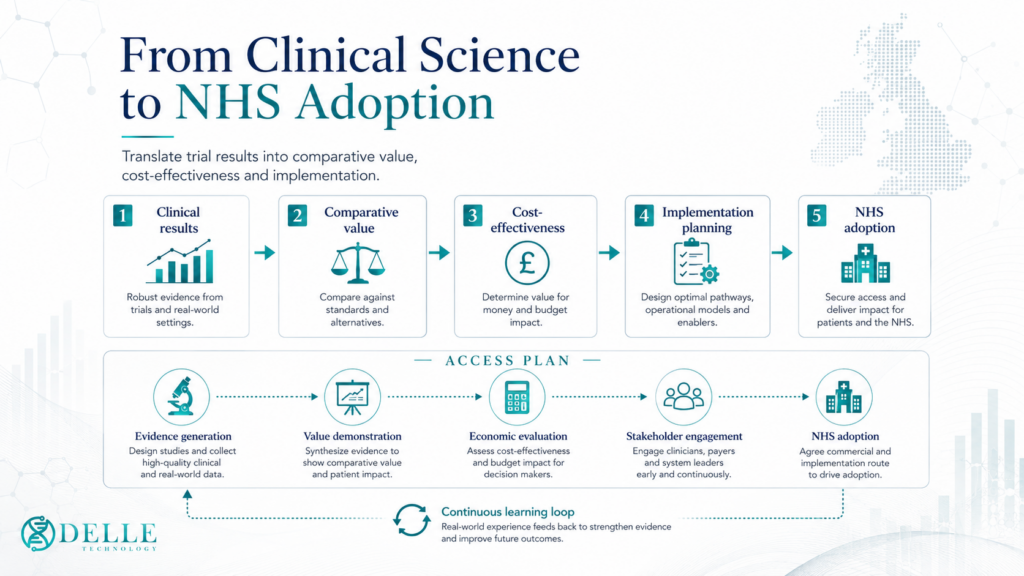
1. Start with the NHS decision problem, not the regulatory dossier — Define the target NHS population, current pathway, comparator(s), unmet need, outcomes that matter to patients and clinicians, and the likely economic decision problem before the pivotal study is finalised.
2. Put UK PharmaScan on the critical path — If the Aligned Pathway is a realistic launch objective, the medicine must be registered on UK PharmaScan at least three years before expected MHRA authorisation. A missed horizon-scanning milestone can become a market-access scheduling problem.
3. Use MHRA–NICE scientific advice to test the pivotal trial — Take questions that expose divergence: label versus reimbursement population, placebo versus active comparator, surrogate versus patient-relevant outcome, trial horizon versus economic-model horizon, and whether planned RWE can resolve residual uncertainty.
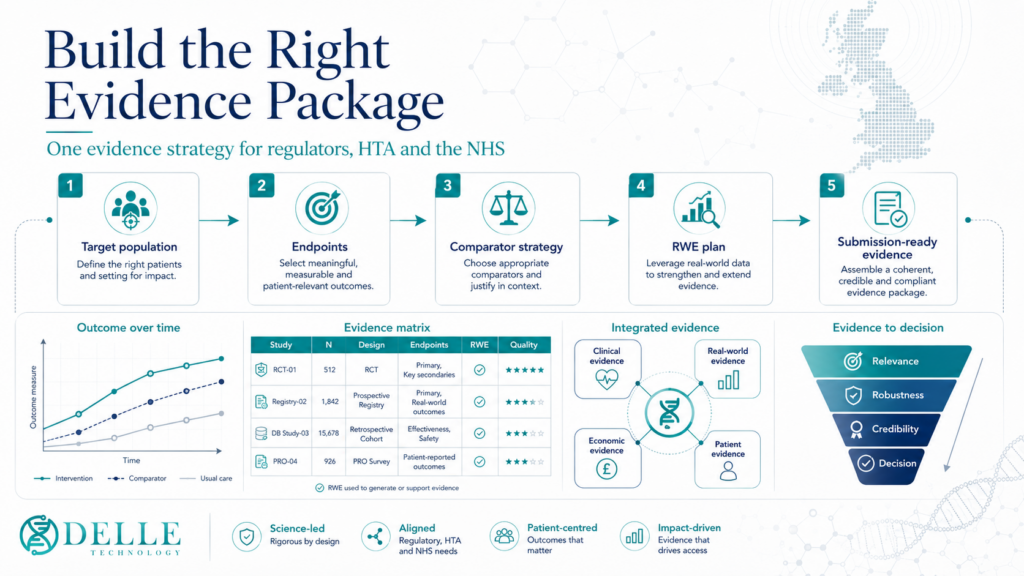
4. Design one evidence architecture serving multiple decisions — Build a canonical evidence plan linking clinical endpoints, safety, quality of life, utilities, resource use, treatment discontinuation, downstream events, monitoring burden, comparator evidence and economic-model inputs.
5. Use ILAP when the product is early enough to benefit — If preliminary human safety exists but confirmatory trials have not started and the product meets ILAP criteria, the Innovation Passport/TDP route can bring regulatory, HTA and NHS access thinking into development earlier.
6. Treat the NICE dossier as a pre-authorisation deliverable — On the Aligned Pathway, NICE recommends submission around seven months before expected MHRA authorisation. The company should therefore lock the economic model, comparator narrative, evidence synthesis and commercial assumptions well before the licence date.
7. Prepare implementation and commercial strategy before the decision — A positive NICE recommendation is not the same as effortless adoption. Anticipate service capacity, diagnostics, monitoring, prescribing location, budget impact, pathway displacement, patient identification and commercial arrangements.
8. Run one cross-functional decision calendar — Regulatory, clinical, HEOR, pricing, market access, medical affairs and UK commercial teams should work from one dated plan that shows dependencies between MHRA questions, NICE evidence, committee timing, contracting and NHS implementation.
Common failure modes
Waiting until after MHRA submission to choose the NICE comparator.
Assuming the placebo-controlled pivotal trial automatically answers the NHS comparative-effectiveness question.
Allowing the proposed licensed population and the modelled reimbursement population to drift apart without a clear evidence bridge.
Collecting clinical outcomes but omitting utilities, resource use, monitoring burden or patient-reported outcomes needed for HTA.
Treating RWE as a post-launch afterthought rather than defining its intended decision role prospectively.
Missing UK PharmaScan or NICE scheduling milestones.
Deferring price, contracting and NHS implementation planning until the guidance is almost final.
The broader lesson for UK market access
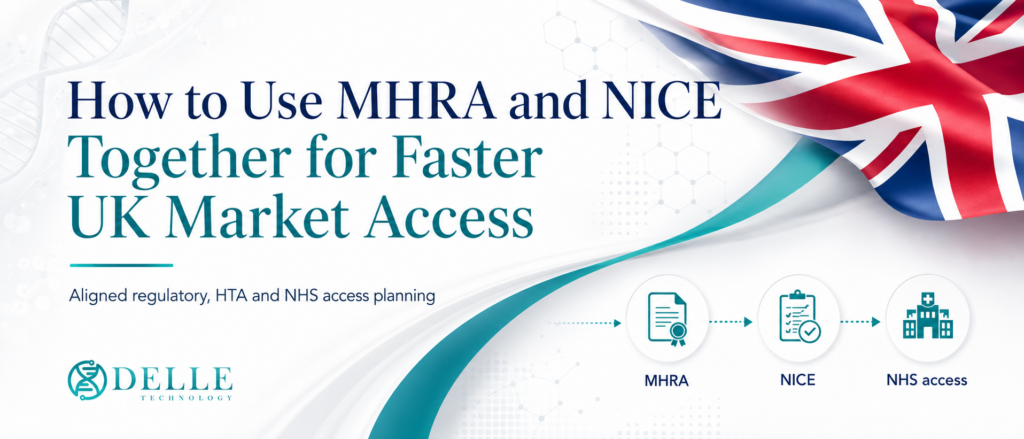
The new UK model’s most important feature is its emphasis on upstream market-access thinking. It requires developers to align regulatory, HTA, and adoption strategies into a cohesive program. This approach does not eliminate uncertainty or guarantee reimbursement. Still, it makes disagreements more visible early, enabling adjustments to trial design, data collection, comparator strategy, and commercial planning before final decisions are made.
For manufacturers, this should change governance. The “regulatory plan” and the “market-access plan” should no longer be separate documents maintained by teams that meet shortly before launch. A better model is a single evidence and access architecture: one target population, explicit comparator logic, a hierarchy of outcomes, a defined RWE role, an HTA-ready economic model, and a dated path through MHRA, NICE and NHS implementation.
The question is no longer simply: “How do we get MHRA approval?” It is: “What evidence programme allows MHRA, NICE and the NHS to make different decisions from the same coherent body of evidence, at the earliest responsible point?”
Current action points for developers (8 August 2026)
If your medicine could use the Aligned Pathway, confirm that the UK PharmaScan record and expected authorisation date are current.
If pivotal trial design is not yet locked, consider Integrated Scientific Advice before endpoints, comparator strategy and evidence collection become fixed.
If the product is earlier-stage and ILAP-eligible, the current Innovation Passport round closes at 17:00 GMT on 4 November 2026.
If launch is within the next 12–18 months, build the NICE submission, economic model, evidence synthesis and NHS implementation plan now rather than after the regulatory dossier is filed.
Conclusion
The MHRA–NICE Aligned Pathway is a structural change in UK medicines market access. Integrated Scientific Advice provides a mechanism to reconcile regulatory and HTA evidence requirements before pivotal development is complete. ILAP can move that alignment even earlier for eligible innovations. Aficamten shows what coordinated licensing and value-assessment decisions can look like in practice.
For companies, the competitive advantage will not come from knowing that these routes exist. It will come from using them early enough to change the evidence programme. The highest-value work is therefore upstream: comparator selection, trial design, endpoint strategy, RWE planning, health-economic evidence and NHS implementation — all built before the market-access clock starts visibly ticking.
Primary sources and scientific references
1. MHRA. Get medicines to NHS patients earlier via the MHRA–NICE aligned pathway.
https://www.gov.uk/government/publications/get-medicines-to-nhs-patients-earlier-via-the-mhra-nice-aligned-pathway/get-medicines-to-nhs-patients-earlier-via-the-mhra-nice-aligned-pathway
2. MHRA/NICE. Medicines: get Integrated Scientific Advice from the MHRA and NICE.
https://www.gov.uk/guidance/medicines-get-integrated-scientific-advice-from-the-mhra-and-nice
3. MHRA. Innovative Licensing and Access Pathway (ILAP): application guidance.
https://www.gov.uk/government/publications/innovative-licensing-and-access-pathway-ilap/ilap-application-guidance
4. MHRA. What’s on offer in the ILAP.
https://www.gov.uk/government/publications/innovative-licensing-and-access-pathway-ilap/whats-on-offer-in-the-ilap
5. MHRA MedRegs. The ILAP and the Aligned Pathway – What’s the difference? 24 June 2026.
https://medregs.blog.gov.uk/2026/06/24/the-ilap-and-the-aligned-pathway-whats-the-difference/
6. MHRA. Innovation Passports awarded for cancer and dementia products; next ILAP round opened 4 August 2026.
https://www.gov.uk/government/news/the-innovative-licensing-and-access-pathway-grants-innovation-passports-to-investigational-products-for-cancer-and-dementia
7. MHRA. Aficamten: coordinated MHRA and NICE decisions, 30 July 2026.
https://www.gov.uk/government/news/thousands-of-patients-to-benefit-from-new-daily-pill-for-serious-heart-condition-following-co-ordinated-mhra-and-nice-decisions
8. NICE. Aficamten for treating symptomatic obstructive hypertrophic cardiomyopathy (TA1181).
https://www.nice.org.uk/guidance/TA1181
9. NICE. TA1181 committee papers.
https://www.nice.org.uk/guidance/ta1181/evidence/committee-papers-pdf-15785174989
10. Maron MS, et al. Aficamten for Symptomatic Obstructive Hypertrophic Cardiomyopathy. N Engl J Med. 2024;390:1849–1861. PubMed.
https://pubmed.ncbi.nlm.nih.gov/38739079/
11. ClinicalTrials.gov. SEQUOIA-HCM, NCT05186818.
https://clinicaltrials.gov/study/NCT05186818
12. NICE. Same-time decisions on licensing and value: what pharmaceutical companies need to know.
https://www.nice.org.uk/news/blogs/same-time-decisions-on-licensing-and-value-what-pharmaceutical-companies-need-to-know
13. NICE. Life sciences: how to get your product to market.
https://www.nice.org.uk/what-nice-does/life-sciences-how-to-get-your-product-to-market
14. UK PharmaScan.
https://www.ukpharmascan.org.uk/
15. UK Government. Life Sciences Sector Plan.
https://www.gov.uk/government/publications/life-sciences-sector-plan/life-sciences-sector-plan
The UK is moving beyond sequential market access. The MHRA–NICE Aligned Pathway can bring regulatory authorisation and NICE guidance together, while Integrated Scientific Advice and ILAP allow companies to align clinical evidence, HTA requirements and NHS access earlier in development. The strategic opportunity is not simply faster review: it is designing one evidence programme that can answer different regulatory, value and implementation questions without waiting until after approval.