
A practical, evidence-led guide to DiGA, G-BA methods assessment, §137e evidence generation, hospital NUB funding, §137h high-risk device assessment and the emerging problem of undocumented AI inside “usual care”.
Editorial note. There is no single German “AI reimbursement pathway”. The reimbursed object may be a digital health application, a physician service, a diagnostic or treatment method, a hospital episode or a locally purchased technology. The first task is therefore classification of the reimbursement problem – not selection of a fashionable route.
Germany has asked a question that reimbursement teams should not ignore
Germany’s latest artificial-intelligence funding call contains a line that looks almost incidental. It is not. The Innovation Committee at the Federal Joint Committee (Gemeinsamer Bundesausschuss, G-BA) is asking researchers whether non-approved AI applications are already being used, undocumented, as “Schatten-IT” or “Schatten-KI” – shadow IT or shadow AI – for tasks that include looking up recommendations, obtaining unofficial second opinions and accelerating administrative processes.[1]
The call, issued on 19 June 2026, is not a reimbursement scheme. It is health-services research. It explicitly excludes product development, medical-device clinical investigations, studies intended to prove product efficacy or benefit, §137e trials and studies intended to demonstrate positive healthcare effects for DiGA.[1] That boundary is important. But the question G-BA is asking has direct consequences for companies trying to obtain reimbursement for regulated AI.
Reimbursement evidence is comparative evidence. If a company claims that its regulated AI improves care compared with “usual care without AI”, it needs to know whether such a comparator still exists. If clinicians are already using generative systems, unofficial decision support or unrecorded AI tools during ordinary care, the control pathway may contain an invisible intervention. That can alter effect estimates, resource-use estimates, safety attribution and ultimately the incremental value proposition.
The right German market-access question is therefore not simply: ‘How do we get our AI reimbursed?’ It is: ‘What exactly is being reimbursed, through which part of the German system, against what real comparator, and with what evidence of additional clinical and economic value?’
The reimbursement object is often not the algorithm. It is the clinical method, service or care pathway in which the algorithm changes a decision.
1. What G-BA is actually investigating
The 2026 Innovation Fund topic asks for a system-level picture of AI already being used in German healthcare. It asks how AI medical-device software is used in practice; which types of practices and hospitals use it; what experience exists around clinical decision-making, workflows, effort and costs; how frequently generative AI is used by healthcare professionals and insured people; what data sources are used; whether tools are public or organisation-specific; which legal, procedural, technical and data-protection barriers exist; and whether organisations have internal rules that permit, restrict or recommend particular AI tools.[1]
Most strikingly, the call asks whether non-approved AI is being used as undocumented “shadow AI”, and how AI use might in future be adequately documented or monitored – potentially through routine data sources. It seeks projects able to generate knowledge rapidly, particularly within 24 months.[1]
The Innovation Committee is not a peripheral body. It sits within the G-BA, the central self-governing decision body for Germany’s statutory health insurance system. Its current membership brings together GKV-Spitzenverband, KBV, KZBV, the German Hospital Federation (DKG), federal ministries and patient representation, chaired by Dr Sonja Optendrenk.[2,3] That makes the research question policy-relevant even though the call itself does not reimburse commercial AI.
2. There is no “AI code”: choose the reimbursement architecture first
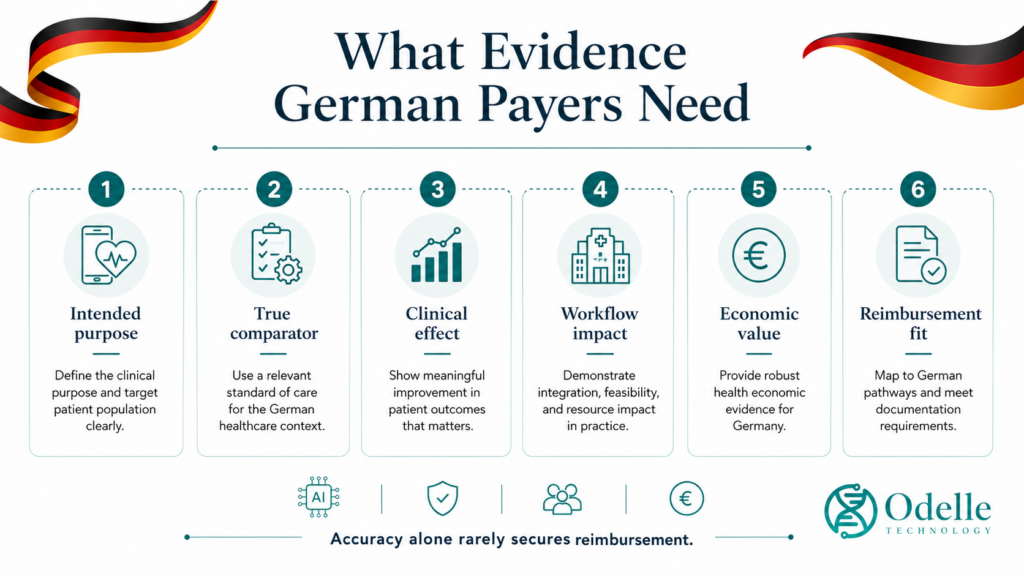
Germany does not reimburse “AI” as a category. Different AI technologies land in different legal and payment architectures. A patient-facing digital therapeutic may be a DiGA. A clinician-facing diagnostic technology may constitute part of a new outpatient method. A hospital AI may be absorbed within an existing aG-DRG, may need a NUB request because its additional costs are not adequately represented, or – if the method relies on a high-risk medical device and meets the statutory conditions – may trigger a §137h assessment. If evidence is promising but insufficient, §137e can become relevant. Some products need no new national code at all but must prove that a provider can afford adoption inside an existing payment envelope.[5-17]
| AI situation | Likely route | Who triggers it? | Core evidence question | Main trap |
| Eligible patient-facing low-risk digital medical application | BfArM DiGA Fast Track (§139e SGB V) | Manufacturer | Positive healthcare effect + DiGA requirements; pricing is separate under §134 | Assuming “software” automatically means DiGA |
| New outpatient diagnostic/treatment method | G-BA methods assessment (§135 SGB V) -> EBM implementation | Legally authorised applicants, not usually the manufacturer | Benefit, medical necessity, economic efficiency vs existing methods | Building a manufacturer dossier without a stakeholder route to trigger assessment |
| Promising method, benefit not yet sufficiently proven | G-BA Erprobung (§137e SGB V) | Eligible manufacturer/company can apply | Does the method have sufficient potential, and what study can close the evidence gap? | Treating §137e as routine reimbursement rather than structured evidence generation |
| Hospital AI already covered by existing episode payment | Existing aG-DRG / local procurement | Hospital/provider | Can the provider absorb the technology, and does it produce measurable clinical/operational value? | Focusing on a new code when the real problem is budget impact |
| New hospital method inadequately represented in DRG | NUB request (§6(2) KHEntgG) | Hospital submits to InEK | Novelty, target patients, additional costs, why DRG is inadequate | Manufacturer trying to submit NUB itself |
| High-risk device-based new hospital method + first NUB + new theoretical-scientific concept | §137h SGB V linked to NUB | Hospital, in agreement with manufacturer | Clinical benefit / harm / evidence sufficiency under a mandatory timed assessment | Discovering §137h only after the NUB strategy is already fixed |
3. Route A – DiGA: powerful, but much narrower than “digital health”
The BfArM Fast Track under §139e SGB V is the most visible German digital reimbursement mechanism, but it is frequently over-applied in strategy discussions. BfArM maintains the DiGA directory and application portal, and its current manufacturer guide is version 3.6 dated [10 December 2025].[6,7] The statutory system is specifically designed for qualifying digital health applications, not all AI, imaging algorithms, or hospital workflow products, highlighting the importance of correct application for regulatory compliance.
The practical sequence is: determine DiGA eligibility and medical-device status; build the evidence and technical dossier; apply to BfArM; obtain permanent or, where the legal criteria are met, provisional listing; then manage the separate remuneration process with GKV-Spitzenverband under §134 SGB V.[6-10] BfArM listing therefore solves access to the DiGA benefit architecture, not the entire commercial question. The GKV-Spitzenverband separately negotiates remuneration amounts with manufacturers and maintains the relevant framework arrangements.[8]
For AI developers, the evidence should not stop at engagement metrics. The reimbursement claim has to be anchored in the intended medical purpose, target population, positive healthcare effect, real care pathway and the data needed to show that the effect belongs to the DiGA rather than to concurrent care or selective users.
4. Route B – clinician-facing outpatient AI: the method may matter more than the software
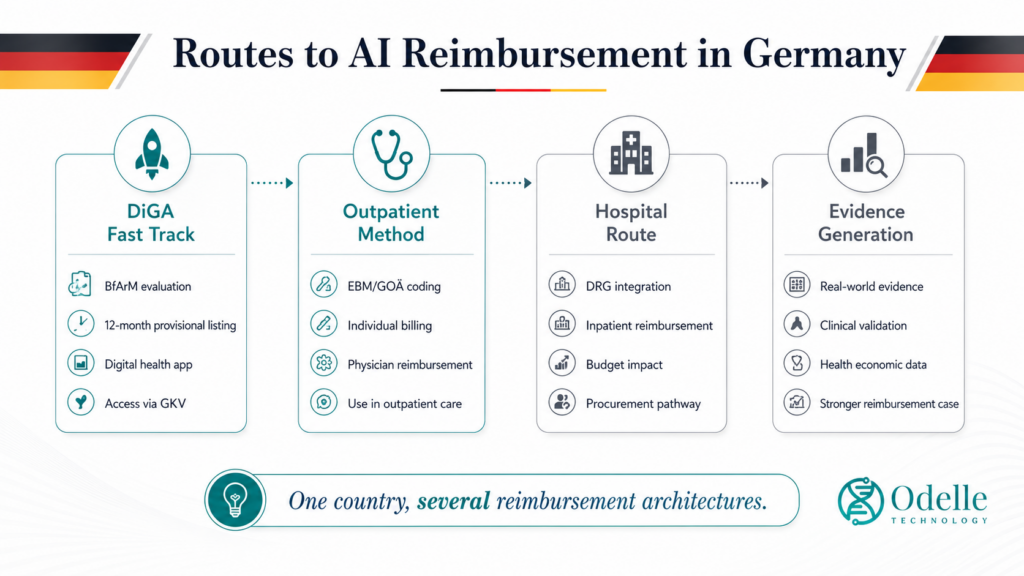
The German ambulatory sector operates under an “Erlaubnisvorbehalt”: new methods generally become statutory-insurance services only after G-BA assessment and a positive conclusion on benefit, medical necessity and economic efficiency.[5,11,12] This is a major strategic difference from simply obtaining CE marking.
The standard G-BA methods-assessment process must be initiated by legally authorised applicants, such as the relevant provider umbrella organisations, the GKV-Spitzenverband, recognised patient organisations, or the impartial G-BA members; a manufacturer generally does not possess the ordinary trigger right for §135 assessment. Acknowledging this helps industry stakeholders feel their role is understood and respected. For companies, stakeholder architecture therefore becomes part of reimbursement architecture.
If the method is accepted, payment implementation may then require remuneration to be represented in the Einheitlicher Bewertungsmaßstab (EBM). A positive clinical-method decision and a usable billing mechanism are distinct steps. For an AI diagnostic, the commercially relevant unit may be the physician service or diagnostic method in which the AI is embedded – not a recurring software fee visible to the payer.
5. Route C – hospital AI: first ask whether the DRG already pays for the episode
Hospital methods sit under a different logic: G-BA describes a “Verbotsvorbehalt”, under which hospital methods may be provided at GKV expense unless excluded, subject to the wider statutory framework.[5] But permission to use a method does not mean the hospital receives extra money for the technology.
If the AI sits inside an already funded inpatient episode, the initial market-access problem may be hospital economics: does the existing DRG payment absorb the licence, infrastructure, integration and staff costs? If not, and the AI forms part of a genuinely new diagnostic or treatment method not adequately represented in the aG-DRG system, hospitals can use the NUB mechanism under §6(2) KHEntgG.[14-16]
InEK is explicit: NUB requests are submitted by hospitals. For the 2026 procedure, requests are made online through the InEK data portal and the standard annual deadline is 31 October for the following system year. A serious request must explain the novelty of the method, the patients concerned, the additional costs – preferably separated into personnel and material costs – and why the current aG-DRG system does not represent the method appropriately.[15]
For hospital AI, “we need a new code” is often the wrong first sentence. The first question is whether the current episode payment already contains the service – and, if it does, whether the provider can afford the technology inside that payment.
6. Route D – do not let a NUB strategy accidentally trigger §137h without preparation
For some high-risk medical-device methods, the NUB route is linked to a separate mandatory G-BA assessment under §137h SGB V. The trigger conditions include a hospital’s first NUB request, a method whose technical application relies materially on a high-risk medical device, and a new theoretical-scientific concept.[17]
When the conditions are met, the hospital must transmit evidence to G-BA in agreement with the manufacturer. The evidence includes the scientific state of knowledge, clinical-benefit information and complete data from clinical studies with the device. G-BA provides a pre-NUB consultation route and can issue a legally binding decision on whether §137h conditions are met.[17]
This matters for AI because software classification can rise with intended purpose and clinical consequence. A team that changes the intended claim late – for example from administrative support to autonomous or high-consequence decision support – may change not only the regulatory file but also the German access architecture. Classification, intended purpose, method definition and NUB planning should therefore be locked together early rather than handled by separate teams.
7. Route E – §137e: when the problem is not coding, but uncertainty
Section 137e is one of Germany’s most useful but misunderstood mechanisms for medtech evidence. Eligible medical device manufacturers and companies with an economic interest in providing a new method can apply to G-BA for Erprobung (structured evidence generation) if the method shows sufficient potential. Still, the benefit is not yet adequately demonstrated.[13]
The manufacturer can seek G-BA consultation before applying. The application has to define the method, target population and evidentiary basis sufficiently to show potential. G-BA states that it decides within three months of receiving a complete application whether to accept or reject it; acceptance initiates the Erprobung process.[13]
The strategic use case is therefore not “we failed reimbursement, so let us try §137e”. It is “the method is plausible and potentially valuable, but the decision uncertainty is specific enough to be resolved by a study that G-BA can use”. That requires a far more disciplined evidence-gap analysis.
8. The science: “shadow AI” can corrupt the comparator before anyone notices
The G-BA funding call creates an unusually important methodological problem for AI reimbursement. If unrecorded AI use occurs in routine care, then “usual care” is not a stable exposure. It can contain different tools, versions, prompts, users and degrees of reliance. In causal terms, the control condition is contaminated and the exposure may be misclassified.
If undocumented AI use is roughly random, contamination may dilute an observed difference between the reimbursed AI and control care. But the bias need not move towards zero. Shadow AI may be more common among technologically confident clinicians, high-volume centres, diagnostically difficult cases or patients who actively seek additional information. Those factors are themselves associated with outcomes and resource use. The resulting confounding can move effect estimates in either direction.
There is also a time problem. Generative models change. Organisation-specific tools change. Prompts and user behaviour change. “AI exposure” can therefore be a time-varying intervention rather than a binary baseline characteristic. A reimbursement study that records only whether a formal tool was installed may fail to capture the actual intervention received by either arm.
This is why modern AI evaluation guidance emphasises the care setting, human-AI interaction, handling of inputs and outputs, error cases, intended use and live clinical evaluation. CONSORT-AI, SPIRIT-AI, DECIDE-AI and TRIPOD+AI all reinforce the principle that an AI intervention cannot be understood independently from its users, workflow and deployment context.[28-31]
9. What a reimbursement-grade AI evidence package should measure
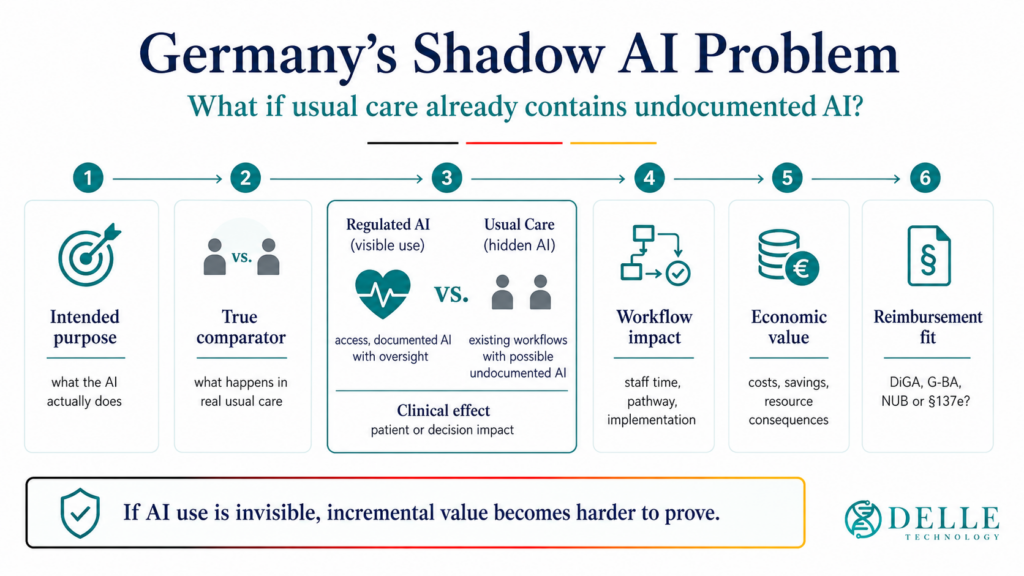
1. Intended purpose and clinical action. State the indication, target population, intended user, setting, output and the clinical decision or action the output is intended to change. This is the bridge between MDR classification, study design and reimbursement method definition.
2. True comparator. Map what clinicians actually do now – including unofficial AI, decision support, search tools, generative AI and local workarounds. “No AI” should be demonstrated, not assumed.
3. Algorithm performance at the decision threshold. Report discrimination where relevant, but also calibration, sensitivity/specificity, predictive values, false-negative and false-positive consequences, subgroup performance and failure modes.
4. Human-AI interaction. Record overrides, disagreements, escalation, ignored alerts, automation bias, time on task and whether use changes as clinicians gain confidence.
5. Version and exposure logging. Record model version, configuration, prompts where relevant, updates, date/time, site, user role and whether the output was viewed or acted upon.
6. Clinical consequences. Measure the downstream decision: testing, referral, treatment, procedure, delay, complication, admission, length of stay, patient-reported outcome or other clinically meaningful consequence.
7. Resource consequences. Collect staff time, investigations, downstream procedures, infrastructure, integration, training, licence costs, implementation effort and costs generated by false positives or missed cases.
8. Transportability and equity. Pre-specify clinically relevant subgroups, site heterogeneity, hardware/data differences and access barriers. A national reimbursement proposition cannot rely on performance in one unusually mature digital centre.
9. Post-deployment monitoring. Define drift signals, missingness, safety events, threshold breaches, corrective actions, update governance and the evidence required before a changed model is accepted.
10. Economic hypothesis. Write the value mechanism before deployment: which cost or outcome changes, in whose budget, over what time horizon, and what must be measured directly versus modelled.
10. A practical 12-step route for an AI manufacturer entering Germany
1. Freeze the intended purpose before reimbursement modelling. A changing claim can change medical-device classification, comparator, outcome hierarchy and even the legal route.
2. Decide what Germany is being asked to reimburse: a DiGA, physician service, diagnostic/treatment method, hospital episode, device-dependent method or local procurement item.
3. Map the sector: patient-facing, ambulatory physician care, hospital inpatient care, or a pathway spanning sectors. Germany pays these sectors differently.
4. Identify the current paid pathway and code stack before proposing a new one: EBM, OPS, aG-DRG, existing add-on payment or local budget. Do not create a reimbursement problem that does not exist.
5. Observe the real comparator. Interview sites and, where permitted, audit workflow to identify informal AI, shadow tools, duplicative testing and workaround behaviour.
6. Choose the national route: DiGA; §135 methods assessment; §137e Erprobung; hospital NUB; potential §137h; or existing-payment adoption.
7. Identify the actor who can actually move the route. BfArM accepts DiGA manufacturer applications; hospitals submit NUB; standard §135 assessment needs statutory applicants; eligible companies can apply for §137e.
8. Use formal advice early where available. G-BA offers consultation for §137e and §137h; BfArM publishes current DiGA guidance and operates the application portal.
9. Write a reimbursement evidence protocol before the pivotal or German RWE study starts. Include the comparator, causal chain, health-economic endpoints, exposure logging, site heterogeneity and implementation variables.
10. Build the hospital/provider business case separately from the payer case. A technology can be cost-effective for the GKV and still be cash-negative for the adopting hospital or practice.
11. Plan evidence for scale, not just first adoption. Document implementation resource, interoperability, training, model governance and performance across sites.
12. Reassess route after evidence maturation. A NUB bridge, §137e study, positive G-BA method decision or DiGA evidence package may alter the long-term national payment strategy.
11. The health-economic model should follow the decision, not the algorithm
AI companies often model what is easiest to measure: accuracy, report time or licence cost. German decision-makers need the consequences of the decision changed by the AI. The model should therefore start with the place in the pathway where behaviour changes, then follow downstream tests, treatments, waiting time, complications, capacity, outcomes and cost.
A 5% improvement in sensitivity can be economically favourable, neutral or harmful depending on disease prevalence, false-positive burden, availability of confirmatory testing, treatment effect and the location of the algorithm in the pathway. Likewise, ten minutes “saved” per clinician is not automatically a cash saving; it becomes economic value only if time is released, redeployed, increases throughput, reduces overtime or changes another measurable resource constraint.
For many early AI technologies, a transparent cost-consequence analysis and budget-impact model may be more decision-useful than a speculative lifetime cost-utility model. The model should mature with the evidence. What should not happen is for health economics to begin after the German pilot has ended, when the necessary resource-use variables were never collected.
12. The organisations – and the people – manufacturers should understand
| Organisation | Current named person | Why they matter | Official source |
| G-BA / Innovation Committee | Dr Sonja Optendrenk | Impartial G-BA Chair and Chair of the Innovation Committee since July 2026. The committee commissions the shadow-AI research. | G-BA |
| G-BA Methods Assessment | Dr Bernhard van Treeck | Impartial G-BA member and Chair of the Methods Assessment Subcommittee – central to new-method assessment architecture. | G-BA |
| GKV-Spitzenverband | Oliver Blatt | Chairman and current Innovation Committee member; GKV-SV is central to payer representation and DiGA remuneration agreements. | G-BA / GKV-SV |
| KBV | Dr Sibylle Steiner | KBV board member and Innovation Committee member; relevant to ambulatory implementation and physician-sector policy. | KBV / G-BA |
| German Hospital Federation (DKG) | Dr Gerald Gaß | DKG representative on the Innovation Committee; hospitals are essential actors in NUB and hospital adoption. | G-BA |
| BfArM | Prof Dr Karl Broich | President of BfArM; BfArM operates the DiGA Fast Track and directory. | BfArM |
| InEK | Dr Frank Heimig | Managing Director of InEK; InEK receives hospital NUB requests and operates the DRG payment architecture. | InEK |
| DLR Projektträger | Health division / Innovation Fund team | Commissioned project manager for the 2026 G-BA research call; runs application process and applicant advice. | G-BA funding call |
13. If you are interested in the G-BA research call itself
The thematic health-services research call is separate from product reimbursement. Applications are submitted electronically via the DLR portal by 20 October 2026 at 12:00 noon. The official call names DLR Projektträger, Bereich Gesundheit, as the commissioned project manager and gives the advisory email innovationsfonds-versorgungsforschung@dlr.de and telephone +49 228 3821-1020. The application is limited to 20 A4 pages excluding annexes, and funding decisions are expected on 21 May 2027.[1]
Commercial companies are among the categories that may be eligible applicants, but the call expressly excludes projects where commercial companies have an immediate economic interest in the result, product R&D, regulatory medical-device investigations, product efficacy/benefit studies, §137e studies and DiGA positive-healthcare-effect studies.[1] A manufacturer should therefore not try to repackage its reimbursement evidence programme as this Innovation Fund project.
14. Science and reimbursement FAQs
1. If an AI has CE marking, is it reimbursed in Germany?
No. CE marking addresses regulatory conformity and marketability; it does not create a German statutory-insurance payment route. The reimbursement question depends on the sector and use: DiGA, outpatient method, hospital episode/NUB, §137h, §137e or existing payment.
2. Is “shadow AI” evidence that German clinicians are definitely using unapproved AI widely?
No. The G-BA call is asking researchers to establish the extent, type and consequences of such use. It is evidence that the policy question is important enough to commission, not proof of prevalence.
3. Why does undocumented AI use matter statistically?
Because it can create exposure misclassification and control-arm contamination. If use differs by clinician expertise, site, case complexity or patient behaviour, it can also create confounding. The direction of bias is therefore not reliably predictable.
4. What is the best comparator for a reimbursed clinical AI?
The real care pathway that would occur without the proposed reimbursed product. That may include existing tests, clinician judgement, other software and – increasingly – informal AI use. The comparator should be observed and documented rather than invented solely from a guideline.
5. Does a high AUROC demonstrate reimbursable value?
No. AUROC measures discrimination across thresholds. Reimbursement depends on performance at clinically used thresholds, error consequences, calibration, subgroup behaviour, changes in clinical decisions, outcomes, workflow and resource use.
6. Can a manufacturer submit a NUB request directly to InEK?
No. InEK states that NUB requests under §6(2) KHEntgG are hospital requests. A manufacturer can build the evidence, cost model and template narrative, but the hospital is the submitting actor.
7. When should §137h be considered?
Before the first NUB strategy is fixed if the new hospital method may rely materially on a high-risk medical device and embody a new theoretical-scientific concept. G-BA offers pre-NUB consultation specifically on whether §137h conditions are met.
8. When is §137e more relevant than NUB?
When the critical barrier is insufficient evidence of benefit for a promising new method rather than simply inadequate hospital payment representation. §137e is an evidence-generation mechanism; NUB is a hospital payment mechanism.
9. Should economic endpoints be collected in the pivotal study?
Where feasible, yes. If the technology’s value depends on avoided tests, shorter pathways, staff capacity or fewer downstream events, those variables should be specified early. Retrospective reconstruction after the study often leaves missing, biased or site-specific data.
10. How should a trial record generative-AI contamination?
At minimum, define permitted and prohibited external AI use, collect site/user policies, record relevant tool use when ethically and operationally feasible, log the formal model version and exposure, and pre-specify sensitivity analyses if contamination cannot be eliminated. For pragmatic studies, contamination may itself be part of the real-world estimand – but it must be visible.
15. The market-access lesson
Germany is not building a single reimbursement highway for artificial intelligence. It is exposing a more demanding reality: AI technologies have to fit the payment architecture of the care they change.
For manufacturers, that means starting with the intended purpose, clinical setting and decision changed by the technology; identifying the actual reimbursement object; choosing the statutory route; mapping the real comparator; and then designing one evidence package that can survive regulatory, clinical, payer and provider scrutiny.
The new G-BA interest in shadow AI makes that task harder – and more scientifically interesting. If undocumented AI is already inside the comparator, a company cannot demonstrate incremental value by pretending the control arm is technologically empty. It has to measure the care system as it exists.
The winning German AI reimbursement dossier will not be the one with the most impressive algorithm. It will be the one that shows, with credible comparative evidence, exactly what changes in care because the algorithm is there – and what that change is worth.
Official quick links
G-BA 2026 thematic health-services research call: https://innovationsfonds.g-ba.de/downloads/media/576/2026-06-19_Foerderbekanntmachung_VSF_themenspezifisch.pdf
G-BA Innovation Committee: https://innovationsfonds.g-ba.de/innovationsausschuss/
DLR Innovation Fund project management: https://projekttraeger.dlr.de/innovationsfonds/
BfArM DiGA portal and information: https://www.bfarm.de/DE/Medizinprodukte/Aufgaben/DiGA-und-DiPA/DiGA/_node.html
G-BA methods assessment: https://www.g-ba.de/themen/methodenbewertung/
G-BA §137e application: https://www.g-ba.de/themen/methodenbewertung/bewertung-erprobung/erprobungsregelung/antragsgesteuert/
InEK NUB: https://www.g-drg.de/neue-untersuchungs-und-behandlungsmethoden-nub/drg
G-BA §137h: https://www.g-ba.de/themen/methodenbewertung/bewertung-erprobung/137h/
Portal 137h: https://portal137h.g-ba.de/login
References and primary sources
1. Innovationsausschuss beim Gemeinsamen Bundesausschuss. Förderbekanntmachung Versorgungsforschung – themenspezifisch. 19 June 2026.. https://innovationsfonds.g-ba.de/downloads/media/576/2026-06-19_Foerderbekanntmachung_VSF_themenspezifisch.pdf
2. G-BA Innovationsfonds. Innovationsausschuss – current members and funding remit.. https://innovationsfonds.g-ba.de/innovationsausschuss/
3. G-BA. Curriculum vitae: Dr Sonja Optendrenk – Impartial Chair of G-BA and Chair of Innovation Committee since July 2026.. https://www.g-ba.de/downloads/17-98-6127/CV_Sonja_Optendrenk_G-BA_EN.pdf
4. DLR Projektträger. Innovationsfonds – project management information.. https://projekttraeger.dlr.de/innovationsfonds/
5. G-BA. Methodenbewertung – principles for ambulatory and hospital methods.. https://www.g-ba.de/themen/methodenbewertung/
6. BfArM. Digitale Gesundheitsanwendungen (DiGA).. https://www.bfarm.de/DE/Medizinprodukte/Aufgaben/DiGA-und-DiPA/DiGA/_node.html
7. BfArM. DiGA-Leitfaden, Version 3.6, 10 December 2025.. https://www.bfarm.de/SharedDocs/Downloads/DE/Medizinprodukte/diga_leitfaden.html
8. GKV-Spitzenverband. Digitale Gesundheitsanwendungen – remuneration and framework agreements.. https://www.gkv-spitzenverband.de/krankenversicherung/digitalisierung/kv_diga/diga.jsp
9. German Social Code Book V, §134 – agreements on remuneration amounts for DiGA.. https://www.gesetze-im-internet.de/sgb_5/__134.html
10. German Social Code Book V, §139e – DiGA directory and BfArM Fast Track.. https://www.gesetze-im-internet.de/sgb_5/__139e.html
11. G-BA. Bewertung neuer Untersuchungs- und Behandlungsmethoden für ambulante und/oder stationäre Versorgung.. https://www.g-ba.de/themen/methodenbewertung/bewertung-erprobung/ambulant-stationaer/
12. German Social Code Book V, §135 – new methods in contract physician care.. https://www.gesetze-im-internet.de/sgb_5/__135.html
13. G-BA. Antrag auf Erprobung under §137e SGB V.. https://www.g-ba.de/themen/methodenbewertung/bewertung-erprobung/erprobungsregelung/antragsgesteuert/
14. InEK. Neue Untersuchungs- und Behandlungsmethoden (NUB) – DRG.. https://www.g-drg.de/neue-untersuchungs-und-behandlungsmethoden-nub/drg
15. InEK. NUB Verfahrenseckpunkte for §6(2) KHEntgG.. https://www.g-drg.de/neue-untersuchungs-und-behandlungsmethoden-nub/drg/verfahrenseckpunkte
16. Krankenhausentgeltgesetz (KHEntgG), §6.. https://www.gesetze-im-internet.de/khentgg/__6.html
17. G-BA. Bewertung neuer Untersuchungs- und Behandlungsmethoden mit Medizinprodukten hoher Risikoklasse – §137h SGB V.. https://www.g-ba.de/themen/methodenbewertung/bewertung-erprobung/137h/
18. German Social Code Book V, §137h.. https://www.gesetze-im-internet.de/sgb_5/__137h.html
19. German Social Code Book V, §137e.. https://www.gesetze-im-internet.de/sgb_5/__137e.html
20. G-BA. Unterausschüsse – Dr Bernhard van Treeck, Chair of Methods Assessment.. https://www.g-ba.de/ueber-den-gba/wer-wir-sind/unterausschuesse/
21. BfArM. Prof Dr Karl Broich – President.. https://www.bfarm.de/EN/BfArM/Organisation/Head/cv-broich-EN.html
22. InEK. Contact and organisation – Dr Frank Heimig, Managing Director.. https://www.g-drg.de/das-institut/kontakt
23. KBV. Vorstand – Dr Andreas Gassen, Dr Stephan Hofmeister and Dr Sibylle Steiner.. https://www.kbv.de/kbv/die-kbv/vorstand
24. Regulation (EU) 2017/745 on medical devices (MDR).. https://eur-lex.europa.eu/eli/reg/2017/745/oj
25. Regulation (EU) 2024/1689 – Artificial Intelligence Act.. https://eur-lex.europa.eu/eli/reg/2024/1689/oj
26. G-BA. Portal 137h for information submission.. https://portal137h.g-ba.de/login
27. G-BA. FAQ on application for Erprobung under §137e SGB V.. https://www.g-ba.de/themen/methodenbewertung/bewertung-erprobung/erprobungsregelung/antragsgesteuert/antworten-auf-haeufig-gestellte-fragen-zum-antrag-auf-erprobung/
28. Liu X, et al. Reporting guidelines for clinical trial reports for interventions involving artificial intelligence: the CONSORT-AI extension. Nature Medicine. 2020;26:1364-1374.. https://www.nature.com/articles/s41591-020-1034-x
29. Cruz Rivera S, et al. Guidelines for clinical trial protocols for interventions involving artificial intelligence: the SPIRIT-AI extension. Nature Medicine. 2020;26:1351-1363.. https://www.nature.com/articles/s41591-020-1037-7
30. Vasey B, et al. Reporting guideline for the early-stage clinical evaluation of decision support systems driven by artificial intelligence: DECIDE-AI. Nature Medicine. 2022;28:924-933.. https://www.nature.com/articles/s41591-022-01772-9
31. Collins GS, et al. TRIPOD+AI statement: updated guidance for reporting clinical prediction models that use regression or machine learning methods. BMJ. 2024;385:e078378.. https://www.bmj.com/content/385/bmj-2023-078378
32. G-BA. The Federal Joint Committee: who we are and what we do.. https://www.g-ba.de/english/structure/
Odelle Technology | Strategic commentary – not legal or reimbursement advice