How London Region I, AI Airlock, real-world evidence and NICE evidence standards are beginning to connect AI regulation with credible NHS adoption.
London Region I is a regulatory sandbox and evidence-generation programme; it is not itself a reimbursement guarantee. The market-access interpretation below is based on the programme’s stated aim of supporting wider adoption, NHS England’s real-world evaluation framework, NICE evidence standards and the wider UK RWE policy direction.
The regulatory sandbox is becoming an evidence pathway
There is a familiar problem in healthcare innovation. A technology can work, satisfy its regulator, impress clinicians – and still fail to become routine care.
For artificial intelligence, the gap can be unusually wide. An algorithm developed on carefully curated data may perform convincingly in validation studies, yet the NHS has to answer a different set of questions before it can use that technology at scale. Will performance remain stable when the patient population changes? Will it behave consistently across hospitals, scanners and workflows? What happens when clinicians disagree with it – or begin to trust it too readily? Does it improve outcomes, release capacity or merely move work elsewhere? And what does it cost once all downstream consequences are counted?
These are partly regulatory questions. They are also clinical, implementation, economic and market-access questions.
The significance of the UK’s latest regulatory experiment is that these questions are beginning to meet in the same place.
On 30 July 2026, the Medicines and Healthcare products Regulatory Agency (MHRA) opened expressions of interest for London Region I, a regulatory sandbox run in partnership with NHS England London and the London Health Innovation Networks. The programme will place selected AI-enabled medical devices into real-world London NHS settings under MHRA oversight. Up to 10 manufacturers will be selected in the initial phase.[1]
The most important sentence in the official announcement is not the word ‘AI’. It is the stated ambition to generate robust real-world evidence on safety and effectiveness while supporting a clearer, more predictable route to wider adoption.[2]
For a manufacturer, that changes the strategic question. The old question was: ‘What evidence do we need to get the device regulated?’ The more useful question is: ‘What evidence programme can support regulatory confidence, clinical adoption, NHS implementation and an eventual value proposition without forcing us to start again after the regulatory milestone?’
The opportunity is not simply to obtain a London pilot. It is to design a London evaluation that answers the questions the next NHS organisation, NICE, a commissioner and a procurement team will ask.
What London Region I actually does
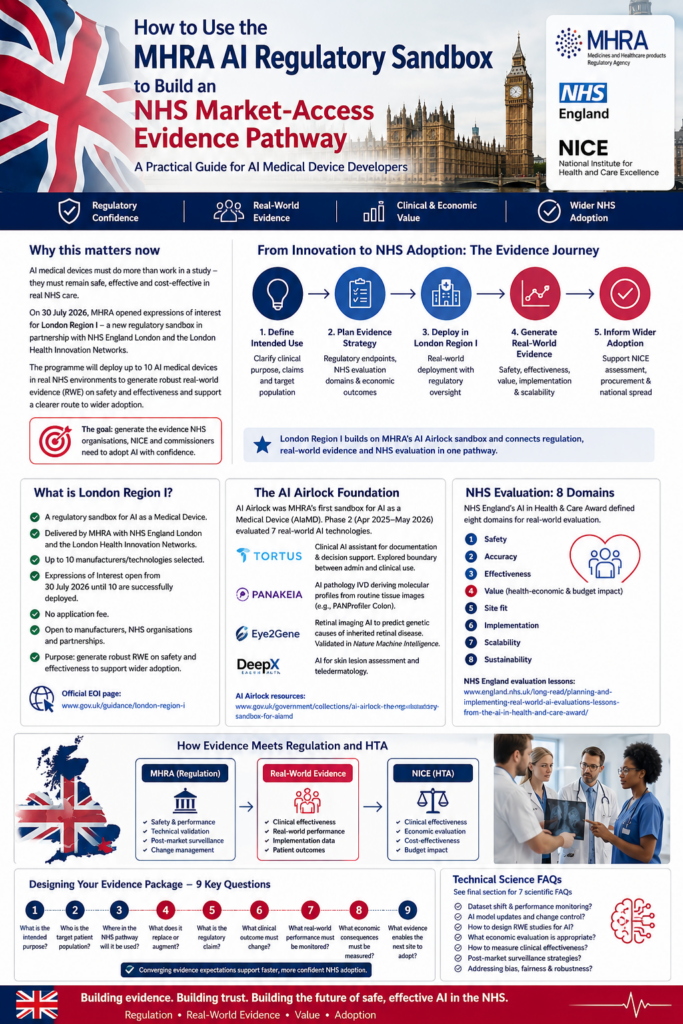
London Region I is not a conventional accelerator or a grant competition. It is a controlled regulatory environment intended to support real-world deployment of AI-enabled medical devices while additional evidence is generated.[1]
The current call is particularly interested in technologies that support preventative and proactive care – especially heart health – neighbourhood and community-based services, increased digital access including use of the NHS App, and other innovations that could improve patient outcomes and healthcare delivery in London. The priorities are not absolute restrictions.[1]
Manufacturers may apply alone, NHS providers in Greater London may apply, and provider-manufacturer partnerships can apply together. There is no application fee, although applicants are responsible for their own costs. The call remains open until 10 devices have been successfully selected, assessed and deployed.[1]
The programme also sits inside a larger London innovation strategy. NHS England London describes an Innovator Passport approach that considers regulatory status, quality management, data protection, NHS clinical-risk and cyber standards, and clinical and economic evidence that could satisfy NICE/MHRA expectations – including clinical investigations, real-world evidence and health-economic models.[3]
Who can apply – the manufacturer criteria matter
The published manufacturer Expression of Interest form reveals much more than the press release. To be considered, a manufacturer must have an AI-enabled product that is a medical device under the UK Medical Devices Regulations 2002, and the device must not already be marketed in the UK for the intended purpose proposed for the programme. The manufacturer must be a legal entity with the right to market the device in the UK, must not be based in a UK-sanctioned jurisdiction, and must commit to working with the London Region I team and partners to assess the programme.[4]
| Manufacturer requirement | What it means |
| Regulatory status | AI-enabled medical device under UK MDR 2002; not already marketed in the UK for the proposed intended purpose. |
| Legal standing | Legal entity with rights to market the medical device in the UK. |
| Sanctions | Not headquartered or operating from jurisdictions subject to relevant UK Government sanctions. |
| Collaboration | Commitment to work with London Region I and programme partners to assess the programme. |
| Application route | Manufacturer, NHS provider, dual-role organisation, or a pre-formed provider-manufacturer partnership. |
| Cost | No application fee; the applicant bears its own application and programme-related costs. |
What MHRA asks you to know before you apply
The EOI form is revealing because it asks manufacturers to define the intended purpose in clinical rather than promotional language. Applicants are asked to describe the structure and function, clinical indication and disease stage, patient population – including special populations and health-equity issues – intended user, intended environment, and the current standard of care.[4]
They must also propose the device classification and justify it; explain any previously marketed intended purpose; state whether they already market medical devices in the UK and provide registration details; and state whether a quality management system is in place, including an ISO standard and certificate number where relevant.[4]
Finally, the manufacturer must confirm that it understands it may be asked to supply information showing the device meets the conditions necessary for consideration for exceptional use authorisation. Exceptional use authorisation is a specific UK mechanism that can permit use of a non-compliant medical device in the interests of health protection; it should not be confused with general UK market authorisation.[5]
That list tells manufacturers how to prepare. If the intended purpose, classification rationale, target population, user, deployment environment and standard of care are still vague, the company is not merely missing paperwork – it is missing the skeleton of its regulatory and market-access evidence strategy.
How to access London Region I now
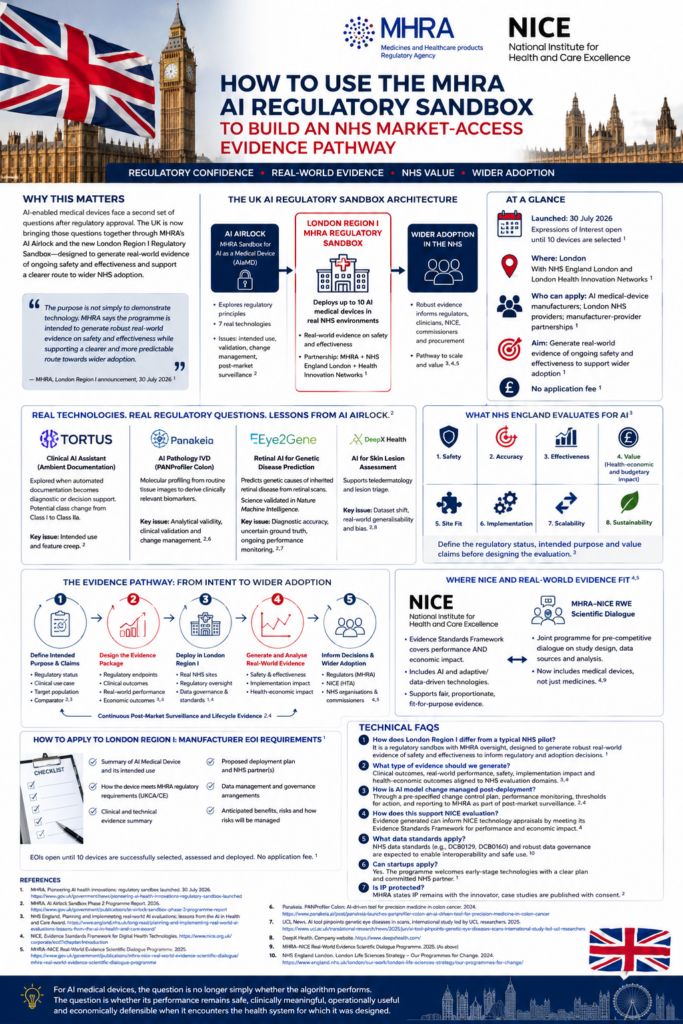
1. Confirm that the product fits the programme. Establish that the product is an AI-enabled medical device, that the proposed UK intended purpose is not already marketed in the UK, and that the legal manufacturer can meet the EOI conditions.[1,4]
2. Freeze the clinical intended-purpose statement before writing marketing claims. Define indication, patient population, user, environment, current standard of care and the clinical action the output is intended to influence. MHRA has separate guidance on crafting intended purpose for software as a medical device.[6]
3. Decide whether to approach as a manufacturer alone or with an NHS provider. A pre-formed provider-manufacturer partnership is expressly permitted. Strategically, a credible NHS site with a real service problem can make the proposed evaluation more clinically meaningful.[1,4]
4. Map the evidence you already have against the evidence the NHS will need. Separate technical validation from clinical performance, workflow impact, safety, equity, implementation and economic evidence. Do not assume a high accuracy metric answers the NHS adoption question.
5. Complete the manufacturer EOI form. The form asks about the challenge addressed, organisation, existing devices, QMS, intended purpose, classification rationale, previous intended purpose and preparedness for exceptional-use considerations.[4]
6. Submit the EOI to MHRA. Completed forms are submitted to LondonRegion-i@mhra.gov.uk. There is no application fee.[1]
7. Treat selection as the start of an evidence programme, not the prize. The value of the sandbox will depend on whether deployment answers questions that can travel beyond the first NHS site.
Why AI needs a different evidence model
London Region I builds on the MHRA AI Airlock – the regulator’s first sandbox for AI as a Medical Device. Phase 2 worked with seven technologies across three challenge areas: extension of intended use and validation, AI-powered in-vitro diagnostics, and post-market surveillance with predetermined change control plans.[7,8]
The Airlock model is useful because it separates different evidence environments. Phase 2 used simulation workshops, virtual or research environments, and real-world environments. In the Airlock definition, the real-world environment could observe deployment in the intended setting while remaining separate from clinical decision-making so evidence could be generated without affecting healthcare outcomes.[8] London Region I pushes the concept further towards live NHS deployment under MHRA oversight.[2]
The scientific problem is that an AI device is not necessarily a stable object. Its input data can change. The prevalence of disease can change. Scanners, laboratories and coding practices can differ between sites. Users can change how they respond to the output. Model updates can alter performance. For adaptive or frequently updated systems, the evidence package therefore has to describe not just how the model performed at one point in time, but how performance will be monitored and controlled over the lifecycle.[7,9]
Three Airlock cases explain the problem better than theory
TORTUS – when documentation begins to influence clinical decisions. TORTUS is an evolving clinical AI assistant integrated with electronic health records. MHRA’s Phase 2 cohort identifies a central boundary problem: functionality may move from documentation support into diagnostic or decision-support use, potentially changing classification. The programme therefore examined verification, validation and post-market surveillance for LLM-enabled functionality operating at a higher regulatory threshold.[8]
Panakeia – when the reference standard and laboratory environment vary. PANProfiler Colorectal uses AI on routine pathology slides to determine MSI/MMR status. The Airlock material notes that hospital laboratory methods vary, tumour biology can vary and definitions of positive and negative results are not perfectly standardised. The technology had been validated on more than 4,700 UK colorectal cancer samples in the cohort description, but the remaining regulatory challenge is not simply aggregate accuracy; it is how to establish robust performance across heterogeneous real clinical systems.[8] A peer-reviewed multi-centre blinded evaluation has since been published in npj Digital Medicine.[21]
Eye2Gene – when post-market surveillance has to detect biology, equipment and population change. Eye2Gene uses retinal imaging to support genetic diagnosis of inherited retinal disease. The Airlock cohort states that post-market surveillance must consider bias and data drift arising from variation in retinal imaging technology, image quality, population differences and new genetic discoveries, with infrastructure for automated logging, outcome capture and clinician feedback. It also highlights predetermined change control plans as a way to define allowable updates and validation requirements.[8] The underlying Eye2Gene model has also been externally evaluated in Nature Machine Intelligence.[20]
The NHS already knows that accuracy is not enough
The strongest practical bridge from regulatory science to market access comes from NHS England’s evaluation of the AI in Health and Care Award. The programme’s Phase 4 technologies were independently evaluated with the intention of informing NICE, the UK National Screening Committee and local and national commissioning decisions.[10]
NHS England’s framework used eight domains: safety, accuracy, effectiveness, value, fit with sites, implementation, feasibility of scale-up and sustainability. ‘Value’ explicitly included health-economic and budgetary impact. Sustainability included pricing, customer feedback and ongoing model training.[10]
This is the crucial point for companies entering a regulatory sandbox. A technically excellent model can still fail if it adds a task elsewhere in the pathway, creates unmanageable false-positive demand, depends on infrastructure that is absent at other sites, or produces a benefit that cannot be converted into a measurable outcome or resource consequence.
The NHS report also contains a warning from earlier evaluations: independent evaluators sometimes arrived after deployment plans had already been fixed. That constrained site selection, randomisation and data collection. In other words, evaluation design was weakened because the commercial deployment plan came first.[10]
For AI market access, the evaluation protocol should be designed before the pilot geography is fixed – not after the first hospital has already agreed to deploy.
Where NICE enters the evidence story
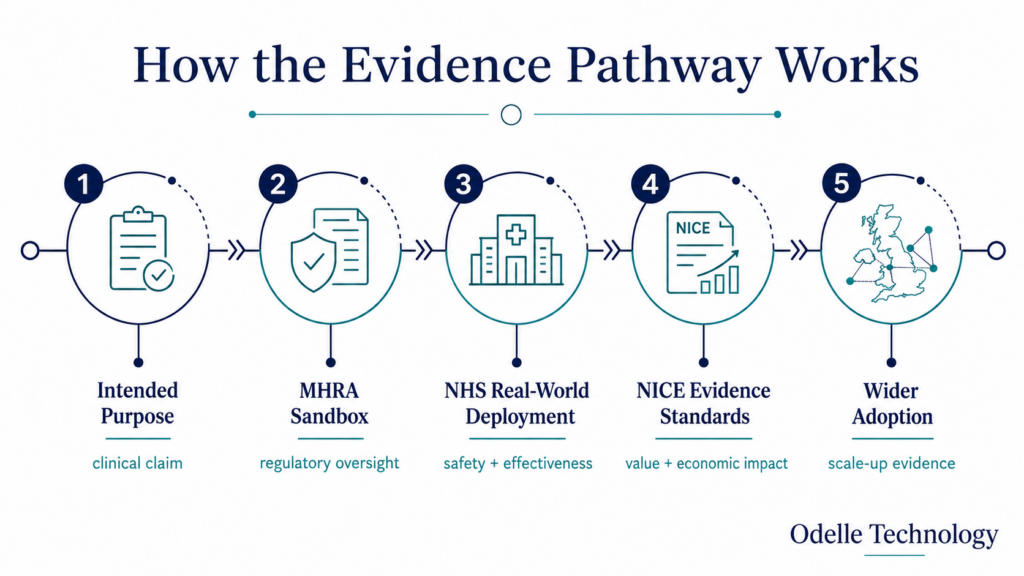
NICE’s Evidence Standards Framework for digital health technologies is a guideline, not an approval mechanism, but it provides a clear outline of what constitutes a credible evidence package. NICE describes the framework as covering evidence of performance relevant to the technology’s purpose and evidence of economic impact relative to financial risk; it also includes design and deployment considerations and specifically accommodates AI and data-driven technologies.[11,12]
That matters because the regulatory and reimbursement questions are related but not identical. Regulation may ask whether the device is acceptably safe and performs as intended. Market access asks what changes in the health system because the device is used – and whether the change is worth paying for.
For an AI diagnostic or triage tool, the market-access chain may run from analytical or clinical performance to a different clinical decision, then to a downstream change in testing, treatment, waiting time, complications, staff time or patient outcomes. If that causal chain is not specified before data collection starts, a company can emerge from a successful pilot with abundant usage statistics but very little evidence of value.
How to design the evidence package before applying
A serious London Region I application should begin with an evidence map rather than a product brochure. The following questions create a practical bridge between the MHRA EOI form, NHS real-world evaluation and future HTA or commissioning needs.
1. What exactly is the intended purpose? Write the clinical indication, target population, user, setting and action supported by the output. Avoid language broad enough to create unplanned scope expansion.
2. What is the decision the AI changes? A prediction that does not change a decision may have little clinical or economic value. Identify the clinician or patient action that is expected to differ.
3. What is the actual NHS comparator? For an augmentative technology, the comparator is often the existing pathway without the AI – not simply another algorithm. Describe current tests, staff, waiting time and downstream consequences.
4. Which performance metric is clinically consequential? Sensitivity, specificity, AUROC, calibration and error rates answer different questions. Pre-specify thresholds that connect to the clinical action and harm profile.
5. Which subgroups could fail differently? Plan analyses by relevant demographics, disease prevalence, site, hardware, image quality or other sources of heterogeneity. Equity should be a performance question, not an appendix.
6. What will be monitored after deployment? Define data drift, performance signals, safety events, user overrides, missingness, update history and feedback loops. Decide what triggers investigation, recalibration or suspension.
7. What resource consequences will be measured? Capture staff time, tests, referrals, treatment delays, admissions, length of stay, avoided activity and any new implementation burden.
8. What is the economic hypothesis? State how the AI creates value: fewer unnecessary referrals, earlier treatment, capacity release, reduced adverse events, shorter pathways, or a better outcome. Then collect the inputs needed to test that hypothesis.
9. What would make another NHS site say yes? Design for transportability. Record site characteristics, workflow variation, implementation resource and technical dependencies so the first evaluation can be interpreted elsewhere.
A second route: the MHRA-NICE Real-World Evidence Scientific Dialogue
London Region I is not the only sign that UK regulatory and HTA evidence expectations are converging. The MHRA-NICE Real-World Evidence Scientific Dialogue now accepts submissions on medical devices. It uses precompetitive ‘safe harbour’ workshops to explore study design, data sources and analytical methods for high-quality RWE. Its stated aim includes promoting consistency between regulatory and HTA expectations.[13]
For the current cycle, expressions of interest are open until 11.59pm BST on 17 August 2026, with up to two applications selected per submission cycle. Workshops are jointly convened by MHRA and NICE, with Approved Body representation where relevant, and MHRA charges no workshop fee.[13,14]
There is, however, an important boundary: proposals are excluded if the product is already in an MHRA pathway or regulatory programme such as ILAP, IDAP or AI Airlock, or if it is undergoing a live UK regulatory/HTA procedure. This is not, therefore, an extra advisory layer to bolt onto an active Airlock product; it is a separate route for cross-cutting RWE questions.[13,14]
The direction of travel is nevertheless clear. The UK’s regulatory, RWE and HTA institutions are increasingly trying to solve evidence problems earlier rather than letting manufacturers discover after launch that the data they collected answers the wrong decision-maker’s question.
The health-economic question: what changes because the AI is there?
AI companies often report model performance because it is measurable. Health systems pay for consequences.
A five-point improvement in sensitivity may be important, irrelevant, or even harmful, depending on disease prevalence, false-positive consequences, treatment availability, and where the algorithm sits in the pathway. A reduction in documentation time is valuable only if the saved time is genuinely released, redeployed or translated into measurable capacity. Faster diagnostic classification matters economically if it changes testing, treatment, waiting time, outcomes or resource use.
The economic model should therefore be built from the clinical pathway backwards. Start with the decision changed by the AI. Map the next events. Assign resource use and outcomes to those events. Identify which parameters are measured directly in the sandbox and which require external evidence. Then test whether the conclusion survives plausible site-to-site variation.
For many AI technologies, the most credible early model may be a cost-consequence or budget-impact analysis rather than an elaborate lifetime cost-utility model. The correct method depends on the maturity of the clinical evidence and the decision the NHS is being asked to make. What matters is that economic data collection begins at the same time as the clinical evaluation, not six months after it ends.
The people and organisations to watch
The programme has unusually senior sponsorship. Dame Caroline Clarke, Director of NHS London, has framed London Region I around rapid but safe adoption and the need to demonstrate value in the real world. Lawrence Tallon, Chief Executive of the MHRA, has described the initiative as evidence that regulation can enable innovation rather than merely constrain it.[2]
Dr Dominique Allwood MBE, Chief Executive of Imperial College Health Partners, has emphasised the role of London’s three Health Innovation Networks in creating the conditions for technologies to be adopted safely, effectively and at scale. Those networks are Imperial College Health Partners, UCLPartners and the Health Innovation Network South London.[2]
The preceding AI Airlock cohort also provides a useful map of companies and technologies confronting different evidence problems: TORTUS in ambient clinical AI, Numan in patient-facing conversational and monitoring AI, Panakeia in AI-enabled molecular pathology, Eye2Gene in inherited retinal disease, and DeepX Health in AI-supported skin cancer assessment.[8,16-19]
Frequently asked science questions
1. Is “model drift” the same thing as “data drift”?
Not exactly. In practice, data drift means the distribution of inputs has changed – for example a new scanner, different patient mix or altered documentation pattern. Concept drift means the relationship between inputs and the clinical target changes. “Model drift” is often used loosely to describe deteriorating performance. For a medical device, the practical question is not the label but whether predefined monitoring can detect a clinically meaningful loss of performance and identify its cause. Eye2Gene is a useful example because MHRA explicitly highlights scanner technology, image quality, population differences and new genetic discoveries as potential sources of real-world change.[8]
2. Why is a high AUROC not enough for NHS adoption?
Because discrimination does not tell the whole clinical story. The NHS needs to know how the model behaves at the decision threshold actually used, including false positives, false negatives, calibration, subgroup performance and the downstream actions triggered. NHS England therefore evaluates AI across safety, accuracy, effectiveness, value, site fit, implementation, scale-up and sustainability rather than accuracy alone.[10]
3. What should count as “ground truth” for diagnostic AI?
The reference standard must align with the clinical claim and intended use, emphasising the crucial role of professionals in maintaining this match. In pathology or genomics, this may be difficult when laboratory methods vary, tests are imperfect, or disease biology is heterogeneous. The Panakeia Airlock case is instructive: MHRA notes variation between laboratories and non-standardised definitions of positive and negative status as part of the regulatory challenge. A large dataset cannot compensate for a poorly specified reference standard.[8,21]
4. Does keeping a human “in the loop” solve the safety problem?
No. Human review is a risk control, not proof of safety. Users may overrule a correct system, accept an incorrect output, or change behaviour as confidence in the tool grows. Evaluation should therefore measure overrides, disagreements, escalation behaviour and workflow effects – not merely state that a clinician remains responsible. For LLM-enabled systems, intended-purpose controls and real-world use also matter because apparently administrative functionality can migrate toward decision support.[8,9]
5. Why should health-economic endpoints be defined before deployment?
Because many of the valuable outcomes are created downstream. If the study does not collect referral rates, staff time, additional testing, waiting time, treatment changes or adverse events, it may be impossible to reconstruct the value case later. NHS England found that evaluation designs were sometimes constrained because deployment plans had already been fixed before evaluators arrived.[10]
6. What is a Predetermined Change Control Plan and why does it matter for AI?
A PCCP is a structured way to define anticipated future modifications, the boundaries within which those changes may occur and the validation or control needed around them. For AI, that matters because performance can improve or broaden over time. The Airlock Phase 2 work on Eye2Gene, DeepX and Octopath specifically treats PCCPs as part of the challenge of allowing responsible evolution without losing regulatory control.[8,15]
7. Should the economic comparator be another AI system?
Usually not by default. The comparator should reflect the actual NHS decision. If the AI augments current care, the relevant comparator may be the same clinical pathway without the AI. If it replaces an existing test or service, that current test or service may be the main comparator. Competitor AI can be explored as a scenario, but it should not distract from the real resource-allocation question.
The market-access lesson
The London Region I sandbox deserves attention because it moves an important part of AI regulation closer to the conditions in which the NHS will actually use the technology.
But companies should resist treating selection as an endpoint. A regulatory sandbox cannot rescue a vague intended purpose, an unsuitable comparator, a poorly chosen performance threshold or an evaluation that forgets to measure economic consequences.
The best use of the programme will be to design one coherent evidence architecture: define the intended purpose and regulatory claim; identify the NHS decision and comparator; measure clinical performance in real practice; monitor drift and user interaction; capture implementation and equity; and connect those outcomes to resource use and value.
For AI medical devices, the question is no longer simply whether the algorithm performs. The question is whether its performance remains safe, clinically meaningful, operationally useful and economically defensible when the algorithm encounters the health system for which it was designed.
That is where regulation ends and market access begins – and increasingly, where the two need to be planned together.
Current application position – checked 9 August 2026
London Region I: expressions of interest are open and the call will remain open until 10 devices have been successfully selected, assessed and deployed. Manufacturer and provider EOI forms are available on GOV.UK. Submission email: LondonRegion-i@mhra.gov.uk.[1]
MHRA-NICE RWE Scientific Dialogue: current cycle closes 11.59pm BST on 17 August 2026; the next 2026 cycle is expected to start in November 2026. Products already in AI Airlock or another specified MHRA pathway/process are excluded from the Dialogue.[13,14]
Useful organisation and company links
Medicines and Healthcare products Regulatory Agency (MHRA) — https://www.gov.uk/government/organisations/medicines-and-healthcare-products-regulatory-agency
NHS England London Life Sciences Strategy — https://www.england.nhs.uk/london/our-work/london-life-sciences-strategy/our-programmes-for-change/
National Institute for Health and Care Excellence (NICE) – Digital health — https://www.nice.org.uk/what-nice-does/digital-health
TORTUS — https://tortus.ai/
Numan — https://www.numan.com/
Panakeia Technologies — https://www.panakeia.ai/
Eye2Gene — https://eye2gene.com/
DeepX Health — https://www.deepxhealth.com/
Imperial College Health Partners — https://imperialcollegehealthpartners.com/
UCLPartners — https://uclpartners.com/
Health Innovation Network South London — https://healthinnovationnetwork.com/
References and primary sources
1. MHRA. London Region I MHRA Regulatory Sandbox: call for expressions of interest. 30 July 2026. https://www.gov.uk/government/publications/london-region-i-mhra-regulatory-sandbox-call-for-expressions-of-interest/london-region-i-mhra-regulatory-sandbox-call-for-expressions-of-interest
2. MHRA. Pioneering AI health innovations regulatory sandbox launched. 10 June 2026; updated 30 July 2026. https://www.gov.uk/government/news/pioneering-ai-health-innovations-regulatory-sandbox-launched
3. NHS England London. London Life Sciences Strategy – Our programmes for change. https://www.england.nhs.uk/london/our-work/london-life-sciences-strategy/our-programmes-for-change/
4. MHRA. London Region I Manufacturer Expression of Interest form (official GOV.UK attachment). https://assets.publishing.service.gov.uk/media/6a69d136229c578debc1a829/LR1_ManufacturerEoI_v.1.0.docx
5. MHRA. Exceptional use authorisation for medical devices. https://www.gov.uk/guidance/exceptional-use-authorisation
6. MHRA. Crafting an intended purpose in the context of Software as a Medical Device (SaMD). https://www.gov.uk/government/publications/crafting-an-intended-purpose-in-the-context-of-software-as-a-medical-device-samd
7. MHRA. AI Airlock Sandbox Phase 2 Programme Report. 9 June 2026. https://www.gov.uk/government/publications/ai-airlock-sandbox-phase-2-programme-report
8. MHRA. AI Airlock Phase 2 Cohort. 16 October 2025. https://www.gov.uk/government/publications/ai-airlock-phase-2-cohort
9. MHRA. AI Airlock Phase 2 simulation report: Scope of intended purpose and validation. 2026. https://assets.publishing.service.gov.uk/media/6a27d04f56e988a798b3880e/AI_Airlock_Scope_of_Intended_Purpose_Simulation_Report.pdf
10. NHS England. Planning and implementing real-world AI evaluations: lessons from the AI in Health and Care Award. 16 October 2024. https://www.england.nhs.uk/long-read/planning-and-implementing-real-world-ai-evaluations-lessons-from-the-ai-in-health-and-care-award/
11. NICE. Evidence Standards Framework for digital health technologies. https://www.nice.org.uk/what-nice-does/digital-health/evidence-standards-framework-esf-for-digital-health-technologies
12. NICE. Evidence Standards Framework – Introduction and evidence principles. https://www.nice.org.uk/corporate/ecd7/chapter/introduction
13. MHRA and NICE. MHRA-NICE Real-World Evidence Scientific Dialogue. Updated 20 May 2026. https://www.gov.uk/government/publications/mhra-nice-real-world-evidence-scientific-dialogue/mhra-real-world-evidence-scientific-dialogue-programme
14. MHRA and NICE. Expression of Interest guidance for MHRA-NICE Real-World Evidence Scientific Dialogue. Updated 20 May 2026. https://www.gov.uk/government/publications/mhra-nice-real-world-evidence-scientific-dialogue/expression-of-interest-guidance-for-mhra-nice-real-world-evidence-scientific-dialogue
15. MHRA. AI Airlock simulation workshop: Post-market surveillance and Predetermined Change Control Plans. 2026. https://assets.publishing.service.gov.uk/media/6a27ce35e13080622db3881c/AI_Airlock_Post_Market_Surveillance_and_PCCPs_Simulation_Report.pdf
16. TORTUS. Official product and evidence site. https://tortus.ai/
17. Numan. Official website. https://www.numan.com/
18. Panakeia Technologies. Official website / PANProfiler Colorectal. https://www.panakeia.ai/
19. Eye2Gene. Official website. https://eye2gene.com/
20. Pontikos N, et al. Next-generation phenotyping of inherited retinal diseases from multimodal imaging with Eye2Gene. Nature Machine Intelligence. 2025;7:967-978. https://www.nature.com/articles/s42256-025-01040-8
21. Bass C, et al. H&E-based MSI/MMR testing with AI in colorectal cancer: a multi-centred blinded evaluation. npj Digital Medicine. 2025. https://pmc.ncbi.nlm.nih.gov/articles/PMC12800188/
22. DeepX Health. Official website. https://www.deepxhealth.com/
23. MHRA. Data Strategy 2024-2027. https://www.gov.uk/government/publications/mhra-data-strategy-2024-2027/mhra-data-strategy-2024-2027
24. UK Government. Medical Devices Regulations 2002 (SI 2002/618). https://www.legislation.gov.uk/uksi/2002/618/contents/made
25. MHRA. National Commission into the Regulation of AI in Healthcare – Research and Engagement Report. June 2026. https://assets.publishing.service.gov.uk/media/6a2a71a2d95ffddb05d4ae79/National_Commission_into_the_Regulation_of_AI_in_Healthcare_-_Research___Engagement_Report.pdf
This article is strategic commentary based on public sources and does not constitute regulatory, legal or HTA advice. Programme criteria, application windows and regulatory requirements can change; applicants should use the live MHRA/NICE/NHS source pages when preparing submissions.
Odelle Technology | MHRA AI Regulatory Sandbox / NHS Market Access | 9 August 202