Odelle Intelligence Briefing UK Digital Health, Adult Social Care, Health Economics and Reimbursement Strategy

Odelle Technology has reviewed the 2026 direction of travel from NICE, the Department of Health and Social Care and NHS England on evidence standards for digital care technologies. The message for healthtech, medtech, AI and adult social care technology companies is clear: UK adoption will increasingly depend on credible evidence of pathway impact, safety, usability, interoperability, implementation quality and economic value.
This is not just another digital health policy update. It is a signal that the UK is moving towards a more disciplined evidence environment for digital technologies used in adult social care, including remote monitoring, falls detection, digital medication support, digital care planning, workforce support tools, AI-enabled risk prediction and technology-enabled models of care.
NICE’s Evidence Standards Framework for Digital Health Technologies already provides evidence standards that evaluators and decision-makers in health and care can use to identify digital health technologies likely to offer benefits to users and the wider system.
The new development is that NICE, working in the context of Department of Health and Social Care and NHS England policy priorities, is adapting this evidence logic for digital care technologies in adult social care. The DHSC social care blog published on 19 May 2026 states that this work builds on NICE’s existing digital health evidence framework and adapts it for use in adult social care.
For companies, the commercial implication is significant.
The UK is no longer asking only whether a technology is digital, innovative or intuitive. The harder question is now:
Can the technology prove that it is safe, effective, implementable and good value in the real care pathway where it will actually be used?
That is a market access question. It is also a reimbursement question.
What changed?

NICE’s work extends the logic of the Evidence Standards Framework for Digital Health Technologies into adult social care. That matters because adult social care has a different evidence and implementation environment from traditional healthcare.
Digital care technologies may be used in people’s homes, residential care, supported living, community care settings, local authority services or by fragmented care teams. The users may include people drawing on care, families, unpaid carers, care workers, local authorities, care providers, integrated care systems and NHS services.
This makes evidence generation more complex.
A medication reminder system is not valuable simply because it sends a prompt. It becomes valuable if it improves adherence, reduces medication-related risk, supports care workers, reduces avoidable escalation or prevents unnecessary healthcare utilisation.
A falls detection system is not valuable simply because it detects a fall. It becomes valuable if it reduces time on the floor, improves response pathways, reduces avoidable ambulance call-outs, supports independent living or helps commissioners target care resources more effectively.
A digital care planning platform is not valuable simply because it digitises a form. It becomes valuable if it improves continuity, reduces duplication, improves safety, strengthens documentation and supports more efficient deployment of scarce workforce capacity.
This is the shift companies need to understand.
Why this matters commercially
For digital health and digital care companies, evidence standards are becoming part of the commercial model.
Many companies still approach the UK as if adoption depends mainly on pilot enthusiasm, product demonstration, local innovation funding or a persuasive founder story.
That is no longer enough.
The UK direction of travel is clear: digital technologies need evidence that can survive scrutiny from commissioners, providers, NICE, local authorities, integrated care systems, NHS England and budget holders.
Companies need to show:
- what clinical, care or operational problem they solve;
- which patient, resident or service-user group benefits;
- where the technology sits in the pathway;
- what decision or action changes because the technology is used;
- what outcomes are improved;
- what resources are avoided, reduced or shifted;
- what implementation burden is created;
- what evidence already exists;
- what evidence still needs to be generated.
In reimbursement and market access terms, the product claim must become a pathway claim.
This is where Odelle Technology believes many digital health companies are still underprepared.
The Odelle interpretation
The key point is this:
Digital health reimbursement is moving from technology enthusiasm to evidence discipline.
A digital care product will not be adopted at scale simply because it is digital. It will need to prove that it changes something meaningful in the care pathway.
For Odelle Technology, this is where health economics, evidence generation, reimbursement strategy, HTA readiness and implementation planning converge.
The commercial question is no longer:
“Does the technology work?”
It is:
“Does the technology work in a way that matters to the payer, the provider, the workforce and the person receiving care?”
That distinction is crucial.
A digital tool may have strong usability data but weak economic evidence.
It may have promising pilot data but no comparator.
It may show user satisfaction but not pathway impact.
It may reduce theoretical risk but fail to demonstrate avoided cost.
It may be clinically plausible but operationally difficult to implement.
These are not academic concerns. They are adoption barriers.
What HealthTech companies must now prove
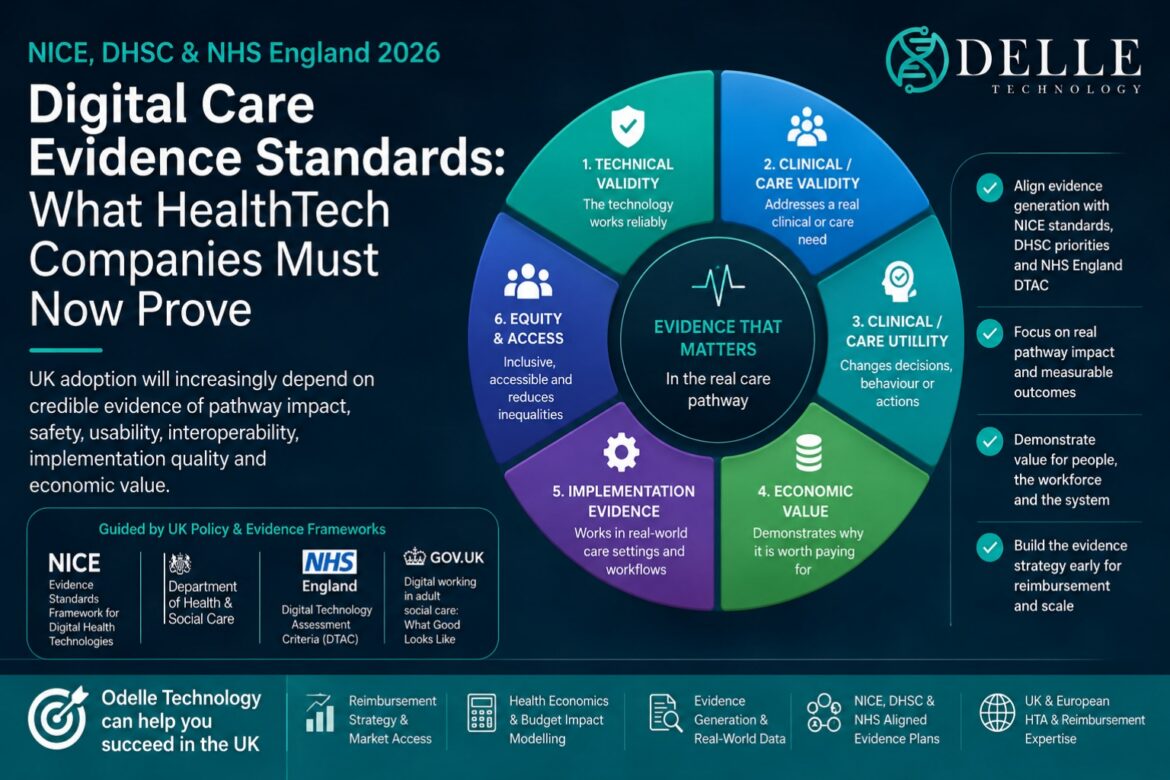
Digital care companies should prepare evidence across six layers.
1. Technical validity
The technology must work reliably.
For AI, sensor-based technologies and remote monitoring tools, this means showing that the system performs consistently across relevant users, care settings and conditions.
For example, a falls detection system should not only show that it detects falls under controlled conditions. It should show performance in real-world care environments, including different housing types, mobility levels, lighting conditions, frailty profiles, comorbidities and care arrangements.
2. Clinical or care validity
The technology must identify, support or influence something that matters.
For medication systems, this may include missed doses, incorrect administration, medication-related harm or escalation risk.
For remote monitoring, this may include deterioration, frailty, falls risk, reduced mobility, behavioural change or deviation from a care plan.
For workforce tools, this may include safer allocation of staff, improved documentation, better continuity of care or reduced duplication.
3. Clinical or care utility

The technology must change a decision, behaviour or action.
This is one of the most important points.
A dashboard that displays risk is not enough. The company must show what happens next.
Does the alert trigger a care visit?
Does the medication warning lead to pharmacist review?
Does the monitoring signal prevent hospital escalation?
Does the care-planning system reduce duplication?
Does the digital tool allow a person to remain independent for longer?
This is where many digital health companies are weak.
They measure product activity, not pathway consequence.
4. Economic value
The technology must show why it is worth paying for.
That does not always require a full cost-utility model or QALY-based analysis. In many digital care settings, a cost-consequence model, budget impact model or resource-use analysis may be more appropriate.
Companies should quantify:
- staff time saved or shifted;
- avoided care visits;
- avoided ambulance call-outs;
- avoided emergency admissions;
- reduced residential care escalation;
- reduced duplication;
- better targeting of scarce workforce capacity;
- reduced medication-related incidents;
- reduced carer burden where relevant.
The economic claim must be realistic. Overclaiming is dangerous.
A payer will not be persuaded by broad claims such as “reduces pressure on the NHS” unless the company can show where, for whom, over what time horizon and against which comparator.
5. Implementation evidence
Adult social care is highly implementation-sensitive.
Even a good technology can fail if it is difficult to deploy, poorly integrated into workflows, burdens care staff, creates alert fatigue, lacks training support or does not fit procurement realities.
This is why NHS England’s Digital Technology Assessment Criteria remain important. DTAC covers core standards, policies and best practice required for use in the NHS and adult social care across clinical safety, data protection, technical security, interoperability, usability and accessibility.
Implementation evidence should include:
- onboarding requirements;
- training burden;
- staff acceptance;
- workflow fit;
- data governance;
- interoperability;
- escalation protocols;
- maintenance and support;
- equity and accessibility;
- real-world retention and usage.
For digital technologies, implementation is not secondary. It is part of the value proposition.
6. Equity and access
Digital care technologies must also address equity.
Adult social care includes people with cognitive impairment, disability, frailty, social isolation, language barriers, digital exclusion and complex support needs.
A technology that works only for digitally confident users may have limited value in the populations where the need is greatest.
The GOV.UK “Digital working in adult social care: What Good Looks Like” guidance sets out what good digital working looks like for care providers and local authorities with responsibility for adult social care in England. It provides common goals to help achieve the wider vision set out in People at the Heart of Care.
Companies should therefore consider evidence on accessibility, usability, inclusion, carer involvement and the risk of widening inequalities.
Why this matters to investors
This NICE, DHSC and NHS England direction of travel should also matter to investors.
A digital care company with weak evidence may still look attractive commercially, but it may struggle to secure durable reimbursement, procurement or system-wide adoption.
Investors should ask:
- Is the company’s claim clinically and operationally specific?
- Does it have real-world evidence beyond supplier-led pilots?
- Is there a credible comparator?
- Does the economic case reflect actual UK care pathways?
- Is the technology aligned with NICE evidence expectations?
- Can the company survive NHS England DTAC scrutiny?
- Does the company understand local authority and adult social care decision-making?
- Can the product move from pilot to commissioned pathway?
The strongest digital health companies will be those that can move from product-market fit to evidence-market fit.
Who should pay attention?
This development is relevant to:
Digital health companies developing remote monitoring, AI triage, medication support, falls detection, digital care planning, workforce tools and virtual care models.
Medtech companies whose devices generate data, support home monitoring or shift care outside hospitals.
AI healthcare companies whose tools support risk prediction, prioritisation, alerts or decision support.
Adult social care providers evaluating which technologies to adopt.
Integrated care systems and local authorities trying to make evidence-based procurement decisions.
Investors and accelerators assessing whether healthtech companies have credible adoption pathways.
Pharma and diagnostics companies exploring digitally enabled care models, adherence support, remote disease management or decentralised monitoring.
What companies should do now
Digital care and healthtech companies should not wait until NICE guidance, procurement scrutiny or commissioner questions arrive.
They should build an evidence and market access strategy early.
The practical steps are:
- Define the exact care pathway.
- Define the user group and subgroup.
- Identify the comparator.
- Convert product features into care consequences.
- Map the decision or action that changes because of the technology.
- Build a proportionate evidence plan.
- Prepare a budget impact or cost-consequence model.
- Document implementation burden.
- Capture real-world usage and retention.
- Align evidence generation with NICE, NHS England, DHSC, local authority and commissioner expectations.
This is the difference between a digital product and a reimbursable health technology.
Official sources and policy references
This Odelle Technology briefing is informed by the following official UK policy and evidence sources.
NICE — Evidence Standards Framework for Digital Health Technologies
NICE describes the ESF as a set of evidence standards for a wide range of digital health technologies. It is intended to help evaluators and decision-makers identify technologies likely to offer benefits to users and to the health and care system. https://www.nice.org.uk/what-nice-does/digital-health/evidence-standards-framework-esf-for-digital-health-technologies
Department of Health and Social Care — Developing evidence standards for digital technologies in adult social care
The DHSC social care blog explains that work is underway to adapt NICE’s digital health evidence framework for adult social care, with co-design involving people who use, deliver and commission technology in the sector. https://socialcare.blog.gov.uk/2026/05/19/developing-evidence-standards-for-digital-technologies-in-adult-social-care/
NHS England — Digital Technology Assessment Criteria
DTAC covers the standards and best practice required for digital technologies used in the NHS and adult social care, including clinical safety, data protection, technical security, interoperability, usability and accessibility. https://digital.nhs.uk/services/digital-technology-assessment-criteria-dtac
GOV.UK — Digital working in adult social care: What Good Looks Like
This GOV.UK guidance is for care providers and local authorities. It sets out what good digital working looks like in adult social care in England. https://www.gov.uk/government/publications/digital-working-in-adult-social-care-what-good-looks-like
GOV.UK A plan for digital health and social care
The government’s digital health and social care plan set out the ambition for health and social care to be delivered in a more digital, connected and effective way. https://www.gov.uk/government/publications/a-plan-for-digital-health-and-social-care/a-plan-for-digital-health-and-social-care
Odelle Technology view
Odelle Technology’s view is that these official sources should be read together, not separately.
NICE is strengthening the evidence logic.
DHSC is framing the adult social care adoption problem.
NHS England’s DTAC addresses assurance, safety, interoperability and usability.
The “What Good Looks Like” framework addresses implementation reality in adult social care.
For digital health companies, the commercial lesson is clear:
UK market access now requires a joined-up evidence, assurance, implementation and economic value strategy.
The future of digital health reimbursement will not be won by the companies with the broadest claims.
It will be won by companies that can show:
the right technology,
in the right population,
in the right pathway,
with the right evidence,
at the right price.
That is the new discipline.
And it is precisely where reimbursement strategy, health economics, real-world evidence and implementation planning need to come together.