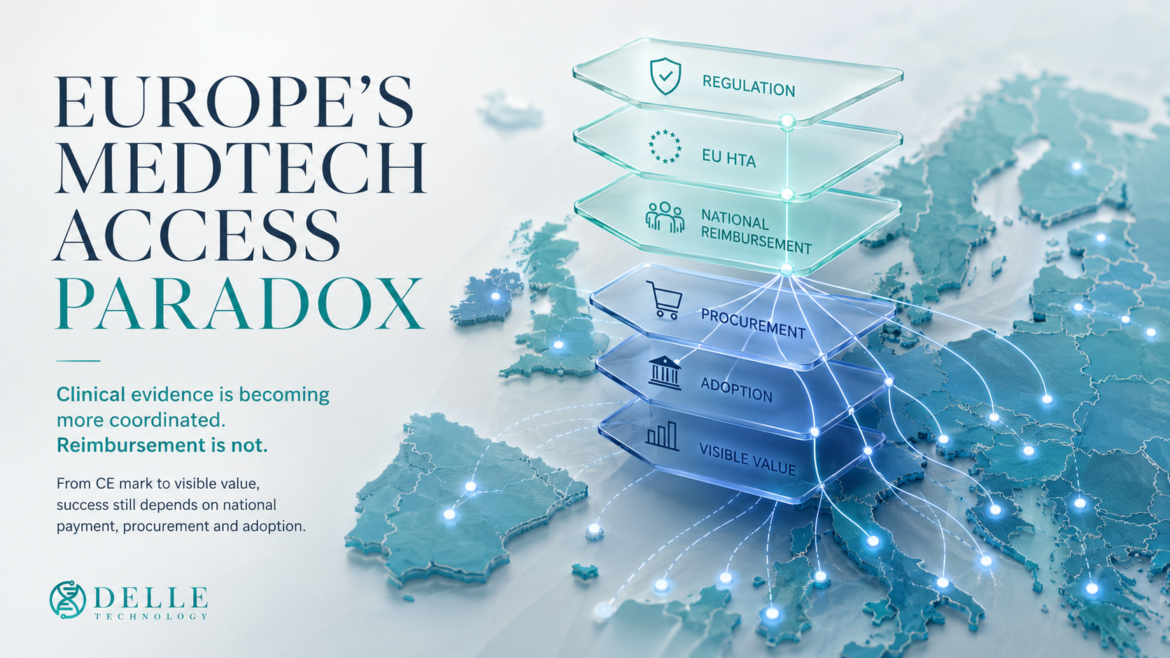
Clinical evidence is becoming more coordinated. Reimbursement is not.
Europe is often described as one of the great prizes for high-risk MedTech and IVD companies. In one sense, that is entirely true. It is large, clinically sophisticated, publicly funded, scientifically ambitious and increasingly focused on healthcare resilience, early diagnosis, digital transformation, precision medicine and better use of constrained resources. For Australian, US, UK and other global companies, Europe can be a market, a research partner, a reference environment and a source of international credibility.
But the word “Europe” can also be misleading. It suggests a single access landscape, when in practice companies encounter a layered system in which regulatory approval, clinical assessment, reimbursement, coding, hospital financing, procurement and adoption are governed by different institutions, different incentives and different national traditions. Europe is becoming more coordinated in the way it discusses clinical evidence, particularly through the Medical Device Regulation, the In Vitro Diagnostic Regulation and the EU Health Technology Assessment Regulation. Yet the commercial reality remains stubbornly national.
That is the new European access paradox. Clinical evidence may increasingly be assessed through a more coordinated European lens, but reimbursement is still decided country by country. Pricing remains national. Coding remains system-specific. Hospital payment is shaped by national tariffs, DRGs, HRGs, sickness funds, regional budgets and procurement rules. Adoption still happens in real hospitals, with real clinicians, real finance departments, real procurement committees and real operational constraints.
For high-risk medical devices and in vitro diagnostics, this distinction is not a technicality. It is the difference between being approved and being paid for; between generating evidence and generating adoption; between entering Europe and succeeding in Europe. A CE mark may open the regulatory door, and a Joint Clinical Assessment may help structure the clinical evidence discussion, but neither automatically creates a reimbursed, procured and clinically adopted technology.
The companies that succeed will therefore be those that stop treating Europe as a single market and start treating it as an access architecture. They will understand that each country asks its own version of the same fundamental question: not simply whether the technology works, but whether it is worth funding in that health system, for those patients, in that pathway, with that comparator, at that price, and with that remaining uncertainty.
In Europe, the strategic challenge is no longer just to obtain approval. It is to make value visible — to clinicians, payers, HTA bodies, procurement teams, hospitals, patients and investors — in the right country, at the right time, with the right evidence.
The false comfort of regulatory success

Regulatory approval is a major achievement. For high-risk devices and diagnostics, the evidence burden is substantial, the documentation demanding, and the regulatory process increasingly exacting. Manufacturers must demonstrate that products are safe, perform as intended, and are supported by appropriate clinical or performance evidence. The tightening of European regulatory standards has made this process more serious and, in many cases, more expensive.
Yet regulatory approval is not the same as market access. The distinction sounds obvious, but it is still one of the most common strategic errors in European launch planning. A CE mark answers the question of whether a product can be placed on the market. Reimbursement asks whether a health system should pay for it. Procurement asks whether an institution can buy it. Adoption asks whether clinicians can and will use it inside routine care.
These are different questions, and they demand different evidence. A device can be technically impressive and clinically promising but still fail to fit an existing payment route. An implant can reduce complications over time while creating immediate cost pressure for the hospital expected to purchase it. A diagnostic can achieve strong analytical performance while failing to demonstrate that it changes clinical management. A digital or AI tool can show algorithmic accuracy while leaving unanswered questions about workflow, accountability, integration, governance and budget responsibility.
The result is a familiar market access gap. A product is approved, but not funded. Clinicians are interested, but procurement hesitates. Evidence is strong, but not aligned with payer questions. A hospital sees potential value, but the payment system cannot recognise it. In Europe, many technologies do not fail because value is absent. They fail because value is not visible to the right decision-maker at the right time.
Table 1. The European access stack
| Layer | Core question | Main decision-makers | Strategic risk |
|---|---|---|---|
| Regulation | Can the product be marketed? | Notified bodies, regulators, expert panels, manufacturers | Assuming approval equals access |
| European HTA | What is the comparative clinical evidence? | EU HTA structures, clinical experts, national HTA bodies | Assuming clinical assessment equals payment |
| National HTA | Does the evidence matter in this healthcare system? | National HTA agencies, ministries, payers | Using the wrong comparator or endpoint |
| Coding and payment | Can the system see and fund the technology? | Payers, coding bodies, hospitals, sickness funds | Clinical value becomes financially invisible |
| Procurement | Can the buyer actually buy it? | Hospital procurement, regional authorities, tender committees | Reimbursement exists but purchasing fails |
| Implementation | Can the technology live inside routine care? | Clinicians, managers, IT, laboratories, theatres, care teams | Evidence does not translate into workflow |
| Real-world evidence | Can value be measured after adoption? | Registries, hospitals, payers, manufacturers | Uncertainty remains unmanaged |
What EU HTA changes and what it does not
The EU Health Technology Assessment Regulation is one of the most important developments in European health technology policy. For selected technologies, including certain high-risk medical devices and IVDs, Joint Clinical Assessments are intended to reduce duplication and create a more coordinated European approach to comparative clinical evidence. This matters because fragmented clinical assessment has long created inefficiency for both companies and national HTA bodies.
However, the practical importance of EU HTA lies as much in what it does not do as in what it does. Joint Clinical Assessment is not a European reimbursement decision. It does not determine price, cost-effectiveness, budget impact, tariff adequacy, procurement status or clinical adoption. It may help establish a shared clinical evidence spine, but national systems still decide whether a technology should be funded, under what conditions, in which patient groups, and through which payment route.
This creates a more sophisticated access environment, not necessarily a simpler one. Companies will need to prepare for a coordinated European clinical evidence discussion while still adapting to country-specific payer expectations. A clinical endpoint that satisfies one system may not satisfy another. A comparator may be relevant in one country but not in another. A technology may be regarded as promising at the European clinical assessment level while still facing difficult national questions about affordability, implementation, budget impact and opportunity cost.
The strategic implication is clear. Companies need to design evidence that can travel, but they also need to understand where it will land. The best European evidence strategy is not a single dossier repeated across countries. It is a European evidence spine with national reimbursement adaptations.
Table 2. What Joint Clinical Assessment can and cannot do
| Issue | More coordinated through EU HTA? | Still national, regional or local? |
|---|---|---|
| Comparative clinical evidence | Yes | National interpretation may still differ |
| Clinical endpoints | Partly | Local relevance may differ |
| Comparator discussion | Partly | Standard of care may differ by country |
| Clinical uncertainty | Yes | National risk tolerance varies |
| Cost-effectiveness | No | Yes |
| Pricing | No | Yes |
| Budget impact | No | Yes |
| Coding and tariff fit | No | Yes |
| Hospital funding | No | Yes |
| Procurement | No | Yes |
| Implementation | No | Yes |
| Real-world reassessment | Partly | Often national or local |
Joint Scientific Consultations as a strategic protection mechanism
Joint Scientific Consultations may become increasingly important for companies developing high-risk technologies. Their value is not simply procedural. Their value is strategic, because they allow companies to test whether the evidence they intend to generate is likely to answer the questions future assessors will ask.
This matters because the most expensive evidence is often the evidence a company realises it needs after the pivotal study has already finished. For a high-risk device, the problem may be insufficient follow-up, weak subgroup definition, inadequate resource-use data, or a comparator that does not reflect actual care. For an IVD, it may be strong analytical validity but insufficient evidence of clinical utility. For an AI tool, it may be algorithmic performance without evidence of workflow effect, clinician behaviour, accountability, patient outcomes or implementation burden.
Early scientific advice should therefore be viewed as a market access protection mechanism. It can help companies avoid generating regulatory evidence that is elegant but commercially incomplete. It can also help investors understand whether the evidence plan is built around future reimbursement questions rather than only regulatory milestones.
The companies that use early advice well will not ask only, “What do we need for approval?” They will ask, “What evidence will make this technology fundable, usable and credible in the first countries that matter?”
Table 3. Evidence decisions that should be tested early
| Evidence decision | Why it matters |
|---|---|
| Comparator choice | The wrong comparator can weaken both HTA and reimbursement relevance |
| Target population | Too broad a claim can dilute value; too narrow a claim can limit adoption |
| Endpoint selection | Regulators, clinicians and payers may value different outcomes |
| Follow-up duration | Some devices and diagnostics create value over time |
| Resource-use collection | Budget impact and cost-effectiveness require pathway data |
| Subgroup strategy | Reimbursement may depend on identifying the highest-value patients |
| Clinical utility | Diagnostics and AI tools must show what decision changes |
| Implementation evidence | Workflow, training and infrastructure can determine adoption |
| Real-world evidence plan | Uncertainty often needs post-launch evidence |
| Reassessment criteria | Conditional access requires a credible decision point |
The country problem has not disappeared
European harmonisation is often discussed as though it removes national complexity. It does not. Germany is not France. France is not the Netherlands. The Netherlands is not Belgium. Belgium is not Spain. Spain is not Italy. Italy is not Sweden. The UK, while still one of Europe’s most influential health technology markets, is now outside the EU regulatory framework and follows its own route through MHRA, NICE, NHS England, devolved bodies, local procurement and NHS payment structures.
Each system has its own payer logic, institutional history, coding architecture, tariff structure, evidence culture and procurement behaviour. Germany may place early emphasis on coding visibility, hospital financing and specialist pathways. France may focus on clinical benefit, improvement over comparators, public health relevance, pricing and reassessment. The Netherlands may be attractive for pragmatic evidence generation and pathway validation. Belgium may require precise navigation of nomenclature, device lists and hospital financing. Spain and Italy often require regional strategy and strong clinical champions. The Nordics may offer powerful registry infrastructure but smaller immediate revenue opportunities.
This means European launch sequencing cannot be a sales map with flags. It must be an evidence and access strategy. The right first country is not always the largest. It is the country where the pathway, evidence requirements, reimbursement route, procurement process and clinical ecosystem align sufficiently to make value visible.
A first market should do more than generate activity. It should reduce uncertainty. It should produce learning that helps the next market. It should create reference sites, payer insight, real-world evidence, clinical credibility and investor confidence. In a complex European environment, the first launch country should be an evidence platform, not simply a territory.
Table 4. Country-specific access watch-outs
| Country or region | What to watch |
|---|---|
| Germany | OPS and G-DRG visibility, NUB and ZE logic, hospital financing, G-BA/IQWiG processes where relevant, statutory versus private routes |
| France | HAS and CNEDiMTS expectations, LPPR route selection, clinical benefit, improvement over comparators, pricing and reassessment risk |
| United Kingdom | NICE, NHS England priorities, HRG payment, local procurement, ICB adoption, evidence of system value and affordability |
| Netherlands | Zorginstituut logic, appropriate care, pragmatic evidence generation, conditional evidence routes, reference-centre value |
| Belgium | INAMI/RIZIV nomenclature, device lists, hospital financing, sickness funds, university hospital influence |
| Spain | RedETS, autonomous community variation, regional procurement, hospital champions, evidence from leading centres |
| Italy | Regional procurement, AGENAS, national versus regional implementation, centres of excellence, outcomes programmes |
| Nordics | Registries, population-level data, procurement, smaller market size but high evidence value |
How payment systems hide innovation
Hospital payment systems are designed to classify activity, allocate budgets and control expenditure. They are not designed to recognise every innovation quickly. For high-risk medical devices, this creates one of the most common adoption barriers in Europe: the technology may create clinical value, but the payment system may not see it.
A device that reduces complications may be bundled inside an existing hospital tariff. A procedure that prevents future revision surgery may create cost today and savings years later. A technology that improves theatre efficiency may benefit the hospital operationally but remain invisible in a national payment schedule. A diagnostic that reduces inappropriate treatment may save money in oncology, infectious disease or emergency care while increasing cost in the laboratory budget.
This is the value-flow problem. The person who pays is not always the person who benefits. The department that carries the cost may not receive the savings. The payer may value long-term outcomes, but the hospital must manage immediate budget pressure. Unless companies map this value flow, they risk mistaking system value for buyer value.
For market access, the task is not only to prove that a technology works. It is to prove that the value it creates can be recognised, funded and acted upon by the decision-makers who control adoption.
Table 5. How payment systems hide innovation
| Problem | What happens | Why it blocks adoption |
|---|---|---|
| Bundled payment | Device cost is absorbed inside an existing hospital tariff | Hospital may lose money per case |
| No specific code | Activity cannot be clearly identified | Use becomes financially invisible |
| Inadequate tariff | Payment exists but does not reflect the new cost structure | Finance teams resist adoption |
| Wrong budget holder | One department pays while another benefits | Incentives are misaligned |
| Delayed benefit | Value appears through avoided future events | Short-term budgets do not capture savings |
| Procurement separation | Reimbursement exists but buying approval is separate | Adoption stalls after funding logic is solved |
| Weak resource-use evidence | Clinical outcomes are shown but system impact is not | Payers cannot see economic value |
IVDs: value is downstream
In vitro diagnostics face a different but equally important challenge. A test is rarely valuable simply because it produces a result. It is valuable because the result changes a clinical decision. That decision may be to treat, not treat, refer, monitor, discharge, escalate, de-escalate, select therapy, avoid therapy, isolate, operate, reassure or investigate further.
For IVDs, the reimbursement question is therefore not only whether the test performs accurately. It is what happens because the result is known. Does it select the right patient? Does it avoid ineffective treatment? Does it reduce diagnostic delay? Does it improve antimicrobial stewardship? Does it guide cancer therapy? Does it reduce unnecessary procedures? Does it support serial monitoring? Does it shorten length of stay? Does it improve outcomes or reduce downstream cost?
This is why analytical validity alone is not enough. Payers increasingly need to see the full chain from test result to clinical decision, from clinical decision to pathway change, and from pathway change to patient outcome and resource impact.
For diagnostics, reimbursement value is downstream. The test matters because of the decision it changes.
Table 6. Evidence requirements for IVD value
| Evidence domain | What it shows |
|---|---|
| Analytical validity | The test measures what it claims to measure |
| Clinical validity | The result is associated with the clinical condition or outcome |
| Clinical utility | The result changes management or improves decision-making |
| Pathway impact | The test changes referral, treatment, monitoring or discharge |
| Resource impact | The test affects admissions, staff time, procedures, treatment use or length of stay |
| Economic value | The test improves outcomes, reduces waste or justifies additional cost |
| Implementation evidence | The test can be used reliably in real clinical settings |
| Behavioural evidence | Clinicians act on the result appropriately |
AI and digital health: performance is not adoption
AI and digital health add another layer of complexity. These technologies may be regulated as software as a medical device, but their adoption depends on far more than regulatory classification. They may face questions about data protection, cybersecurity, interoperability, explainability, transparency, clinical accountability and post-market monitoring. In practice, they must also survive the realities of workflow, staffing, procurement, IT governance and clinical trust.
Even when the technology works, the access question remains unresolved. Who uses it? Who acts on its output? Who is responsible for the decision? Who pays for the software? Who pays for implementation? Who monitors model performance? Who updates the algorithm? Who carries liability? Who integrates the tool into the electronic health record? Who proves that it improves care rather than adding another digital task to an already pressured system?
For AI and digital health, the reimbursement question is rarely about the algorithm alone. It is about the service model around the algorithm. It is about whether the technology helps the health system make better decisions under pressure, and whether those improvements can be measured in a way that matters to payers, clinicians and patients.
A high-performing algorithm is not the same as an adoptable health technology. Adoption requires evidence, workflow fit, governance, trust and payment logic.
Managing uncertainty as part of access
High-risk devices and IVDs often enter the market with residual uncertainty. This is not unusual. Long-term outcomes may still be emerging. Operator learning curves may matter. Real-world patients may differ from trial populations. Diagnostic impact may depend on clinician adherence. AI tools may require continuous monitoring. Implants may require registry follow-up.
The important question is not whether uncertainty exists. It is whether uncertainty can be managed responsibly.
This is where conditional reimbursement, registry-linked access, managed entry agreements, coverage with evidence development and structured pilots become important. Used well, they can allow earlier access while protecting payers and generating evidence. Used poorly, they become vague pilots, weak discounts or unfunded data exercises.
Risk-sharing is not a slogan. It is an evidence contract. A credible agreement must define the target population, comparator, outcomes, data source, follow-up duration, decision thresholds, governance, payer responsibilities, manufacturer responsibilities and reassessment process. Without those elements, uncertainty is not being managed. It is simply being postponed.
Table 7. How uncertainty can be managed
| Access mechanism | Best suited to | What makes it credible |
|---|---|---|
| Conditional reimbursement | Promising technologies with incomplete evidence | Clear reassessment criteria |
| Coverage with evidence development | Technologies needing real-world evidence | Funded data collection and defined endpoints |
| Registry-linked reimbursement | Implants, procedures, diagnostics, AI tools | High-quality registry infrastructure |
| Managed entry agreement | Higher-cost or uncertain technologies | Shared risk and transparent outcomes |
| Regional pilot | Pathway-changing technologies | Clear scale-up plan |
| Outcomes-based agreement | Technologies with measurable outcomes | Reliable data and agreed performance metrics |
| Budget-cap arrangement | Technologies with uncertain uptake | Defined population and budget exposure |
The investor issue: first market as risk management
For investors, European launch sequencing should be viewed as risk management. A poorly chosen first market can create activity without evidence, pilots without adoption, and distributor noise without revenue. A well-chosen first market can do something much more valuable: it can generate reference centres, payer learning, coding insight, real-world evidence, pathway validation, procurement learning, clinical publication and confidence for later markets.
This matters because European market access is not linear. A first country can either clarify the story or confuse it. It can create transferable evidence or produce isolated activity. It can build a clinical and economic case that travels, or it can consume capital in a market that was never structurally ready to adopt.
The first European market should reduce uncertainty, not simply create movement. It should answer questions that later countries will also ask. It should make the company smarter, the evidence stronger and the next reimbursement discussion easier.
Table 8. What a good first European market should produce
| Output | Why it matters |
|---|---|
| First paid use | Shows the technology can move beyond approval |
| Reference centres | Creates clinical credibility |
| Reimbursement learning | Reveals payer questions and evidence gaps |
| Coding and payment insight | Shows whether the system can see the technology |
| Real-world evidence | Demonstrates performance in routine care |
| Registry or audit data | Supports reassessment and long-term credibility |
| Procurement learning | Reveals buying barriers |
| Patient pathway validation | Shows where the product fits |
| Publication potential | Helps evidence travel |
| Investor confidence | Converts access progress into enterprise value |
Red flags before entering Europe
The red flags are often visible early, but companies ignore them because the commercial story is more exciting than the access reality. A distributor says the market is ready but cannot explain reimbursement. A clinician is enthusiastic but has no budget influence. The evidence is strong but uses the wrong comparator. A device is approved but the tariff cannot absorb it. A diagnostic works but no one has shown that it changes management. A digital platform is elegant but the workflow burden is unclear.
Another common red flag is market-size bias. A company chooses Germany because it is large, France because it is structured, or the UK because NICE is influential, without asking whether that country is the right first evidence market for its specific technology. That is not strategy. It is geography.
A serious European launch strategy asks where the technology can become visible fastest: clinically, economically, operationally and commercially. It asks where evidence can be generated, where uncertainty can be managed, where the first use can be paid for, and where adoption can influence the next market.
Table 9. European launch red flags
| Red flag | Why it matters |
|---|---|
| CE mark but no reimbursement route | Product can be sold but not paid for |
| Strong evidence but wrong comparator | HTA relevance may be weak |
| High device cost inside bundled tariff | Hospital may lose money using it |
| No clinical utility evidence | Payer cannot see what decision changes |
| No budget-holder analysis | Buyer may not benefit from savings |
| No implementation plan | Workflow may block adoption |
| No procurement strategy | Funding logic may not become purchasing |
| No registry or RWE plan | Uncertainty remains unmanaged |
| Distributor cannot explain access | Sales activity may not become adoption |
| First country chosen by size alone | Evidence may not travel |
The Odelle Approval-to-Visible-Value Framework
At Odelle Technology, we describe this challenge as the journey from approval to visible value. Approval is essential, but it is only the first layer. A technology must then become credible through evidence, visible through coding, usable through reimbursement, purchasable through procurement and real through adoption.
That journey is different for every technology. A surgical device, an implant, a Class D IVD, an AI diagnostic, a remote-monitoring platform and a digital therapeutic all face different access questions. But the underlying logic is consistent. The company must understand who pays, who benefits, what decision changes, what evidence matters, what uncertainty remains, and which first market can create the most useful European signal.
The best companies do not wait until after approval to ask these questions. They design evidence, reimbursement strategy, country sequencing and real-world data plans together. They understand that Europe rewards innovation, but it rewards disciplined innovation.
Table 10. The Odelle Approval-to-Visible-Value Framework
| Domain | Question | Why it matters |
|---|---|---|
| Regulatory readiness | Can the product be placed on the market? | Approval is the first gate |
| HTA readiness | Can the evidence withstand comparative assessment? | Weak comparators and endpoints damage access |
| JCA relevance | Is European clinical assessment likely? | Evidence planning must start early |
| National reimbursement | Who pays and through which route? | Payment remains country-specific |
| Coding and tariff visibility | Can the system see the technology? | Invisible technologies struggle to scale |
| Economic value | Is budget impact and cost-effectiveness understood? | Payers need more than clinical performance |
| Clinical utility | What decision changes? | Essential for IVDs, AI and diagnostics |
| Implementation | Can the technology live inside routine care? | Workflow determines adoption |
| Procurement | Can the buyer buy it? | Payment and purchasing are not the same |
| Uncertainty management | Can residual uncertainty be handled? | Conditional access requires credible evidence plans |
| Evidence transferability | Will evidence travel? | The first market should de-risk later markets |
| Ecosystem readiness | Are societies, centres, registries and patients aligned? | Adoption is social as well as technical |
Selected evidence base
Recent academic and policy literature points in the same direction. High-risk devices and IVDs are entering a more structured European evidence environment, but the route from evidence to payment remains heterogeneous. Digital medical devices face an even more fragmented landscape, with countries experimenting with different assessment and reimbursement models. Coverage with evidence development may help manage uncertainty, but only when it is designed as a disciplined evidence-generation mechanism rather than a vague pilot. The practical conclusion is clear: Europe is not becoming simple. It is becoming more evidence-led.
Selected references include work on decision-making and reimbursement pathways for high-risk medical devices in the EU, EEA and UK; European approaches to digital medical device assessment and reimbursement; coverage with evidence development schemes for medical devices; implementation of evidence-development schemes; OECD work on good practices in assessment of digital medical devices; and official European Commission guidance on implementation of the EU Health Technology Assessment Regulation.
Conclusion: Europe rewards disciplined innovation
Europe is becoming more coordinated, but it is not becoming simple. MDR and IVDR govern approval. EU HTA may shape the clinical evidence conversation. National systems still decide reimbursement. Hospitals still manage budgets. Procurement still decides whether a product is bought. Clinicians still decide whether it is used. Patients still experience whether it matters.
The winners will be the companies that understand the whole chain. Not just approval. Not just evidence. Not just reimbursement. Not just procurement. But the relationship between all of them.
In Europe, approval makes a technology available. Evidence makes it credible. Coding makes it visible. Reimbursement makes it usable. Procurement makes it purchasable. Adoption makes it real.
For high-risk MedTech and IVD companies, the task is not simply to enter Europe.
It is to make value visible.
Selected references
- Alshaikh RA, Walsh KA, El-Komy F, Spillane S, Carrigan M, Larkin L, Harrington P, O’Neill M, Teljeur C, Ryan M, O’Driscoll CM. Mapping current decision-making pathways and reimbursement processes for high-risk medical devices in EU/EEA member states and the UK: a scoping review. International Journal of Technology Assessment in Health Care. 2025.
https://doi.org/10.1017/S026646232510319X - Tarricone R, Petracca F, Weller H-M. Towards harmonizing assessment and reimbursement of digital medical devices in the EU through mutual learning. npj Digital Medicine. 2024;7:268.
https://doi.org/10.1038/s41746-024-01263-w - Federici C, Reckers-Droog V, Ciani O, Dams F, Grigore B, Kaló Z, Kovács S, Shatrov K, Brouwer W, Drummond M. Coverage with evidence development schemes for medical devices in Europe: characteristics and challenges. The European Journal of Health Economics. 2021;22:1253–1273.
https://doi.org/10.1007/s10198-021-01334-9 - Kovács S, Kaló Z, Daubner-Bendes R, Kolasa K, Hren R, Tesar T, Reckers-Droog V, Brouwer W, Federici C, Drummond M, Zemplényi AT. Implementation of coverage with evidence development schemes for medical devices: a decision tool for late technology adopter countries. Health Economics. 2022;31(S1):195–206.
https://doi.org/10.1002/hec.4504 - Drummond M, Tarricone R, Torbica A. Coverage with evidence development for medical devices: is there evidence of value? Health Economics. 2022;31(S1):5–15.
https://doi.org/10.1002/hec.4478 - European Commission. Implementation of the Regulation on Health Technology Assessment.
https://health.ec.europa.eu/health-technology-assessment/implementation-regulation-health-technology-assessment_en - European Union. Regulation (EU) 2021/2282 on health technology assessment and amending Directive 2011/24/EU.
https://eur-lex.europa.eu/legal-content/EN/TXT/?uri=CELEX:32021R2282 - European Union. Regulation (EU) 2017/745 on medical devices.
https://eur-lex.europa.eu/legal-content/EN/TXT/?uri=CELEX:32017R0745 - European Union. Regulation (EU) 2017/746 on in vitro diagnostic medical devices.
https://eur-lex.europa.eu/legal-content/EN/TXT/?uri=CELEX:32017R0746 - OECD. Towards identifying good practices in the assessment of digital medical devices. 2025.
https://www.oecd.org/en/publications/towards-identifying-good-practices-in-the-assessment-of-digital-medical-devices_b485ee1f-en.html