Price Follows the Patient Pathway
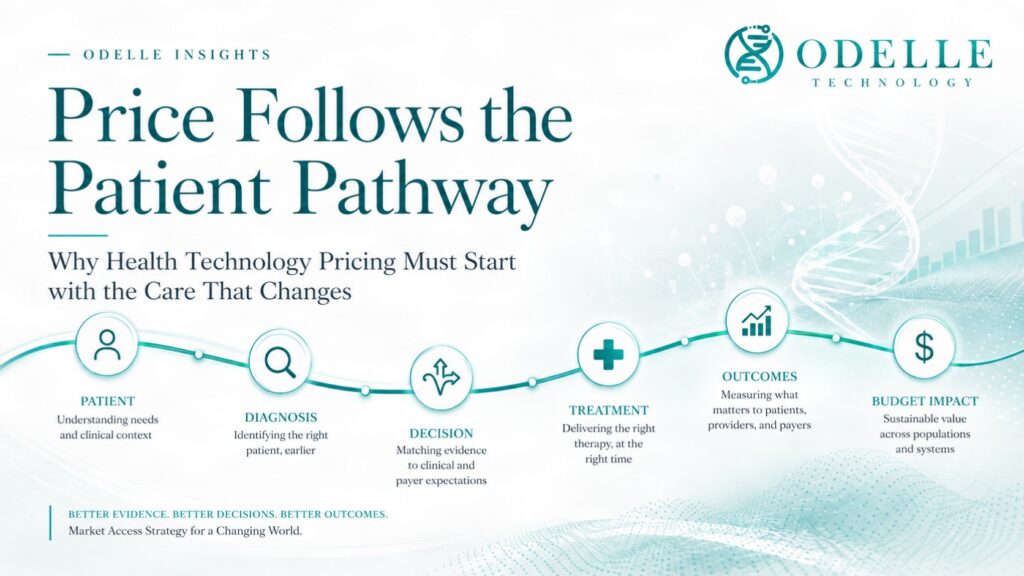
Healthcare companies often begin their pricing story in the wrong place.
They start with the product.
They describe the device, the assay, the implant, the digital platform, the artificial intelligence model, the biomarker, the software interface, the companion diagnostic, the sensor, the surgical instrument or the biological mechanism. They explain why it is novel, faster, more accurate, less invasive, more scalable or more elegant than what came before.
That may be scientifically impressive.
It may interest clinicians.
It may secure investment.
It may even help achieve regulatory approval.
But it is not yet a reimbursement argument.
Healthcare systems do not usually pay for technology because it is clever. They pay when a technology changes care in a way that is clinically meaningful, economically measurable, operationally feasible and affordable to the organisation being asked to fund it.
That is why the most defensible price for a health technology is rarely found inside the product itself.
It is found in the patient pathway the product changes.
At Odelle, we describe this simply:
Price follows the patient pathway.
The phrase is deliberately simple. The discipline behind it is not.
It means that a company cannot build a serious pricing or reimbursement case by asking only what the technology does. It must ask what changes because the technology is used.
Does the patient avoid an invasive procedure?
Does the clinician make a different decision?
Does the test safely rule out disease and prevent unnecessary admission?
Does the device move selected patients from inpatient surgery to day-case care?
Does the algorithm reduce avoidable escalation?
Does the digital therapeutic improve a patient-relevant outcome?
Does the implant reduce revision, theatre time, complications or length of stay?
Does the therapy justify its price through survival, remission, durability or avoidance of later treatment?
These are the questions that turn a product claim into a payer argument.
Product-first pricing is no longer enough
Many companies still assume that innovation creates price.
It does not.
Innovation creates attention. It may create scientific credibility, investor confidence and early clinical enthusiasm. But payers, hospitals, insurers, HTA bodies and procurement committees work within a harder reality. Budgets are finite. Workforce capacity is constrained. Waiting lists are visible. Every new technology competes with other uses of money, staff, theatre time, diagnostic capacity and political attention.
This is the concept of opportunity cost. When a healthcare system funds one technology, it is not simply saying yes to innovation. It may also be saying no to something else: another intervention, another clinic, another nurse, another diagnostic service, another waiting-list initiative, another public-health programme.
That is why health technology assessment is not a beauty contest for innovation. HTA is a multidisciplinary process that determines the value of a health technology at different points in its lifecycle, with the purpose of informing decisions that promote an equitable, efficient and high-quality health system. (HTAi)
This definition matters because it explains why reimbursement is more demanding than evidence generation alone. The payer is not only asking, “Does this technology work?” The payer is asking, “Is this the best use of scarce resources in this pathway, for this patient group, at this price, under real-world conditions?”
That is a much more difficult question.
It is also the question that companies must learn to answer.
A good technology can still be a weak reimbursement case
One of the commonest mistakes in health technology commercialisation is to confuse technical performance with reimbursable value.
Companies say the test is faster.
The algorithm is accurate.
The procedure is less invasive.
The app improves engagement.
The device saves time.
The therapy is transformative.
These claims may be true, but a payer will ask what they mean in practice.
Faster diagnosis matters only if it changes treatment, avoids deterioration, prevents complications, reduces unnecessary testing, shortens the time to effective therapy or allows safer discharge.
Reduced workload matters only if it releases real capacity, not if it merely shifts work from one professional group to another.
Earlier intervention matters only if it improves outcomes, avoids more expensive care later or changes the natural history of disease.
Better engagement matters only if it improves adherence, symptoms, quality of life, disease control or service utilisation.
Less invasive care matters only if it reduces complications, recovery time, theatre use, length of stay, repeat procedures or downstream cost.
This is where many companies lose the reimbursement argument. They prove that the technology performs, but not that performance changes the pathway in a way that matters to the budget holder.
A rapid diagnostic test may deliver results in hours rather than days. But if antimicrobial stewardship, pharmacy and clinical teams are not organised to act on those results, the economic value may remain theoretical.
A digital monitoring tool may predict deterioration. But if the clinical team has no capacity to respond, prediction becomes another alert rather than a pathway improvement.
A device may reduce procedure time. But if theatre scheduling, coding, tariff structures and staffing models do not recognise or reward that change, the value may not be visible to the organisation being asked to pay.
The price therefore cannot be built on the feature.
It must be built on the consequence.
Cost-effective is not the same as affordable
There is another distinction that companies often underplay.
A technology can be cost-effective and still be difficult to adopt.
Cost-effectiveness asks whether the health gain is worth the additional cost, often over a long time horizon. Budget impact asks whether the payer can afford the technology within the real budget cycle. These are related questions, but they are not the same.
A technology may offer good value over ten years but create an unaffordable financing shock in year one. It may be cost-effective in a model but difficult to implement at scale. It may save money in the long term but require upfront investment from a hospital that will not receive the downstream benefit. It may generate efficiency gains that are real operationally but not cash-releasing financially.
This is why budget impact analysis is not just an appendix to the economic model. It is often the moment when the value story becomes real.
The NHS MedTech Funding Mandate gives a clear example. To qualify, technologies must have positive NICE guidance, be cost-saving within three years according to NICE modelling, and have a national budget impact that does not exceed £20 million in any of the first three years. (NHS England)
That is pathway-based pricing in policy form.
The technology must work.
The savings must be credible.
The time horizon must be relevant.
The budget impact must be affordable.
This is the standard companies increasingly have to meet.
The real comparator is often the current pathway
A serious value argument begins with the comparator.
But in MedTech, diagnostics and digital health, the comparator is often misunderstood.
It is not always another product. It may be the current pathway itself.
That pathway may include delayed diagnosis, repeat testing, outpatient review, invasive investigation, unnecessary admission, standard imaging, manual interpretation, broad-spectrum treatment, watchful waiting, unnecessary follow-up, avoidable escalation or no intervention at all.
This is crucial because many technologies do not simply replace another technology. They change timing, setting, staffing, patient selection, decision thresholds and resource flows.
The value of a test may lie in ruling out disease earlier.
The value of a device may lie in moving patients from inpatient surgery to day-case treatment.
The value of an app may lie in improving self-management before a crisis occurs.
The value of an AI tool may lie in helping clinicians target scarce capacity to the patients most likely to benefit.
This is why medical devices, diagnostics and digital technologies cannot be assessed as if they were simply pharmaceutical products in different packaging. The European MedtecHTA programme recognised this problem directly: device value is shaped by how technologies are integrated into clinical practice, including organisational impacts, learning curves, and implementation. (MedTech Europe)
The technology is not entering a vacuum.
It is entering a pathway.
And the pathway is where the price must be defended.
Subgroups matter because value is not evenly distributed
Another reason product-first pricing fails is that it often assumes value is uniform.
It rarely is.
The value of a technology is usually highest in the patient subgroup where the current pathway is most burdensome, expensive, uncertain, risky or inefficient. A price that is defensible in a high-risk, high-cost subgroup may be much harder to justify if the technology is used broadly in patients with lower baseline risk or less expensive current care.
This is especially important for diagnostics, digital health, AI, devices and advanced therapies.
A biomarker may be valuable where it changes treatment selection, but less valuable where treatment decisions would not change.
A rapid diagnostic may be valuable in a hospital with active stewardship, but less valuable in a setting that cannot act on the result.
A device may be cost-saving when used in selected patients suitable for day-case care, but not if used indiscriminately.
A digital tool may be valuable in patients at high risk of deterioration, but weak if deployed broadly to a low-risk population with limited capacity to respond.
The commercial temptation is always to maximise the eligible population.
The payer discipline is often the opposite: find the group where the marginal value is strongest.
That is why pathway-based pricing begins not with the largest possible market, but with the most defensible one.
HeartFlow: the value was not the algorithm, but the avoided invasive pathway
HeartFlow is one of the clearest examples of pathway-based value.
The technology is sophisticated. It uses coronary CT angiography data to estimate fractional flow reserve non-invasively. But the reimbursement argument is not that the algorithm is impressive. The argument is that it changes the diagnostic pathway for patients with suspected coronary artery disease.
The relevant question is not “How clever is the model?”
The relevant question is “Which invasive procedures can be avoided, and which patients can be better targeted for further intervention?”
NICE’s HealthTech guidance states that, assuming access to appropriate CCTA facilities, HeartFlow FFRCT may lead to cost savings of £391 per patient. NICE also estimated that NHS England could save at least £9.4 million by avoiding invasive investigation and treatment. (NICE)
This is the lesson.
The price is not defended by the elegance of the algorithm.
It is defended by the diagnostic pathway it changes.
PlGF testing: the value was not the biomarker, but safer triage
PlGF-based testing for suspected pre-eclampsia is another strong example.
The test is not valuable simply because it measures a biomarker. It is valuable because it changes how pregnant women with suspected pre-eclampsia are assessed, triaged and managed.
The pathway problem is clear. A woman presents with suspected pre-eclampsia. The system must decide whether she requires admission, intensified monitoring, specialist management or whether she can be managed safely without unnecessary hospitalisation.
A biomarker becomes valuable when it improves that decision.
NICE concluded that several PlGF-based tests were cost-effective compared with standard assessment for ruling in and ruling out pre-eclampsia. (NICE) The broader economic literature also supports PlGF-based testing as cost-effective in suspected pre-eclampsia, while recognising that results depend on how the test is used in the pathway. (PMC)
The diagnostic lesson is fundamental.
A test is rarely reimbursed because it produces information.
It is reimbursed when information changes care.
Rapid diagnostics: speed is conditional value
Rapid diagnostics in bloodstream infection and sepsis show both the opportunity and the danger of pathway-based value.
The opportunity is clear. Faster pathogen identification and antimicrobial susceptibility information may support earlier effective therapy, de-escalation, reduced broad-spectrum antibiotic exposure, shorter length of stay and better antimicrobial stewardship.
But speed alone is not enough.
A rapid result must enter a pathway that is ready to respond. Physicians, pharmacists, microbiologists, nurses and antimicrobial stewardship teams must be organised around the result. Protocols must be clear. Alerts must be acted upon. Local treatment algorithms must support escalation and de-escalation. Otherwise, technical speed may not become clinical value.
This is why rapid diagnostics should be treated as conditional pathway technologies. Their value depends on implementation, governance and local readiness. Without those, the product may perform well but the pathway may fail.
That is not a weakness of the concept. It is the point.
A faster test has value only when the system can act faster.
UroLift: value through shifting selected patients to a less intensive pathway
Some technologies create value by moving appropriate patients into a less resource-intensive route of care.
UroLift is a useful example. Its value is not simply that it is an implant for lower urinary tract symptoms caused by benign prostatic hyperplasia. Its value lies in the possibility of treating selected patients through a less invasive, less resource-intensive pathway than standard surgical alternatives.
NICE reports that cost analyses suggest UroLift is likely to be cost-saving compared with TURP or HoLEP because it is done as day surgery with reduced operating and recovery costs. (NICE) NICE modelling estimated five-year savings per person of £981 compared with bipolar TURP, £1,242 compared with monopolar TURP and £1,230 compared with HoLEP when UroLift is done as a day-case procedure. (NICE)
The word “selected” matters.
The reimbursement argument is strongest when the patient group is carefully defined and the pathway shift actually occurs. If the technology is used too broadly, or if day-case delivery is not achieved in practice, the economic logic weakens.
This is why price follows not only the patient pathway, but the right patient pathway.
SecurAcath: the unit price is not the pathway cost
Pathway-based pricing is not only relevant to expensive innovations.
SecurAcath is useful precisely because it is a practical example. It shows how a product with a higher acquisition cost can still be economically attractive if it reduces the total cost of managing the pathway.
The question is not simply, “What does the securement device cost?”
The better question is, “What does catheter management cost with and without it?”
NICE’s review reported that SecurAcath can be cost-saving compared with adhesive securement devices for PICCs with sufficient dwell time, with estimated savings ranging from £9 to £95 per patient and savings resulting from shorter maintenance times and reduced need for device replacement. (NICE)
This example is important because it challenges a common procurement reflex.
The cheapest item is not always the lowest-cost pathway.
A higher unit price may be defensible when the total cost of care is lower, the staff burden is reduced, and complications or replacements are avoided.
DiGA: digital health is reimbursed when care effects are demonstrated
Germany’s DiGA pathway is one of the clearest examples of digital health entering formal reimbursement.
But the significance of DiGA is not that Germany reimburses apps.
The significance is that reimbursement is linked to evidence of positive healthcare effects.
BfArM states that approximately 73 million people covered by German statutory health insurance are entitled to use a DiGA prescribed by a physician or psychotherapist and reimbursed by health insurance. (BfArM) However, the core logic of the pathway is that digital health applications must demonstrate positive healthcare effects, either through medical benefit or patient-relevant improvements in structures and processes of care. (PMC)
This is the digital version of the same principle.
The value is not being digital.
The value is the effect in care.
That is why engagement metrics alone are insufficient. A payer does not reimburse a digital tool because users open it. The payer reimburses it when engagement leads to improved outcomes, better self-management, reduced service use, improved adherence, safer monitoring or better care processes.
Digital health reimbursement is therefore not a software question.
It is a pathway question.
CAR-T, gene therapy and AIFA registries: price under uncertainty
The same principle applies to pharma, biotech and advanced therapies, but the pathway is longer and the uncertainty is often greater.
CAR-T therapies and gene therapies create a payer challenge. The upfront price may be very high. The potential benefit may also be very high. But at launch, long-term durability may be uncertain.
How should a payer fund a therapy when the value depends on response, remission, survival, durability and long-term follow-up?
This is where managed entry, outcomes-based reimbursement, staged payments, registries and coverage with evidence development become important.
The payer is not simply buying a product. It is funding a hoped-for change in the patient’s disease pathway, while trying to manage uncertainty if that value is not realised.
Italy’s AIFA monitoring registries are a strong example of this discipline. AIFA describes its registry platform as a system that allows homogeneous access to treatment, supports control of prescriptive appropriateness, enables planning of monitored medicines across the territory and controls expenditure. (aifa.gov.it) The published analysis of AIFA registries also describes their role in monitoring long-term outcomes and real-world effectiveness. (ScienceDirect)
This is pathway-based pricing extended over time.
Access, appropriateness, outcomes and expenditure are connected.
That is where high-cost innovation increasingly has to go.
The Odelle Pathway-Based Pricing Framework
The practical question is how a company turns this into a repeatable discipline.
At Odelle, pathway-based pricing begins with the highest-value patient subgroup. Broad populations often weaken a value argument. A technology may be clinically interesting across many patients, but economically compelling only where the current pathway is expensive, uncertain, risky or inefficient. The first task is not to maximise the theoretical market. It is to identify where value is most defensible.
The next task is to map the real comparator pathway. This means understanding what happens today: how the patient enters the system, which tests or procedures are used, where delays occur, which clinicians are involved, what decisions are made, what costs arise, and which outcomes matter. The comparator must be current practice, not a convenient straw man.
The third task is to identify the clinical decision that changes. This is often the missing link in weak reimbursement submissions. A test result, algorithm score, digital alert or device output must alter something clinically meaningful: admission or discharge, treatment or no treatment, escalation or de-escalation, surgery or monitoring, referral or local management, broad-spectrum therapy or targeted therapy.
The fourth task is to quantify the consequences. Decision changes must be translated into clinical outcomes, quality of life, complications, admissions, staff time, procedures, diagnostics, length of stay, treatment use, follow-up and setting of care. This is where value becomes measurable.
The fifth task is to map the budget holders. The organisation that pays may not be the organisation that benefits. A hospital may pay while a national payer, insurer, commissioner, primary-care system, social-care system or patient receives the benefit. If these incentives are misaligned, the access strategy must recognise that from the beginning.
The sixth task is to price implementation honestly. Training, integration, governance, cybersecurity, procurement, workflow redesign, onboarding, clinical monitoring and temporary productivity loss are real costs. A model that ignores them may look attractive but fail in practice.
The final task is to build a learning evidence strategy. The first economic model is not the final truth. It is a hypothesis. Real-world evidence should test whether the right patients are being selected, whether clinicians are acting on the technology, whether resource use changes as expected, whether implementation costs are manageable, and whether the original price remains defensible.
This is why pathway-based pricing is not a slogan.
It is a method.
The first model is only a hypothesis
One of the most important shifts in reimbursement thinking is the move from static evidence to learning evidence.
Companies often behave as though the economic model is finished before launch. In reality, the first model is usually a structured hypothesis about where value should appear.
Real-world use then tests that hypothesis.
Are clinicians using the technology in the intended population?
Are patients adhering?
Are results acted on?
Are admissions actually reduced?
Is staff time saved or merely shifted?
Are implementation costs higher than expected?
Are savings visible to the organisation paying for the technology?
Is the technology being used too broadly, weakening the value case?
Is there a subgroup where the value is much stronger than expected?
This matters because modern reimbursement increasingly rewards technologies that can learn, adapt and prove value over time. Managed entry agreements, coverage with evidence development, registries, post-market evidence plans and real-world performance tracking all reflect the same direction of travel.
For Odelle, the implication is clear.
A strong reimbursement strategy is not built around a single model. It is built around a learning system that connects evidence, implementation, affordability and adoption.
Equity and capacity must not be afterthoughts
Pathway value is not only economic. It is also organisational and ethical.
A technology may appear efficient in a well-resourced specialist centre but fail to deliver the same value in smaller hospitals, community settings or underserved regions. A digital tool may widen access for some patients while excluding others because of language, literacy, connectivity, disability or confidence. A device may reduce length of stay but depend on theatre capacity that is already constrained. A diagnostic may improve decision-making in theory but require laboratory infrastructure that only larger centres possess.
Payers increasingly care about these questions because adoption decisions affect not only cost, but distribution.
Does the technology widen or narrow inequalities?
Does it depend on specialist infrastructure?
Does it shift burden onto patients or carers?
Does it displace another service?
Does it create demand the system cannot absorb?
Does it help scarce staff manage more patients safely, or does it add work to an already fragile pathway?
These questions do not weaken a value argument. They make it credible.
A company that understands equity, capacity and implementation is far more persuasive than one that presents savings as if healthcare systems were frictionless.
What payers will challenge
A serious payer will not reject innovation simply because it is new. But they will challenge weak value logic.
They will ask whether the comparator is realistic.
They will ask whether the effect is clinically meaningful.
They will ask whether savings are cash-releasing or theoretical.
They will ask whether the time horizon fits the budget cycle.
They will ask whether implementation creates new workload.
They will ask whether the eligible population has been inflated.
They will ask whether the technology works equally well across subgroups.
They will ask what happens if uptake is slower than expected.
They will ask whether benefits accrue to the organisation being asked to pay.
They will ask whether adoption worsens or reduces inequity.
They will ask what other services are displaced if the technology is funded.
These are not objections to innovation.
They are the normal questions of a healthcare system under pressure.
The companies that answer them early are more credible.
The real lesson from the examples
The strongest examples all tell the same story.
HeartFlow was not valued only as an AI-enabled coronary model. It was valued because it could help avoid unnecessary invasive investigation.
PlGF testing was not valued only as a biomarker assay. It was valued because it improved triage in suspected pre-eclampsia.
Rapid diagnostics are not valuable merely because they are fast. They are valuable when the clinical pathway can act on the result.
UroLift was not valued only as an implant. It was valued when it shifted appropriate patients towards a less resource-intensive route of care.
SecurAcath was not valued only as a securement device. It was valued when it reduced total catheter-management cost.
DiGA does not reimburse digital health because it is digital. It reimburses digital health when positive healthcare effects are demonstrated.
CAR-T and gene therapies are not priced only as products. Their reimbursement increasingly reflects response, durability, evidence development and uncertainty management.
AIFA registries do not simply collect data. They connect access, appropriateness, outcomes and expenditure control.
Across all of these examples, the pattern is the same.
The value is not in the technology alone.
The value is in what the technology changes.
Conclusion: the price is in the pathway
The future of reimbursement for MedTech, diagnostics, digital health, AI, pharma and biotechnology will not be won by describing technologies in isolation.
It will be won by showing how technologies change care.
That means the strongest companies will not only generate evidence of performance. They will generate evidence of pathway impact.
They will know the patient subgroup.
They will know the comparator.
They will know the clinical decision.
They will know the budget holder.
They will know the implementation burden.
They will know the uncertainty.
They will know which costs move, when they move and who benefits.
They will measure what happens in the real world and refine the value story as evidence improves.
That is why Odelle uses the principle:
Price follows the patient pathway.
But the deeper point is this:
Pathway-based pricing is not a single economic model. It is a disciplined method for turning innovation into reimbursement.
Reimbursement follows evidence.
Adoption follows the budget holder.
And value follows the care that actually changes.
Selected References with Links
- Health Technology Assessment International (HTAi). What is Health Technology Assessment? HTAi.
Link: https://htai.org/what-is-hta/
Useful for defining HTA as a multidisciplinary process that assesses value across the technology lifecycle to support equitable, efficient, and high-quality health systems. - NHS England. Medical technology (MedTech) funding mandate and support. NHS England.
Link: https://www.england.nhs.uk/aac/what-we-do/how-can-the-aac-help-me/the-medtech-funding-mandate/
This is the key policy source for the requirement that technologies must have positive NICE guidance, be cost-saving within 3 years, and have a national budget impact not exceeding £20 million in any of the first 3 years. - National Institute for Health and Care Excellence (NICE). HeartFlow FFRCT for estimating fractional flow reserve from coronary CT angiography. NICE HealthTech Guidance HTG429. Published 13 February 2017; last reviewed 19 May 2021.
Link: https://www.nice.org.uk/guidance/htg429
NICE states that HeartFlow FFRCT is evidence-based guidance for estimating fractional flow reserve from coronary CT angiography and that the guidance was updated to reflect 2021 costs. - National Institute for Health and Care Excellence (NICE). HeartFlow FFRCT for estimating fractional flow reserve from coronary CT angiography — cost considerations. NICE HealthTech Guidance HTG429.
Link: https://www.nice.org.uk/guidance/htg429/chapter/5-Cost-considerations
Use this for the specific cost-saving claim: NICE’s updated model found a base-case saving of £391 per patient compared with the current treatment pathway. - National Institute for Health and Care Excellence (NICE). PLGF-based testing to help diagnose suspected preterm pre-eclampsia. NICE HealthTech Guidance HTG630. Published 27 July 2022.
Link: https://www.nice.org.uk/guidance/htg630
This is the central NICE source for PlGF-based testing, replacing/migrating previous diagnostics guidance. - Duhig KE, Seed PT, Myers JE, Bahl R, Bambridge G, Barnfield S, Ficquet J, Girling JC, Khalil A, Shennan AH, Chappell LC, Hunter RM. Placental growth factor testing for suspected pre-eclampsia: a cost-effectiveness analysis. BJOG: An International Journal of Obstetrics & Gynaecology. 2019;126(11):1390–1398. doi: 10.1111/1471-0528.15855.
Link: https://doi.org/10.1111/1471-0528.15855
This is a strong academic health-economic reference for the PlGF example. - National Institute for Health and Care Excellence (NICE). UroLift for treating lower urinary tract symptoms of benign prostatic hyperplasia. NICE HealthTech Guidance HTG578. Published 4 May 2021.
Link: https://www.nice.org.uk/guidance/htg578
This is the official NICE guidance source for UroLift. NICE states that evidence supports adoption and that the system relieves symptoms, avoids risk to sexual function and improves quality of life. - Knight L, Dale M, Cleves A, Pelekanou C, Morris S, Palmer S, Taylor-Phillips S, Stevenson M, Duffy S, Heneghan C, Carolan-Rees G. UroLift for Treating Lower Urinary Tract Symptoms of Benign Prostatic Hyperplasia: A NICE Medical Technology Guidance Update. Applied Health Economics and Health Policy. 2022;20(5):669–680. doi: 10.1007/s40258-022-00735-y.
Link: https://doi.org/10.1007/s40258-022-00735-y
This is the peer-reviewed NICE guidance update article for UroLift. - National Institute for Health and Care Excellence (NICE). SecurAcath for securing percutaneous catheters. NICE HealthTech Guidance HTG440. Published 5 June 2017; last updated 10 August 2022.
Link: https://www.nice.org.uk/guidance/htg440
This is the official NICE guidance source for SecurAcath. - Macmillan T, Pennington M, Summers JA, Goddard K, Zala D, Herz N, Peacock JL, Keevil S, Chalkidou A. SecurAcath for Securing Peripherally Inserted Central Catheters: A NICE Medical Technology Guidance. Applied Health Economics and Health Policy. 2018;16(6):779–791. doi: 10.1007/s40258-018-0427-1.
Link: https://doi.org/10.1007/s40258-018-0427-1
This is the peer-reviewed NICE medical technology guidance paper for SecurAcath. - Federal Institute for Drugs and Medical Devices (BfArM). Digital Health Applications (DiGA): Interesting facts. BfArM.
Link: https://www.bfarm.de/EN/Medical-devices/Tasks/DiGA-and-DiPA/Digital-Health-Applications/Interesting-facts/_artikel.html
This is the official German source for DiGA, including the “app on prescription” framework and entitlement for approximately 73 million people covered by statutory health insurance. - Gensorowsky D, Witte J, Batram M, Greiner W. Market access and value-based pricing of digital health applications in Germany. Cost Effectiveness and Resource Allocation. 2022;20:25. doi: 10.1186/s12962-022-00359-y.
Link: https://doi.org/10.1186/s12962-022-00359-y
This is the best academic source for DiGA market access and value-based pricing in Germany. - Italian Medicines Agency (AIFA). Monitoring Registers. AIFA.
Link: https://www.aifa.gov.it/en/registri-farmaci-sottoposti-a-monitoraggio
Official AIFA source describing monitoring registers as a platform that supports homogeneous access, prescribing appropriateness, territorial planning, and expenditure control. - Capuozzo M, Celotto V, Ottaiano A, Zovi A, Langella R, Ferrara F. The Italian experience with the use of monitoring registers attached to negotiated agreements (MEAs) of the Italian Medicines Agency is a tool for governance and clinical appropriateness. Journal of Cancer Policy. 2023;38:100450. doi: 10.1016/j.jcpo.2023.100450.
Link: https://doi.org/10.1016/j.jcpo.2023.100450
Strong academic source on AIFA monitoring registers, MEAs, clinical appropriateness and governance. - Montilla S, Xoxi E, Russo P, Cicchetti A, Pani L. Monitoring registries at Italian Medicines Agency: fostering access, guaranteeing sustainability. International Journal of Technology Assessment in Health Care. 2015;31(4):210–213. doi: 10.1017/S0266462315000446.
Link: https://doi.org/10.1017/S0266462315000446
This is another strong AIFA registry reference, particularly for managed entry agreements, real clinical practice data and access/sustainability. - MedTech Europe. Health Technology Assessment. MedTech Europe.
Link: https://www.medtecheurope.org/access-to-medical-technology/health-technology-assessment/
Useful industry-facing source for explaining why HTA for medical technology must consider clinical, economic, organisational and access dimensions.