From national evidence to regional care
When Sweden issued a national recommendation for Automated Insulin Delivery systems in adults with type 1 diabetes, the headline could easily have been read as another diabetes technology story.
It is more significant than that.
This is a case study in how Sweden turns medical technology evidence into access.
Not through a simple national reimbursement decision.
Not through a central instruction to every region.
Not because regulatory approval alone is enough.
Sweden used something more deliberate: ordnat införande — orderly, or managed, introduction.
That is the real lesson.
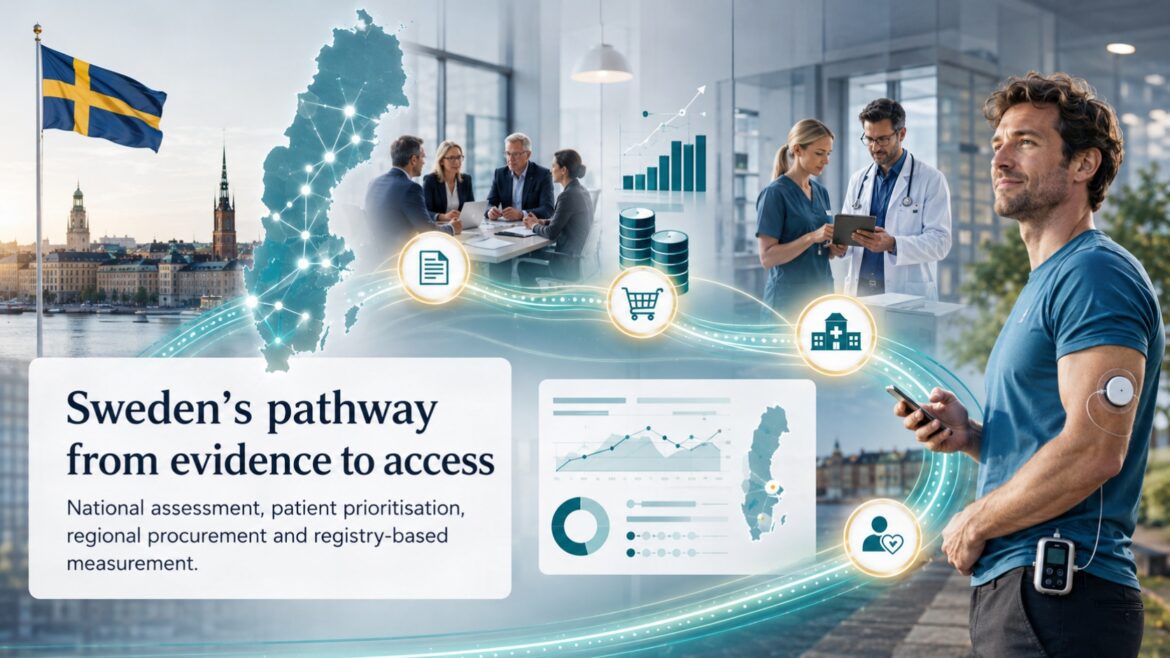
A high-value, high-cost technology was moved from clinical promise towards structured regional access through a recognisable sequence: national selection, health economic assessment, patient prioritisation, pricing and procurement discipline, regional implementation, and real-world measurement.
For MedTech, diagnostics, digital health and AI companies, this is the access architecture that increasingly matters.
The important question is not simply whether Sweden has recommended Automated Insulin Delivery systems.
The important question is: how did Sweden decide who should receive them, who should pay, what price is justified, how regions should implement them, and how outcomes can be measured?
That is where the real market access lesson sits.
Sweden did not simply “approve” AID systems
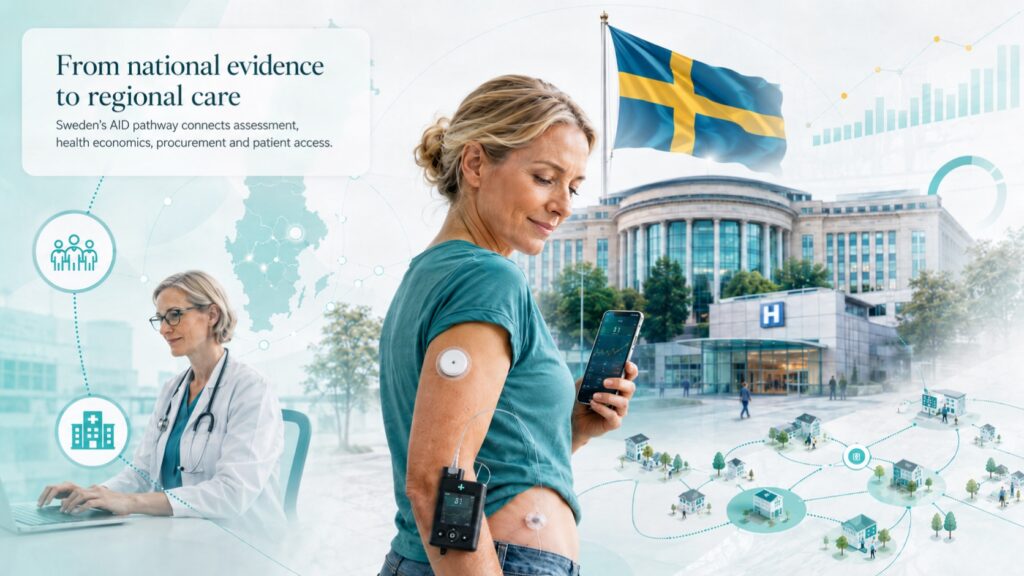
Automated Insulin Delivery systems, or AID systems, bring together three elements of modern diabetes care: an insulin pump, continuous glucose monitoring and an algorithm that adjusts insulin delivery in response to glucose data.
The promise is clear. Better glycaemic control. Less day-to-day treatment burden. Fewer dangerous episodes of hypoglycaemia for selected patients. Potential reduction in long-term diabetes complications.
But Sweden did not treat that promise as enough.
The Swedish process did not ask a simple question: is this technology innovative?
It asked the harder health-system question: how should this technology be introduced, for whom, at what price, and with what evidence that it will deliver value in routine care?
That distinction matters.
AID systems are not merely products. They change a pathway. They affect clinical workload, patient training, procurement budgets, data flows and long-term disease management. Their value depends on who receives them, how they are supported, and whether the expected benefits are realised outside the controlled setting of a study.
So Sweden approached the decision as a managed introduction problem.
The evidence had to identify the relevant comparator. The health economic model had to translate improved glucose control into costs, quality of life and long-term consequences. The recommendation had to define the patients most likely to benefit. The regions then had to consider procurement, affordability, implementation capacity and follow-up.
That is what makes the AID case important.
Sweden did not simply move from regulatory approval to reimbursement. It moved from evidence to access through a structured sequence of assessment, prioritisation, pricing, regional implementation and measurement.
In modern MedTech, access is no longer a single gate.
It is a pathway.
The Swedish model: national coordination, regional responsibility
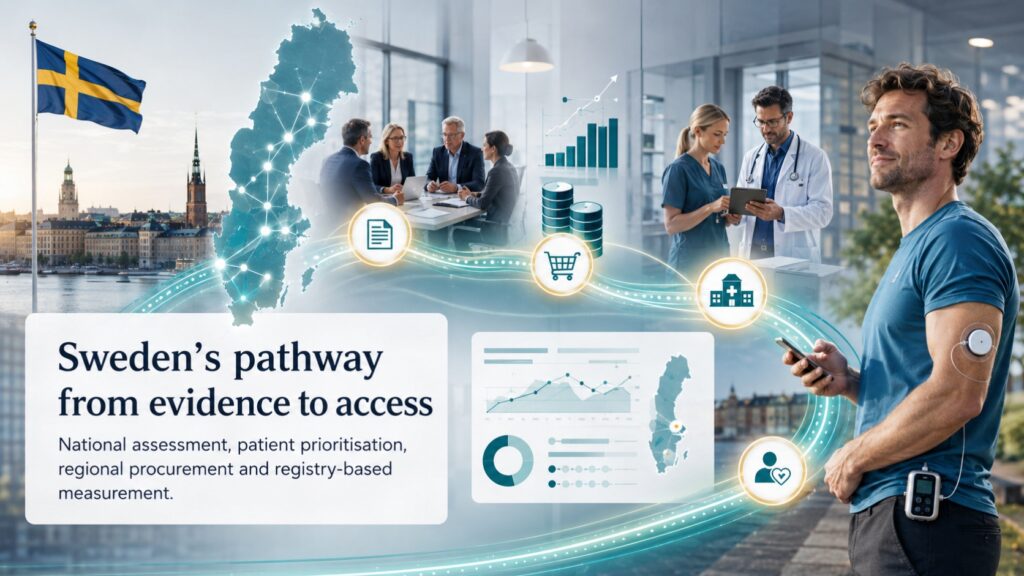
Swedish healthcare is decentralised. The regions are responsible for organising, funding, procuring and delivering most healthcare. That creates a particular challenge for new medical technologies.
If every region assesses each product separately, adoption can become fragmented. Some regions may move early. Others may wait. Evidence may be interpreted differently. Procurement may vary. Patients with similar clinical need may receive different access depending on where they live.
Sweden’s response is not to remove regional responsibility. It is to coordinate it.
For selected medical technologies, Sweden uses a national cooperation model called Nationell samverkan medicinteknik, also described as Regionernas samverkansmodell för medicinteknik. This is the structure through which Sweden’s regions can work together on technologies that raise national questions of clinical value, cost-effectiveness, priority-setting, procurement and implementation.
In practical terms, the process works as a form of managed introduction.
A technology or product group is identified as nationally relevant. It may be new, costly, clinically important, difficult to implement, or at risk of being adopted unevenly across the country. The technology can then be considered within the national medical technology cooperation model.
Within that model, MTP-rådet, the Medical Technologies Product Council, can decide that a recommendation should be prepared. Where health economic evidence is needed, TLV, the Swedish Dental and Pharmaceutical Benefits Agency, may be asked to assess the clinical and economic value of the technology. That assessment can then be used by MTP-rådet to issue a recommendation to Sweden’s regions.
This is the key distinction.
Sweden is not running a simple national reimbursement programme in which one central decision automatically funds and implements a product everywhere. It is running a national process that supports regional decision-making.
The national system creates a structured access signal. It asks whether the technology should be introduced, for which patients, on what evidence, and under what economic and implementation conditions.
The regions then make access real. They decide how the recommendation is handled locally, how procurement is organised, how budgets are allocated, which clinical services deliver the technology, how patients are selected, and how follow-up is managed.
So the Swedish model is neither fully centralised nor purely local.
It is nationally coordinated regional implementation.
That is why the AID case matters. It shows Sweden using national assessment and health economics to reduce uncertainty, define priority patient groups and guide the regions — while still leaving the practical work of funding, procurement and implementation to the regional healthcare system.
The role of SKR
SKR’s official page on Samverkan inom medicinteknik explains that the model includes MTP-rådet, a decision group with representatives from Sweden’s six healthcare cooperation regions, and that MTP-rådet issues recommendations on ordnat införande orderly or managed introduction and use of medical technologies.
https://skr.se/vardochbehandling/medicinteknik/samverkaninommedicinteknik.7899.html
SKR is important because it represents the regional structure of Swedish healthcare. The regions remain responsible for healthcare delivery, but the cooperation model gives them a way to act together when a new technology raises national questions of evidence, cost, equity, procurement and implementation.
In practice, SKR provides the coordinating framework around the regional cooperation model. It does not replace the regions as funders or implementers. Instead, it supports a system in which regional representatives, MTP-rådet, TLV, clinical experts and other stakeholders can work through the evidence and access questions before individual regions make implementation decisions.
For companies, this is a critical point. A Swedish market access strategy cannot be reduced to one hospital, one clinician, one payer or one procurement discussion. It requires understanding how national coordination and regional implementation interact.
The practical question is not only: “Can we sell this product in Sweden?”
It is:
Can we build a case strong enough for national coordination, credible enough for health economic assessment, practical enough for regional procurement, and measurable enough for clinical implementation?
The role of MTP-rådet
At the centre of this process is MTP-rådet, the Medicintekniska produktrådet, or Medical Technologies Product Council.
Official link:
https://samverkanmedicinteknik.se/mtp-radet
MTP-rådet is the decision group within Sweden’s regional cooperation model for medical technology. It has representatives from Sweden’s six healthcare cooperation regions and issues recommendations on ordnat införande — orderly or managed introduction — and the use of selected medical technologies.
But MTP-rådet is not simply an administrative committee.
Its function is to help the regions make complex, evidence-based decisions about technologies that may be clinically promising, economically challenging, difficult to implement, or likely to create unequal access if every region acts alone.
In practical terms, MTP-rådet asks whether a technology should enter a structured national process. Its investigators can identify or receive nominations for technologies that may be relevant for national orderly introduction. MTP-rådet can then decide whether a national recommendation should be prepared. That decision is made using prioritisation criteria, and where several similar products exist, the recommendation may cover a whole product group rather than one named product.
That is important for MedTech.
It means Sweden may assess the category of innovation, not only an individual device. In the AID case, this matters because the clinical and economic question was not simply whether one branded pump works. The question was whether advanced insulin pump systems, as a technology group, should be introduced for defined adults with type 1 diabetes.
Scientifically, MTP-rådet’s role is to convert evidence into a usable health-system recommendation.
It does not replace the health economic assessment. For that, it can involve TLV. It does not replace the regions. The regions still decide and implement locally. Instead, MTP-rådet sits between evidence generation and regional adoption. It interprets the clinical, economic, ethical and practical evidence and turns that into a recommendation the regions can use.
That recommendation may say a product or product group should be used, may be used, should not yet be used, or should be avoided. It can also define conditions: which patients should be prioritised, what uncertainty remains, whether further evidence is needed, and what implementation considerations matter.
Its recommendations are not casual advice. The official Swedish material says an MTP-rådet recommendation should be strongly guiding for the handling of medical technologies in healthcare. But it is still a recommendation to the regions, not a legal instruction that automatically forces every region to implement a product overnight.
That is the Swedish nuance.
MTP-rådet creates national direction, consistency and evidence discipline. The regions still carry the responsibility for funding, procurement and implementation.
TLV supplies the health economic spine
For the AID systems decision, MTP-rådet asked TLV, the Tandvårds- och läkemedelsförmånsverket, to carry out the health economic evaluation.
Official TLV link to the completed AID assessment:
https://www.tlv.se/medicinteknikforetag/halsoekonomiska-bedomningar-och-rapporter-medicintekniska-produkter/avslutade-bedomningar/2025-12-17-halsoekonomisk-bedomning-av-avancerade-insulinpumpar.html
TLV’s role was crucial because it supplied the economic spine of the recommendation.
It did not simply ask whether AID systems work. It asked whether this product group creates enough value, in the right adult type 1 diabetes population, compared with relevant existing care, to justify regional investment.
That is what health economic assessment does. It translates clinical effect into consequences that a healthcare system can use: costs, health outcomes, quality of life, uncertainty, budget pressure, and the likely value of using the technology in different patient groups.
TLV’s wider role in medical devices is also important. TLV explains that its health economic evaluations of medical devices are intended to support clinical and procurement decisions made by the regions. These assessments are not binding decisions, because the regions have autonomy in organising healthcare services, but they provide a structured evidence base for regional decision-making.
https://www.tlv.se/in-english/medical-devices/health-economic-evaluations.html
https://www.tlv.se/in-english/medical-devices/health-economic-evaluations/health-technology-assessment.html
In September 2024, TLV announced that MTP-rådet had asked it to evaluate advanced insulin pumps, then described as hybrid closed-loop systems, for adults with type 1 diabetes. TLV explained that it would begin with a preliminary study to determine how the health economic assessment should be carried out for the product group.
https://www.tlv.se/press/nyheter/arkiv/2024-09-20-tlv-ska-utvardera-avancerade-insulinpumpar.html
That first step matters.
Before a model can be built, the assessment question has to be framed. TLV needed to define the technology group, the intended population, the comparator, the relevant outcomes, the time horizon, the cost categories and the uncertainty that had to be tested.
By December 2025, TLV had completed the health economic evaluation of advanced insulin pump systems for automated insulin delivery, or AID systems, in adults with type 1 diabetes.
https://www.tlv.se/press/nyheter/arkiv/2025-12-17-tlv-avslutar-stort-projekt-for-att-utvardera-avancerade-insulinpumpar.html
A key feature was that TLV assessed the product group, not just one named branded system.
That is significant for MedTech. In many device and digital categories, several products may perform a similar function but differ in price, usability, integration, support needs, procurement arrangements and service burden. A category-level assessment asks the system-level question: what is the value of this type of technology in this clinical pathway?
For AID systems, the comparator was not “no treatment”. It was relevant existing care: insulin pen therapy in combination with glucose monitoring. This is essential because health economics is always comparative. A company cannot simply show that a technology works. It must show that it improves outcomes compared with what the healthcare system is already doing.
The expected value mechanism for AID systems is clinically plausible: improved glycaemic control, reduced daily treatment burden, lower risk or fear of hypoglycaemia in selected patients, improved quality of life, and potential reduction in long-term diabetes complications.
But TLV’s assessment also shows why patient selection matters.
The value case was not treated as identical for every adult with type 1 diabetes. TLV assessed patient groups with different baseline HbA1c levels. HbA1c reflects long-term blood glucose control, so patients with higher baseline HbA1c have greater scope for improvement and potentially greater long-term benefit from better glucose control.
That changes the economics.
The same technology can be more cost-effective in one subgroup than another because baseline risk, expected benefit and avoided complications are different. This is why TLV’s assessment became the scientific foundation for a targeted recommendation rather than universal access.
In other words, TLV did not just ask:
“Is AID clinically beneficial?”
It asked:
“Where is AID clinically beneficial enough, economically credible enough, and sufficiently valuable to support regional introduction?”
That is the science of access.
It is where clinical evidence, patient stratification, modelling, cost-effectiveness, quality of life and uncertainty analysis become the basis for a real-world recommendation.
From evidence to recommendation
After TLV completed the health economic assessment, MTP-rådet converted the evidence into a national recommendation to Sweden’s regions.
On 16 June 2026, MTP-rådet issued its recommendation for AID systems in adults with type 1 diabetes.
The following day, the national medical technology cooperation site explained the logic more clearly: the regions were encouraged to direct advanced insulin pumps to patients with the greatest medical need. The recommendation was based on TLV’s health economic evaluation, medical evidence summaries and ethical considerations.
This was not a universal entitlement.
It was a targeted recommendation.
AID systems should be offered to adults with type 1 diabetes who have a high risk of hypoglycaemia and to those with long-term high blood glucose levels above 70 mmol/mol.
Selected patients with HbA1c between 64 and 70 mmol/mol may also be offered AID systems, as may patients whose diabetes management requires substantial effort, regardless of HbA1c level.
Patients already using AID systems and benefiting from them should be able to continue.
This is not crude rationing. It is prioritisation.
Sweden is saying: use the technology where clinical need, likely benefit and economic value are most aligned.
The ethical logic
The Swedish process is not only technical. It is also ethical.
MTP-rådet works within the principles used for prioritisation in Swedish healthcare. This matters because health systems do not have unlimited resources. When a high-cost technology is introduced widely, the money, staff time and service capacity must come from somewhere.
The question is not only: does the technology help?
The question is also: who should receive it first, and what might be displaced if adoption is not controlled?
In the AID case, the official Swedish communication explicitly recognises the risk of displacement effects in healthcare. Even if not all adults with type 1 diabetes are eligible, the total cost could still be significant. There may also be practical capacity limits: diabetes teams need time to identify patients, prescribe the system, train users and provide follow-up.
This is the kind of issue that companies often underestimate.
A device can be clinically strong and economically plausible, but still difficult to scale if the implementation burden is ignored.
Are the regions forced to adopt?
No.
This is one of the most important points for companies to understand.
After MTP-rådet issues a recommendation that a product should or may be introduced, each region decides whether implementation should occur in line with that recommendation. Implementation is then handled according to each region’s local routines. The individual region remains responsible for introducing the recommended product.
So the Swedish model sits between two extremes.
It is not a fully centralised national reimbursement command.
But it is also not a purely local free-for-all.
It is a nationally coordinated access signal, followed by regional implementation.
That is why the Swedish process is so interesting. It gives national structure without removing regional responsibility.
Who pays?
The regions pay.
The recommendation does not create a separate automatic national MedTech reimbursement pot. Funding must be made real through regional healthcare budgets, procurement processes, diabetes services, training, clinical pathways and follow-up.
That means the practical route to access is not simply:
recommendation published → product adopted everywhere.
It is more likely to be:
recommendation published → regions review local position → procurement and pricing are addressed → eligible patient groups are identified → clinical services implement → uptake and outcomes are followed.
This is why pricing matters so much.
The official Swedish commentary on the AID recommendation states that cost-effective prices are not available in all regions, that prices vary between systems and regions, and that regions need to work strategically with procurement and purchasing statistics.
That is an unusually useful access message.
It means that the recommendation is not a blank cheque. It is conditional in practice on the ability of regions to procure AID systems at prices consistent with value.
For companies, the lesson is clear.
The health economic model opens the door. Procurement decides whether the door stays open.
Pricing is part of the evidence story
Many companies treat price as something to be negotiated after the evidence case is complete.
Sweden’s AID example suggests a more disciplined approach.
Price is not separate from value. Price determines whether the value case survives contact with the healthcare system.
A technology may look cost-effective at one price and unattractive at another. It may be affordable in a narrow subgroup but unaffordable in a broad population. It may create long-term value but short-term budget pressure. It may require procurement alignment across regions to avoid variation in access and cost.
For AID systems, Sweden’s recommendation recognises that the same technology class can create different value in different patients and that regional prices may vary.
That makes procurement part of the access pathway.
For companies, the pricing case should therefore be built into the dossier from the beginning. A credible Swedish access dossier should explain not only the clinical benefit, but the pricing logic, expected budget impact, procurement options and the relationship between price and measurable health-system value.
Who manages the roll-out?
There is no single Swedish national roll-out manager equivalent to a centrally commanded NHS programme.
Instead, responsibility is distributed.
SKR coordinates and manages the regional cooperation model on behalf of all regions.
MTP-rådet issues the national recommendation.
TLV provides the health economic assessment.
The regions fund, procure and implement.
Clinical services identify eligible patients, prescribe or provide the technology, train users and follow outcomes.
This is why market access in Sweden cannot be reduced to one submission. Companies need a national evidence story and a regional implementation story.
The national evidence story explains why the technology should be introduced.
The regional implementation story explains how it can be introduced without creating unmanageable budget, workforce or pathway pressure.
Both are necessary.
What gets measured?
The formal recommendation is published by MTP-rådet and the national cooperation model. TLV publishes the health economic evaluation. But the real-world consequences of implementation are likely to be seen through Sweden’s diabetes data infrastructure.
The most important registry in this context is the Nationella Diabetesregistret, the Swedish National Diabetes Register, or NDR.
NDR was launched in 1996 to support evidence-based development of diabetes care. It reports on glycaemic treatment, risk factors and complications, and supports quality improvement in hospitals and primary care.
This is not a minor detail.
Registry infrastructure changes the access conversation.
It allows a health system to move beyond pre-launch claims and ask what happens after adoption.
Are eligible patients receiving access?
Does uptake vary by region?
Are patients with the highest clinical need being prioritised?
What happens to HbA1c?
What happens to hypoglycaemia risk?
Can time in range be tracked?
Does the technology reduce long-term complications?
Does access remain equitable?
What happens to service workload?
Does real-world use match the assumptions in the health economic model?
That is why registries matter. In modern MedTech access, registry data is not an academic afterthought. It is part of the reimbursement architecture.
Reimbursement is not one moment
The Swedish AID case is a useful correction to a common misunderstanding.
Reimbursement is often described as if it were a single event: a yes-or-no decision, a code, a listing, a tariff, a national approval.
Sweden shows something more sophisticated.
The pathway is:
clinical need;
national horizon scanning or product selection;
decision to prepare a recommendation;
health economic assessment;
medical and ethical review;
recommendation to the regions;
patient-group prioritisation;
regional procurement;
local implementation;
real-world measurement.
This is reimbursement as a managed process, not reimbursement as a switch.
Why this matters beyond diabetes
The AID case is relevant far beyond type 1 diabetes.
Many of the technologies now entering European healthcare face the same access problem.
AI diagnostics, digital therapeutics, connected implants, point-of-care diagnostics, robotic systems, remote monitoring platforms and algorithm-supported care models may all be clinically promising. But their value depends on where and how they are used.
They may benefit some patients more than others.
They may require pathway redesign.
They may shift costs between budgets.
They may depend on staff training, software integration and patient adherence.
They may generate value through avoided admissions, fewer complications, better long-term disease control, improved workforce efficiency or reduced treatment burden.
They may also be unaffordable if used without patient selection or pricing discipline.
Sweden’s AID recommendation shows how a serious health system approaches that problem.
It does not ask only: is this technology innovative?
It asks: who needs it, what does it replace, what value does it create, what price is justified, who pays, who implements, and how will we know whether it worked?
The access dossier companies need
For MedTech companies, the Swedish message is direct: access is not won at the moment of regulatory approval. It is won much earlier, when the company begins to assemble the scientific, economic and operational case that a healthcare system can trust.
A company entering Sweden should not arrive with a product brochure, a CE mark and a set of optimistic clinical claims.
It should arrive with an access dossier.
That dossier needs to do more than describe the technology. It must explain the disease burden, the unmet need, the current standard of care, the relevant comparator, the number of patients who may be eligible, and the subgroup in which the technology is expected to create the greatest value.
It must also show where the technology belongs in the pathway.
Is it used before failure of current care, after failure of current care, as a replacement for an existing intervention, or as an add-on that increases short-term cost but may reduce long-term complications? Does it change clinical decision-making? Does it reduce admissions, procedures, staff time, complications or future treatment costs? Does it improve quality of life in a way that is measurable and credible?
These are not marketing questions. They are access questions.
The Swedish AID example makes this clear. The issue was not simply whether automated insulin delivery works. The issue was whether the technology creates sufficient value in defined adult type 1 diabetes populations, compared with insulin pen therapy and glucose monitoring, at a price and implementation burden that regions can justify.
That is the level of argument companies need to prepare.
A strong access dossier should therefore contain four connected cases: the scientific case, the health economic case, the implementation case and the measurement case. If any one of these is weak, adoption becomes harder, even if the product is technically impressive.
The scientific case
The scientific case must show more than clinical enthusiasm.
It should explain the mechanism by which the technology changes care and then support that mechanism with evidence. For AID systems, the mechanism is not simply “better technology”. It is improved glycaemic control, reduced treatment burden, fewer dangerous hypoglycaemic events in selected patients, and the possibility of reducing long-term diabetes complications.
For another technology, the mechanism may be earlier diagnosis, better risk stratification, improved surgical precision, fewer complications, reduced length of stay, better adherence, earlier discharge, or avoidance of downstream treatment.
The evidence package needs to be organised around this mechanism.
That means clinical effectiveness, safety, usability, patient-reported outcomes where relevant, and evidence that the claimed benefit is meaningful in real practice. It also means being honest about uncertainty. Are the studies randomised or observational? Are they single-centre or multicentre? Are the patients comparable to Swedish patients? Are the outcomes surrogate, intermediate or final? Is follow-up long enough to support the economic model? Are there data on discontinuation, adherence, training burden or device failure?
For MedTech, these questions matter because the value of a device is often inseparable from the pathway in which it is used.
A diagnostic test only creates value if the result changes a decision.
A surgical device only creates value if it changes outcomes, complications, operating time, revision risk or hospital resource use.
A digital tool only creates value if patients and clinicians use it consistently and if the data are acted upon.
A connected care platform only creates value if it reduces risk, improves control or shifts care safely into a lower-cost setting.
The scientific case therefore has to move from “the product works” to “the product changes care in a way that matters”.
The health economic case
The health economic case must translate the clinical mechanism into value.
This is where many MedTech submissions fail. They present clinical outcomes and then assume the economic case is obvious. It rarely is.
The economic model has to make the pathway explicit. It must define the comparator, the eligible population, the time horizon, the cost categories, the expected health gains, the avoided events, the quality-of-life impact and the uncertainty around each assumption.
For technologies such as AID systems, this means modelling not only the cost of the pump, sensor, consumables, software and clinical support, but also the expected effect on glycaemic control, hypoglycaemia, complications, quality of life and long-term healthcare utilisation.
It also means testing subgroups.
The Swedish AID case is important because the value case was not treated as identical for every adult with type 1 diabetes. Baseline HbA1c mattered. Hypoglycaemia risk mattered. Treatment burden mattered. These factors changed the expected benefit and therefore changed the economic argument.
That is the science of access.
Cost-effectiveness is not a slogan. It is a structured argument about who benefits, by how much, at what cost, over what time horizon, and with what uncertainty.
A credible health economic case should therefore include scenario analyses, sensitivity analyses and a clear explanation of the assumptions that drive the model. It should show what happens if uptake is higher than expected, if the device price changes, if discontinuation is significant, if clinical benefit is smaller in routine care, or if staff time is greater than anticipated.
It should also distinguish between long-term cost-effectiveness and short-term affordability.
A technology may be cost-effective over a lifetime but still difficult for a region to fund this year. It may reduce future complications but require immediate expenditure on devices, training, staffing and follow-up. It may save costs in one part of the system while creating pressure in another.
That is why budget impact is not a secondary appendix. It is central to whether adoption happens.
The implementation case
The implementation case is just as important as the model.
A technology may be clinically effective and economically attractive on paper, but still fail if the system cannot introduce it.
Companies need to show how the product will actually enter care.
Who identifies eligible patients? Which clinical team owns the pathway? What training is required? How long does initiation take? How often is follow-up needed? What happens if a patient stops using the technology? What technical support is required? What data are captured routinely? Which outcomes are reported? How are adverse events managed? How is equity protected across regions?
In Sweden, this matters because the regions remain responsible for funding, procurement and implementation. A national recommendation can guide adoption, but it does not create staff capacity, local workflows, procurement contracts or patient training programmes by itself.
For AID systems, implementation is not just the act of providing a device. Diabetes teams must identify the patients most likely to benefit, educate them, support initiation, troubleshoot use, monitor outcomes and decide whether treatment should continue. That requires workforce capacity and pathway design.
For other MedTech categories, the operational burden may look different, but it is always there. A diagnostic may require laboratory workflow changes. An AI tool may require IT integration, clinical governance and monitoring of algorithm performance. A surgical technology may require training, theatre scheduling and new procedure coding. A remote monitoring platform may require escalation protocols and responsibility for responding to alerts.
These are not administrative details. They are part of the value proposition.
If the company cannot explain implementation, the payer or region is left carrying the operational risk.
The procurement and pricing case
The pricing case must be explicit.
A favourable recommendation does not remove the need for disciplined procurement. In Sweden, procurement is where the recommendation becomes real.
If the price is too high, if prices differ substantially between regions, if the budget impact is uncertain, or if adoption threatens to displace other care, implementation will slow. A company may have a positive evidence story and still struggle because the purchasing route does not match the value proposition.
The Swedish AID example is especially useful because the official commentary recognises pricing and procurement as part of the access challenge. Cost-effective prices are not available in all regions. Prices vary between systems and regions. The regions need to work strategically with procurement and purchasing statistics.
That is a very practical signal.
For companies, the pricing case should explain why the proposed price is justified by measurable health-system value. It should show how price relates to patient selection, expected outcomes, avoided costs, service burden and uncertainty. It should also consider whether different procurement arrangements may be needed for different regional contexts.
This is particularly important for technologies where costs and benefits occur at different times.
A device may require upfront expenditure but generate value through fewer complications over many years. A digital tool may increase monitoring costs but reduce avoidable deterioration. A diagnostic may add cost at the point of testing but prevent inappropriate treatment later. A surgical technology may increase procedure cost but reduce revision risk.
The pricing case has to connect these timeframes.
It must show the conditions under which the investment becomes reasonable.
The measurement case
The dossier should not end at launch.
The company must identify how outcomes will be measured after adoption. Registry data, real-world evidence, routine clinical data and quality indicators are no longer optional extras. They are becoming part of the access contract between innovation and the healthcare system.
This is particularly important in Sweden because registry infrastructure can make post-adoption measurement more credible.
In diabetes, the Nationella Diabetesregistret provides a national data environment in which uptake, treatment patterns, outcomes and regional variation can be followed over time. That makes the AID story more powerful. The recommendation can be judged not only by what was expected in the model, but by what happens in routine care.
For companies, this means the evidence plan should include data fields, endpoints, collection frequency, registry alignment and responsibility for analysis. It should define what success looks like after adoption.
The relevant measures will vary by technology, but the questions are consistent.
Are eligible patients being reached?
Is access equitable across regions?
Is the technology being used as intended?
Are outcomes improving?
Is the implementation burden acceptable?
Are complications, discontinuation or safety events being captured?
Does real-world performance match the assumptions used in the model?
Does the value case remain defensible after launch?
This is where MedTech access is moving.
The evidence dossier is no longer a static pre-launch document. It is becoming a living evidence architecture that begins before adoption and continues after implementation.
The lesson for MedTech companies
Sweden’s AID recommendation is not just a diabetes technology story.
It is a blueprint for modern MedTech access.
The pathway is not:
regulatory approval → sales discussion → reimbursement hope
It is:
clinical need → evidence strategy → health economic modelling → access dossier → national assessment → patient prioritisation → regional procurement → implementation → registry-based measurement
That pathway is more demanding, but it is also more rational.
It tells companies what the healthcare system needs to see before it can act. It needs credible science, a defined population, a relevant comparator, a transparent model, a defensible price, an implementation plan and a measurement system.
Innovation does not win access because it is clever.
It wins access when the healthcare system can see why the technology is needed, who should receive it first, what value it creates, what it costs, how it can be introduced without damaging other services, and how the promised outcomes will be measured in real life.
That is Sweden’s quiet lesson.
And it is one that every MedTech company should understand before entering the market.
Official reference list
[1] Sveriges Kommuner och Regioner (SKR) — Samverkan inom medicinteknik
Official SKR page explaining Sweden’s regional cooperation model for medical technology, including MTP-rådet and the role of the six healthcare cooperation regions.
https://skr.se/vardochbehandling/medicinteknik/samverkaninommedicinteknik.7899.html
[2] Nationell samverkan medicinteknik — Ordnat införande
Official page explaining Sweden’s national orderly introduction process for medical technologies, including selection, health economic assessment, recommendation, procurement, implementation and follow-up.
https://samverkanmedicinteknik.se/ordnat-inforande
[3] Nationell samverkan medicinteknik — MTP-rådet
Official page for Medicintekniska produktrådet / MTP-rådet, the Medical Technologies Product Council that issues recommendations to the regions.
https://samverkanmedicinteknik.se/mtp-radet
[4] Nationell samverkan medicinteknik — Införande
Official implementation page explaining that, after an MTP-rådet recommendation, each region decides whether implementation should occur in line with the recommendation and remains responsible for local implementation.
https://samverkanmedicinteknik.se/ordnat-inforande/inforande
[5] TLV — “TLV ska utvärdera avancerade insulinpumpar”, 20 September 2024
Official TLV news item stating that MTP-rådet asked TLV to evaluate advanced insulin pumps / hybrid closed-loop systems for adults with type 1 diabetes.
https://www.tlv.se/press/nyheter/arkiv/2024-09-20-tlv-ska-utvardera-avancerade-insulinpumpar.html
[6] TLV — Health economic assessment of advanced insulin pumps, 17 December 2025
Official TLV page for the completed health economic assessment of AID systems for adults with type 1 diabetes.
https://www.tlv.se/medicinteknikforetag/halsoekonomiska-bedomningar-och-rapporter-medicintekniska-produkter/avslutade-bedomningar/2025-12-17-halsoekonomisk-bedomning-av-avancerade-insulinpumpar.html
[7] TLV — Completion news, 17 December 2025
Official TLV news item explaining that AID systems give clinically relevant improvement in glucose control compared with insulin pen plus glucose monitoring, and that cost-effectiveness varies by baseline HbA1c.
https://www.tlv.se/press/nyheter/arkiv/2025-12-17-tlv-avslutar-stort-projekt-for-att-utvardera-avancerade-insulinpumpar.html
[8] Nationell samverkan medicinteknik — AID recommendation page, 16 June 2026
Official recommendation page: “Avancerade insulinpumpar, AID-system, för vuxna med diabetes typ 1.”
https://samverkanmedicinteknik.se/rekommendationer/lista-pa-rekommendationer/rekommendationer/2026-06-16-avancerade-insulinpumpar-aid-system-for-vuxna-med-diabetes-typ-1
[9] Nationell samverkan medicinteknik — AID news release, 17 June 2026
Official news item explaining that regions are encouraged to direct advanced insulin pumps to patients with the greatest medical need, and that pricing, procurement and affordability are important.
https://samverkanmedicinteknik.se/nyheter/nyheter/2026-06-17-rekommendation-till-regionerna–avancerade-insulinpumpar-till-dem-med-storst-behov
[10] Nationella Diabetesregistret (NDR) — Swedish National Diabetes Register, English overview
Official NDR page explaining the register’s purpose in supporting evidence-based development of diabetes care and quality improvement.
https://ndr.registercentrum.se/in-english/the-swedish-national-diabetes-register/p/BJyILnupj
[11] Nationella Diabetesregistret (NDR) — Annual reports page
Official page listing NDR annual reports.
https://ndr.registercentrum.se/statistik/arsrapporter/p/Skf28_I3i
[12] Nationella Diabetesregistret (NDR) — Annual Report 2025 PDF
Official NDR 2025 annual report with diabetes technology uptake data, including glucose sensors, insulin pumps and algorithm-controlled pumps.
https://ndr.registercentrum.se/download?fileUrl=https%3A%2F%2Fregistercentrum.blob.core.windows.net%2Fndr%2Fr%2F-rsrapport-NDR-2025_kompr-ohyRvb7Gt.pdf