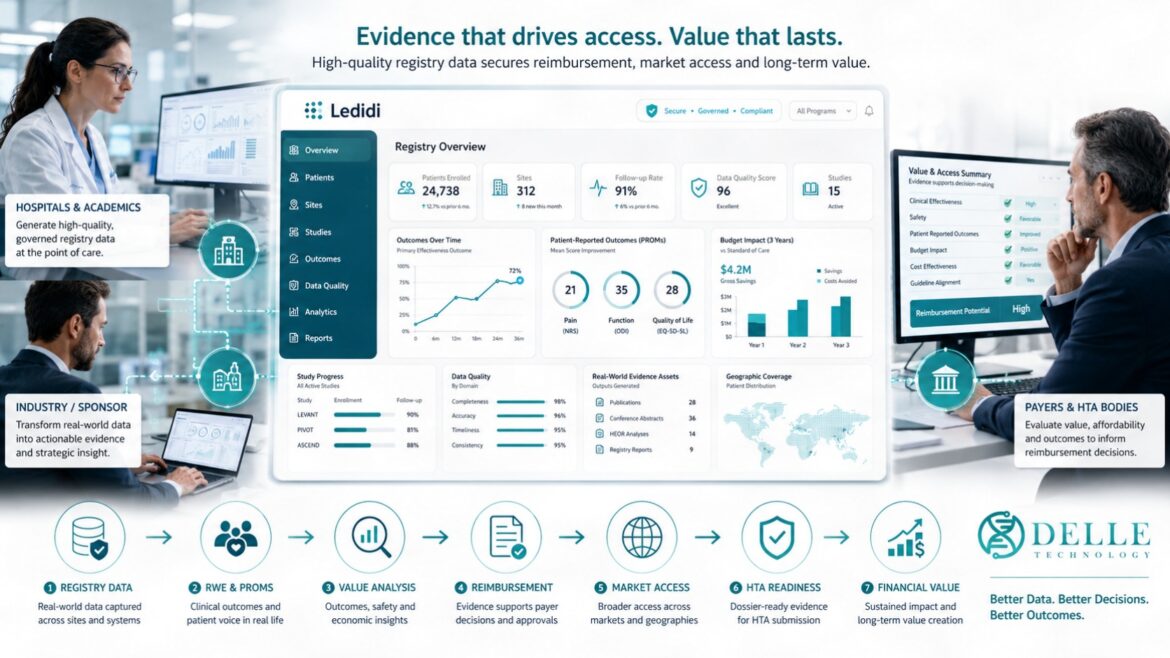
For many MedTech, IVD, digital health, biotech and pharmaceutical companies, the difficult question is no longer simply whether a technology can reach the market. Regulatory approval remains essential. A CE mark, UKCA mark, FDA clearance, FDA approval or national authorisation may open the door to clinical use. But it does not, by itself, answer the harder question that hospitals, payers, procurement committees, insurers, HTA bodies and regional healthcare systems are now asking with increasing discipline: why should this technology be funded, at this price, in this pathway, for this patient population, in our healthcare system, when budgets are constrained and the opportunity cost of every adoption decision is rising?
That question is changing the strategic role of registries. A registry is no longer merely a database for academic follow-up or a passive post-market repository. Used properly, it becomes reimbursement infrastructure. It becomes the evidence spine connecting regulatory obligations, post-market surveillance, real-world evidence, patient-reported outcomes, health-economic modelling, hospital value analysis, clinical publication, payer negotiation and wider market access. It is the mechanism through which a company can move from saying “our product works” to showing “our product creates measurable clinical, patient, operational and economic value in routine care”.
The next point is even more important. High-quality registries may not only support individual reimbursement applications. Over time, they may help shape the evidence standards expected by HTA bodies, payers and hospital systems for whole categories of technology. If a registry in a defined field consistently captures patient selection, comparator care, outcomes, PROMs, resource use, safety signals, subgroup performance and economic consequences, it begins to define what good evidence looks like. In that sense, registries are not only tools for proving value after launch. They may become part of the machinery through which HTA expectations mature.
This is why platforms such as Ledidi are interesting. Ledidi is not positioning registry work as an isolated data-storage exercise. Its MedTech and Diagnostics materials frame evidence generation as part of a full evidence lifecycle: early clinical studies, regulatory-ready evidence, CE, UKCA, FDA, MDR and IVDR requirements, registries, PMCF, real-world evidence, post-market surveillance, market access and reimbursement. Its Biotech and Pharma materials add another dimension: evidence quality, governance, capital efficiency, partner-ready evidence, auditability, data integrity and the reuse of evidence beyond a single study. Its Hospitals and Academics materials complete the picture by emphasising institutional control, privacy, governance, reduced administrative burden, secure collaboration and reusable research infrastructure.
That combination matters. A registry becomes powerful only when all sides see value. Manufacturers gain reimbursement evidence. Hospitals gain reusable research infrastructure. Clinicians gain publishable insight. Patients gain a stronger voice. Regulators gain post-market evidence. Payers gain a more credible basis for funding decisions. HTA bodies gain real-world data that may reduce uncertainty, refine patient selection and support future reassessment.
1. Regulatory approval and reimbursement are different evidence worlds
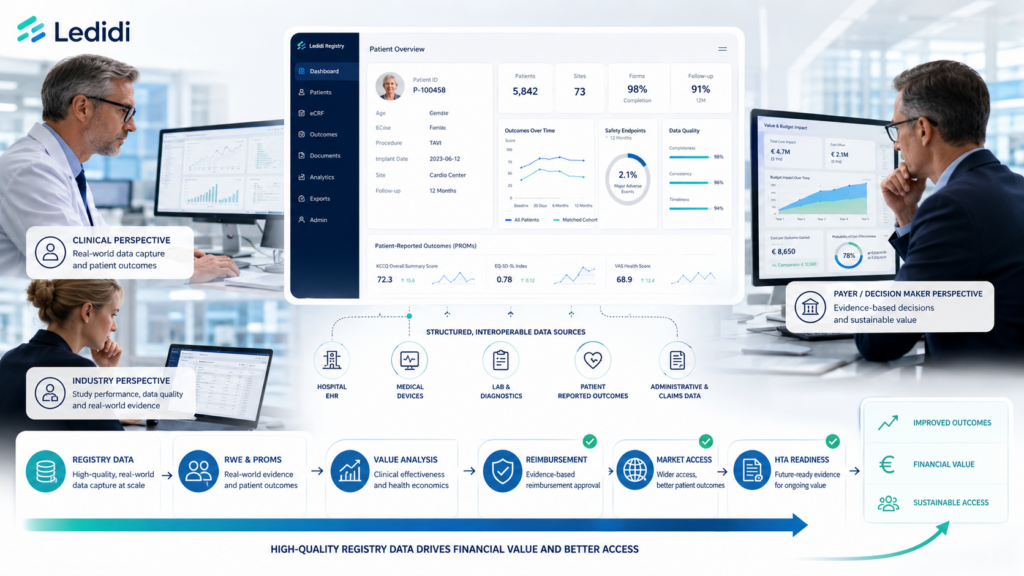
One of the most common mistakes made by innovative companies is assuming that the evidence required to enter the market is the same as the evidence required to be paid for within the market. These are different questions, asked by different institutions, with different consequences.
Table 1. From regulatory approval to reimbursed adoption
| Dimension | Regulatory approval question | Reimbursement / market-access question | Registry contribution |
|---|---|---|---|
| Core decision | Can the technology be placed on the market and used safely? | Should the health system pay for it, at this price, in this pathway? | Shows real-world performance, outcomes, resource use and patient value after launch |
| Evidence logic | Safety, performance, conformity, intended use, benefit-risk | Comparative value, affordability, budget impact, clinical utility and operational utility | Converts early use into payer-relevant evidence |
| Comparator | Intended use, performance claims, clinical performance benchmarks | Current standard of care, local pathway, alternative technology, no intervention | Enables comparison with actual care |
| Population | Intended-use population | Reimbursable population, often narrower and economically defined | Identifies high-value subgroups and appropriate-use criteria |
| Time horizon | Often pre-market or early clinical evidence | Short-term affordability plus longer-term consequences | Captures durability, readmissions, complications, retreatment and follow-up |
| Decision consequence | Permission to market or use | Coverage, reimbursement, procurement, price, scale-up, reassessment | Supports conditional reimbursement, value analysis and payer confidence |
| Risk if weak | Regulatory delay or restricted indication | Adoption stalls despite approval; price pressure; weak procurement | Provides evidence needed to defend adoption after launch |
Regulatory evidence allows a product to be used. Reimbursement evidence determines whether a healthcare system is willing to pay for it, scale it and defend its use under financial pressure. A product can be safe and perform as intended and still fail commercially because no one has shown how it changes the economics of care.
This is why the first hospital introduction should not be treated merely as a sales event. It should be treated as the beginning of an evidence programme. The first hospitals are not simply customers. They are reference sites, data-generation sites, publication partners, workflow laboratories, health-economic observatories and, if approached properly, co-creators of the reimbursement case.
2. The registry as evidence spine
The strongest registries serve multiple decision-makers at once. They do not ask only what the manufacturer wants to prove. They ask what regulators, payers, HTA bodies, hospitals, clinicians and patients need to know.
Table 2. The registry as an evidence spine across stakeholders
| Stakeholder | Their underlying concern | Evidence they need | Registry output that helps |
|---|---|---|---|
| Regulator / notified body | Is the product safe and performing as expected after launch? | PMS, PMCF, PMPF, adverse events, performance drift, subgroup signals | Structured safety and performance follow-up |
| HTA body | Does the technology create meaningful incremental value? | Comparative outcomes, PROMs, utilities, resource use, uncertainty analysis | Real-world model inputs and updated effectiveness evidence |
| Payer / insurer | Is the technology affordable and worth funding? | Eligible population, uptake, budget impact, cost offsets, continuation criteria | Budget impact model and conditional coverage evidence |
| Hospital executive | Does this improve the service or add cost and complexity? | Bed days, staff time, theatre/lab capacity, readmissions, workflow burden | Hospital value-analysis dossier |
| Clinician | Which patients benefit and how should it be used? | Patient selection, outcomes, safety, learning curve, subgroup performance | Appropriate-use framework and publication data |
| Patient / advocacy group | Does this improve life, function or treatment burden? | PROMs, PREMs, quality of life, symptom change, confidence, convenience | Patient-value evidence and human impact story |
| Manufacturer / sponsor | Can value be defended and scaled across markets? | Outcomes, economics, publications, PMS/PMCF/PMPF, payer evidence | Integrated reimbursement and post-market evidence package |
This is the registry’s strategic role. It allows one evidence infrastructure to serve multiple decisions. The same dataset can support regulatory follow-up, payer negotiation, clinical publication, hospital value analysis and future HTA reassessment. The sophisticated company does not build one evidence system for regulators and another for payers. It builds one evidence spine.
3. The mathematical model behind the registry
The mathematical logic is simple, although the implementation is not.
Net Value = Clinical Benefit + Patient Benefit + System Benefit − Total Cost
Each component of that equation must be made visible. Clinical benefit may include fewer complications, faster diagnosis, improved survival, better functional outcomes, reduced infection, better treatment selection, fewer revisions, fewer adverse events or improved disease control. Patient benefit may include less pain, less anxiety, better quality of life, faster return to normal activity, fewer hospital visits, reduced treatment burden or greater confidence in care. System benefit may include reduced length of stay, released theatre capacity, fewer readmissions, fewer repeat tests, fewer unnecessary procedures, better staff productivity, shorter diagnostic delay, reduced antimicrobial misuse or improved pathway efficiency. Total cost includes not only the acquisition price of the device, test, software or therapy, but also training, staff time, consumables, infrastructure, maintenance, complications, follow-up, downstream treatments and the cost of not adopting a better pathway.
A registry is powerful because it allows these variables to be observed rather than merely asserted. Without registry data, the value equation is populated by assumptions, expert opinion, trial extrapolation or evidence borrowed from another country. With registry data, the company and its clinical partners can begin to replace assumptions with real-world values.
Table 3. Registry variables that turn clinical use into value evidence
| Value domain | Registry variables | Why it matters for reimbursement |
|---|---|---|
| Clinical benefit | Outcomes, complications, deterioration, response, survival, revision, infection | Shows whether the technology improves care compared with current practice |
| Patient benefit | PROMs, PREMs, pain, function, anxiety, quality of life, treatment burden | Shows whether benefit is meaningful to patients, not only clinicians |
| System benefit | Length of stay, theatre time, staff time, bed use, readmissions, outpatient visits | Shows whether the technology improves capacity, flow or efficiency |
| Economic impact | Unit costs, resource use, complications, follow-up, avoided care | Feeds cost-consequence, budget impact and cost-utility models |
| Safety and performance | Adverse events, performance drift, user issues, subgroup performance | Supports PMS, PMCF, PMPF and benefit-risk updates |
| Adoption and scalability | Site uptake, clinician use, training burden, workflow integration | Shows whether the technology can scale beyond early champions |
This is the point at which evidence starts to become market access.
4. The technology is not the product; the pathway is
Many companies still model the product alone. That is usually too narrow. Payers do not reimburse products in isolation. They reimburse pathways.
The correct question is not simply: what does the product cost?
The better question is: how does the product change the pathway, and what are the clinical, operational and economic consequences of that change?
A useful pathway equation is:
Total Pathway Cost = Diagnosis + Treatment or Procedure + Complications + Follow-up + Readmissions + Long-Term Care
If a technology adds cost to one part of the pathway but reduces complications, readmissions, follow-up intensity or long-term care, then the narrow acquisition-cost argument may be misleading. Conversely, if it adds cost but fails to change downstream outcomes or resource use, the market-access case weakens.
Table 4. Product cost versus pathway value
| Technology type | Narrow cost view | Better pathway question |
|---|---|---|
| IVD | What does the test cost? | What decision does the test change, and what downstream cost or harm does that decision avoid? |
| Surgical robot | What is the capital and consumable cost? | Does the robot reduce complications, length of stay, reoperations, variation or pathway burden? |
| Digital therapeutic | What is the subscription price? | Does engagement translate into durable clinical benefit and reduced service use? |
| AI diagnostic | What is the software cost? | Does the algorithm improve decisions without increasing unsafe false positives, workload or inequity? |
| Biotech therapy | What is the acquisition cost? | Does the therapy reduce progression, hospitalisation, rescue therapy, disability or carer burden? |
| Remote monitoring | What does the monitoring system cost? | Does earlier detection prevent deterioration, admissions, emergency care or unnecessary visits? |
This is why registry-based pathway modelling is central to modern reimbursement strategy.
5. IVDs: diagnostic value must be modelled downstream
For IVDs, the value often does not sit in the test itself. It sits in the decision the test enables. A rapid antimicrobial resistance test, sepsis diagnostic, molecular oncology assay, companion diagnostic or rule-out test may be economically valuable only if it changes management.
The diagnostic value chain is:
Test → Result → Decision → Treatment Change → Outcome Change → Resource-Use Change → Economic Value
The key equation for diagnostics is:
Diagnostic Value = Probability of Decision Change × Consequence of Decision Change
This is where many IVD reimbursement dossiers are weak. They demonstrate analytical validity and perhaps diagnostic accuracy, but they do not sufficiently demonstrate decision impact, treatment impact or downstream resource consequences.
Table 5. IVD registry variables and reimbursement purpose
| IVD registry variable | Reimbursement purpose |
|---|---|
| Test indication | Defines appropriate use and reimbursable population |
| Turnaround time | Shows whether the test changes the clinical window for action |
| Result category | Links the test to actionable patient stratification |
| Pre-test and post-test treatment | Demonstrates decision impact |
| Antibiotic escalation/de-escalation | Supports antimicrobial stewardship and resource-use arguments |
| Admissions, ICU transfers, readmissions | Captures downstream system consequences |
| Repeat testing and imaging | Shows whether diagnostic waste is reduced |
| PROMs and patient experience | Captures reduced uncertainty, confidence and treatment burden |
| Resource use and cost | Feeds budget impact and cost-consequence models |
Without registry evidence, the company may only be able to say: our test is accurate. With registry evidence, it can say: our test changed prescribing, reduced unnecessary treatment, improved time to appropriate therapy and reduced avoidable resource use in routine practice.
That is a reimbursement argument.
6. Surgical robots: visible cost, distributed value
Surgical robots are useful because they show why simple cost comparisons are often inadequate. The capital cost, maintenance cost and consumable cost are visible and immediate. The benefits may be distributed across complications, recovery, length of stay, reoperation, surgeon learning, theatre utilisation, institutional reputation and service-line development.
A basic robotic procedure cost model may be written as:
Cost per Robotic Case = Capital Allocation per Case + Maintenance per Case + Consumables + Staff Time + Theatre Time + Complication Cost + Follow-up Cost
But the strategic value model is broader:
Incremental Robotic Value = Avoided Complications + Avoided Bed Days + Avoided Reoperations + Improved Outcomes + Released Capacity + Strategic Service Value − Incremental Robotic Cost
Table 6. Surgical robot value-analysis framework
| Registry variable | Why it matters |
|---|---|
| Case mix and baseline risk | Allows fair comparison with conventional surgery |
| Surgeon experience and learning curve | Separates early inefficiency from mature performance |
| Operative time and theatre utilisation | Captures workflow and capacity effects |
| Conversion rates and blood loss | Measures procedural value |
| Complications and reoperations | Captures major cost and quality drivers |
| Length of stay and ICU use | Captures hospital capacity and cost impact |
| PROMs and return to function | Captures patient-level value |
| Capital utilisation and consumables | Enables realistic cost per case |
| Readmissions and follow-up | Captures downstream pathway impact |
| Referral and service-line growth | Captures strategic institutional value |
Without registry evidence, the robot is an expensive capital purchase. With registry evidence, it may become a service-line investment supported by measurable outcomes, pathway redesign and local value analysis.
7. Digital therapeutics and AI: modelling engagement, drift and persistence
For digital therapeutics and AI, the economic model depends heavily on what happens after launch. A DTx product may show efficacy in a trial, but real-world value depends on activation, engagement, adherence, persistence of use, clinical response and durability of effect.
The relevant equation is:
DTx Value = Engagement × Effect Size × Duration of Benefit × Avoided Resource Use
If engagement falls rapidly, the model weakens. If engagement is sustained and translates into fewer appointments, fewer relapses, reduced medication escalation or improved quality of life, the model strengthens.
For AI, the registry must monitor not only accuracy but also workflow impact, false positives, false negatives, clinician override, alert fatigue, subgroup performance, equity, drift and safety.
Table 7. Digital and AI registry variables
| Digital / AI registry variable | Reimbursement relevance |
|---|---|
| Activation and onboarding | Shows whether patients or clinicians actually begin using the product |
| Engagement and adherence | Determines whether efficacy can translate into real-world value |
| Dropout and persistence | Measures durability of use |
| Clinical response | Links use to outcome |
| PROMs and quality of life | Captures patient-centred benefit |
| Service use | Captures avoided appointments, admissions or escalation |
| Algorithm performance by subgroup | Supports safety, equity and trust |
| False positives / false negatives | Captures harm, waste and downstream burden |
| Clinician override and alert fatigue | Captures workflow reality |
| Performance drift | Supports post-market monitoring and reassessment |
The economic question is not whether the algorithm can perform under test conditions. It is whether it improves decisions enough to justify its cost, integration burden and governance requirements in real clinical practice.
8. Biotech and pharma: evidence as a long-term asset
For biotech and pharma companies, registries add another dimension: capital efficiency and evidence reuse. Early-stage companies often burn capital generating evidence for one milestone, one investor round, one partner discussion or one regulatory interaction, only to discover later that the data were not structured for HTA, payer dialogue, label expansion, subgroup analysis, real-world follow-up or future partnerships.
That is why the idea of clinical evidence as a long-term asset is so important. A sponsor-controlled evidence platform can allow variables, governance, workflows and datasets to be designed early so that evidence remains accessible, extensible and reusable across indications, submissions, partnerships, geographies and future market-access discussions.
Table 8. Sector-specific evidence pressure and registry value
| Sector | Evidence pressure | Registry / platform value | Market-access consequence |
|---|---|---|---|
| MedTech | MDR, PMCF, safety, performance, workflow, procurement | Links post-market evidence with clinical outcomes, resource use and value analysis | Supports adoption, reimbursement, reassessment and price defence |
| IVD / diagnostics | IVDR, PMPF, clinical utility, decision impact, downstream value | Captures test-to-decision-to-outcome evidence | Converts accuracy into reimbursement-relevant utility |
| DTx / AI | Engagement, persistence, safety, drift, equity, service impact | Tracks real-world use, adherence, performance and workflow burden | Supports payer confidence and reassessment |
| Biotech / pharma | Regulatory scrutiny, capital burn, partner-ready evidence, data integrity | Creates reusable, sponsor-controlled evidence assets across studies and geographies | Supports valuation, partnering, submissions, HTA and long-term payer strategy |
| Hospitals / academics | Data control, governance, collaboration, staff burden, publication | Creates reusable research infrastructure with institutional control | Supports credible evidence generation and clinical leadership |
The registry is not simply a place where data are stored. It is where clinical evidence becomes a reusable asset: regulatory evidence today, partner-ready evidence tomorrow, HTA evidence later, and post-market reimbursement evidence after launch.
9. Counterfactuals: what would have happened otherwise?
A registry is most valuable when it helps answer the question: what would have happened without the technology?
Reimbursement decisions are comparative. The company must show how the observed pathway with the technology compares with current standard care, historical controls, matched external controls, before-and-after practice, a pragmatic comparator or a registry-based control group.
The core health-economic equations are:
Incremental Cost = Cost with Technology − Cost with Standard Care
Incremental Outcome = Outcome with Technology − Outcome with Standard Care
Where the outcome is expressed in QALYs:
ICER = Incremental Cost / Incremental QALYs
For budget impact:
Annual Budget Impact = Eligible Population × Uptake Rate × Incremental Cost per Patient − Cost Offsets
For many MedTech, IVD and digital health cases, a cost-consequence analysis may be more persuasive than a pure cost-utility model because it shows multiple consequences separately.
Table 9. How registry data feed health-economic models
| Model type | Decision it supports | Key registry inputs | Main outputs | Best suited to |
|---|---|---|---|---|
| Hospital value analysis | Should this hospital adopt, expand or renew the technology? | Procedure time, bed days, staff time, complications, readmissions, consumables | Net hospital impact, capacity released, local cost offsets | MedTech, robotics, diagnostics, AI tools |
| Micro-costing | What does the pathway actually cost? | Staff minutes, theatre/lab time, consumables, capital use, follow-up visits | Episode cost, cost per case, cost drivers | Hospital-based devices, surgical tools, IVDs |
| Budget impact analysis | Can the payer afford adoption? | Eligible population, uptake, incremental cost, offsets, implementation costs | Annual budget impact, phased adoption scenarios | Payers, insurers, regional systems |
| Cost-consequence analysis | What are the multiple effects of adoption? | Outcomes, PROMs, complications, readmissions, workflow and cost data | Separate clinical, patient, system and cost outcomes | MedTech, IVDs, DTx where QALYs miss value |
| Cost-utility analysis | Is the technology cost-effective in QALY terms? | Utilities, survival, quality of life, event rates, resource use | ICER, QALYs gained, incremental costs | HTA submissions where QALYs are central |
| Subgroup economic analysis | Who should be reimbursed first? | Baseline risk, subgroup outcomes, subgroup costs, differential response | High-value patient segments, restricted indication | Conditional reimbursement, phased launch |
| Scenario analysis | What happens under different prices, uptake rates or assumptions? | Variable cost inputs, uptake curves, outcome ranges, uncertainty | Best/worst/base-case results | Price negotiation and payer confidence |
| Managed entry / reassessment model | Should funding continue, expand or stop? | Agreed outcomes, safety, PROMs, resource use, continuation thresholds | Reassessment evidence, payment conditions | Conditional coverage and evidence development |
A registry provides the inputs for each of these approaches.
10. Patient selection: the hidden reimbursement advantage
One of the strongest economic uses of a registry is identifying where the technology is most valuable.
Many technologies fail because the initial commercial claim is too broad. The company says the product is useful for everyone. The payer sees a large budget impact and uncertain value. A registry can identify where the technology is most valuable: high-risk patients, diagnostically uncertain patients, patients likely to deteriorate, patients with high resource use, patients at risk of readmission, patients with poor response to current care or patients most likely to experience quality-of-life improvement.
The average value of a technology may conceal the reimbursable value:
Average Value = Σ Subgroup Value × Subgroup Proportion
If one subgroup has high benefit and another has low benefit, a broad reimbursement claim may dilute the case. A registry allows the company to identify the subgroup in which:
Incremental Benefit / Incremental Cost
is most favourable.
This is not only a statistical point. It is a market-access strategy. Many technologies should not begin by asking for broad reimbursement. They should begin with the population in which the clinical, economic and budget-impact case is strongest, then expand as evidence accumulates.
11. Conditional reimbursement: the registry as the contract
Modern reimbursement is becoming less binary. Payers do not always need to say yes or no. They can say: we will fund this in selected centres; we will support this under a pilot; we will reimburse this conditionally; we will reassess after 12, 24 or 36 months; we need registry data; we need PROMs; we need safety monitoring; we need local budget impact; we need evidence of organisational value.
In this context, the registry becomes part of the reimbursement contract. It gives the payer a way to say “yes, but with evidence”, rather than “no, not yet”.
Table 10. Registry role in market-access mechanisms
| Market-access mechanism | Role of registry |
|---|---|
| Hospital pilot | Captures local workflow, outcomes, costs and feasibility |
| Conditional reimbursement | Defines evidence requirements for continued funding |
| Managed entry agreement | Tracks outcomes, safety and budget impact |
| Coverage with evidence development | Allows access while uncertainty is reduced |
| HTA reassessment | Supplies updated real-world outcomes and resource use |
| Procurement renewal | Supports value defence and contract continuation |
| Price negotiation | Links price to observed value and patient selection |
| Market expansion | Converts early-site evidence into multi-site adoption |
This is where the registry stops being an academic tool and becomes a market-access instrument.
12. Could registries feed future HTA assessment standards?
This is the most strategically interesting question.
Yes — not in the sense that a company-owned registry automatically becomes an HTA standard, and not in the sense that registry data replace randomised trials where randomised evidence is required. But high-quality, well-governed, methodologically credible registries can increasingly influence what HTA bodies, payers and hospital systems expect from a technology category.
This may happen in several ways.
First, registries can define the minimum dataset that becomes expected for a category. If leading centres evaluating robotic surgery consistently capture case mix, operative time, learning curve, complications, length of stay, readmissions, PROMs and capital utilisation, those variables may become the informal evidence standard for future robotic surgery value assessments. A company entering the category without those variables will look underprepared.
Second, registries can define appropriate endpoints. For a rapid IVD, it may no longer be enough to show accuracy and turnaround time. The expected evidence may become test-to-decision time, treatment change, escalation or de-escalation, admission avoidance, antimicrobial use, readmission and patient experience. The registry therefore helps shift the standard from analytical performance to clinical utility and pathway value.
Third, registries can define appropriate-use populations. HTA bodies and payers often want to know not only whether a technology works, but where it works best. Registries can identify the high-value subgroup and therefore help define the reimbursable population.
Fourth, registries can define model structure. If registry evidence repeatedly shows that value is driven by avoided bed days, avoided complications, reduced ICU transfer, earlier discharge or improved adherence, those variables may become expected in future budget impact or cost-consequence models.
Fifth, registries can support reassessment standards. Technologies increasingly evolve after launch, particularly software, AI, digital therapeutics, diagnostics and iterative devices. A registry can provide the evidence structure for reassessment: what must be monitored, how often, in which population, with what thresholds, and with what consequences for continued funding.
This is why registries may become more than supporting evidence. They may become part of the machinery through which HTA expectations evolve.
Table 11. From registry evidence to HTA expectations
| Registry output | How it can influence HTA expectations |
|---|---|
| Standardised baseline variables | Defines what case-mix adjustment should include |
| Comparator pathway data | Clarifies what current standard care looks like in practice |
| PROMs and PREMs | Encourages patient-centred outcomes to become expected evidence |
| Resource-use variables | Defines what economic models should measure |
| Subgroup performance | Helps define reimbursable populations and appropriate-use criteria |
| Longitudinal outcomes | Supports reassessment, durability and post-launch evidence expectations |
| Safety/performance monitoring | Links PMS, PMCF/PMPF and HTA reassessment |
| Multi-site evidence | Improves generalisability and transferability |
| Publication and peer review | Converts local data into category-level evidence |
| Model-ready datasets | Shapes future budget impact, cost-consequence and cost-utility models |
The highest-value registries are therefore not merely descriptive. They are model-ready, HTA-ready and reassessment-ready.
13. PMS, PMCF and PMPF: one evidence spine, multiple uses
Post-market surveillance should be viewed through the same lens. For medical devices and IVDs, PMS, PMCF and PMPF are often discussed as regulatory obligations. They are that, but they are also strategic assets.
A well-designed registry can support safety signal detection, performance drift monitoring, user learning-curve analysis, subgroup performance, long-term outcomes and benefit-risk updates. The same dataset may help answer regulatory questions about safety and performance, payer questions about outcomes and cost, hospital questions about workflow, clinician questions about appropriate use, and HTA questions about comparative value.
Table 12. One registry, multiple evidence uses
| Evidence need | Registry contribution |
|---|---|
| PMS | Tracks safety, adverse events, use patterns and field performance |
| PMCF | Confirms clinical performance and benefit-risk over time |
| PMPF | Confirms IVD performance in routine use and relevant subgroups |
| Reimbursement | Captures outcomes, resource use, PROMs and budget impact |
| Health economics | Supplies model inputs and scenario data |
| Publication | Generates abstracts, papers and clinical credibility |
| Procurement | Supports local value analysis and renewal decisions |
| Payer reassessment | Shows whether value persists after launch |
| HTA evolution | Helps define category-specific evidence expectations |
The clever company does not build one evidence system for regulators and another for payers. It builds one evidence spine.
14. The minimum dataset for a reimbursement-grade registry
A registry designed for reimbursement should begin with the end in mind. It should capture the evidence that decision-makers will actually need.
Table 13. Minimum dataset for a reimbursement-grade registry
| Dataset category | Examples |
|---|---|
| Patient baseline | Age, sex, disease severity, comorbidities, risk factors, prior treatment |
| Current pathway | Standard care, comparator treatment, diagnostic route, waiting time |
| Intervention details | Device/test/app/therapy used, operator, dose, version, setting |
| Clinical outcomes | Response, complications, deterioration, survival, revision, infection |
| Patient outcomes | PROMs, PREMs, pain, function, anxiety, quality of life |
| Safety | Adverse events, user issues, performance concerns, subgroup signals |
| Resource use | Staff time, theatre time, lab time, bed days, ICU use, visits |
| Downstream care | Readmissions, reinterventions, repeat testing, medication changes |
| Economic variables | Unit costs, cost offsets, consumables, capital allocation, follow-up costs |
| Modelling variables | Transition probabilities, event rates, subgroup identifiers, missing-data patterns |
| Publication variables | Follow-up completeness, endpoints, comparator logic, statistical plan |
| HTA-readiness variables | Comparator clarity, patient selection, uncertainty drivers, model-ready endpoints |
The challenge is balance. Too little data, and the registry is too weak to support reimbursement. Too much data, and hospitals stop collecting it. The most successful registries are lean but strategic. They collect the smallest dataset capable of answering the most important clinical, economic, regulatory and payer questions.
15. Why hospitals and academics are central
The hospital perspective is often underestimated. A registry that only serves a manufacturer’s reimbursement objective will struggle in busy clinical environments. Hospitals and academic teams are already managing multiple studies, sponsors, governance requirements and data systems. The best registries do not extract data from hospitals; they help hospitals become stronger evidence-generating institutions.
That matters for market access. Hospital-owned trust, governance, workflow fit and academic value are not peripheral issues. They are prerequisites for credible real-world evidence.
Table 14. What hospitals and academics gain from registry infrastructure
| Hospital / academic need | Why it matters | Registry value |
|---|---|---|
| Institutional control | Hospitals need clarity over ownership, access and reuse | Clear permissions, site visibility, governance and controlled sharing |
| Reduced staff burden | Clinicians and research nurses cannot manage unnecessary duplication | Structured workflows that reduce manual work and fragmented data capture |
| Multi-sponsor participation | Hospitals often work across industry and investigator-led studies | One reusable platform can reduce dependence on sponsor-specific systems |
| Academic independence | Evidence must not look like manufacturer-controlled marketing data | Investigator-led analyses, transparent governance and publication rules |
| Collaboration | Multicentre evidence is more persuasive for HTA and payers | Secure collaboration across sites, sponsors, CROs and research teams |
| Reusable infrastructure | One-off datasets are inefficient | Study frameworks and datasets can be reused across future projects |
| Quality improvement | Hospitals need evidence that improves their own services | Audit, benchmarking, pathway improvement and internal business cases |
| Publication | Clinicians need academic value from participation | Registry datasets can support abstracts, papers and conference work |
Clinicians and hospitals are more likely to participate when the registry supports their own needs, not only the company’s reimbursement ambitions.
16. Country relevance: why this matters across Europe
The use of registry evidence varies by country, but the direction is similar. Healthcare systems are increasingly asking for local, real-world, pathway-based and economically interpretable evidence.
Table 15. Country and pathway relevance
| Market | Why registries matter | Most relevant registry outputs |
|---|---|---|
| UK | NICE, NHS adoption and ICB business cases increasingly need evidence of real-world value, affordability and implementability | Cost-consequence evidence, budget impact, PROMs, local value analysis, evidence-generation plan |
| France | HAS/CNEDiMTS and hospital systems often need evidence of clinical benefit, organisational impact and post-market value | LPPR/CNEDiMTS evidence, Article 51-style pilot data, organisational impact, resource use |
| Germany | Hospital adoption may precede national reimbursement; NUB and procurement arguments need local clinical and cost justification | InEK/NUB support, hospital micro-costing, DRG gap evidence, G-BA readiness |
| Netherlands | Conditional and pragmatic evaluation culture favours structured real-world evidence | Registry-based outcomes, PROMs, long-term follow-up, comparative pathway data |
| Nordics | Strong registry culture makes real-world and linked-data evidence especially credible | Longitudinal outcomes, pragmatic trials, linkage-ready datasets, population-level follow-up |
| EU-wide | MDR/IVDR increases need for post-market evidence; EU HTA creates a stronger need for transferable comparative evidence | PMS, PMCF/PMPF, subgroup performance, RWE for HTA preparedness |
The common theme is that early use must be converted into structured evidence if adoption is to scale.
17. From registry evidence to reimbursement argument
A registry is valuable only if its findings can be translated into the language of decision-makers.
Table 16. From registry evidence to payer argument
| Registry finding | Market-access interpretation | Possible payer argument |
|---|---|---|
| Reduced length of stay | Releases bed capacity and reduces episode cost | Adoption may improve hospital flow and offset acquisition cost |
| Fewer complications | Improves quality and avoids costly rescue care | Higher upfront cost may be justified by avoided adverse events |
| Faster diagnosis | Changes the clinical decision window | Test value lies in earlier action, not only accuracy |
| Better PROMs | Patients experience meaningful benefit | Value includes function, pain, confidence and treatment burden |
| Lower readmissions | Reduces downstream system use | Budget impact should include avoided repeat care |
| High benefit in subgroup | Broad use may not be needed initially | Reimburse first in the high-value population |
| Engagement predicts benefit | DTx value depends on sustained use | Coverage may be linked to activation and adherence thresholds |
| Learning curve improves outcomes | Early performance may underestimate mature value | Evaluation should distinguish start-up phase from stable use |
| Stable post-market safety | Benefit-risk remains favourable in routine care | Supports continued reimbursement and scale-up |
| Poor performance in subgroup | Use should be refined, not necessarily abandoned | Registry supports appropriate-use criteria and payer confidence |
This is the language payers understand. The evidence is not simply descriptive. It becomes actionable.
18. Minimum mathematical structure for a registry-powered value story
A reimbursement registry should be able to feed a model. The mathematics do not need to be complex to be useful. They need to be explicit, credible and linked to real-world data.
Table 17. Mathematical structure for registry-powered value analysis
| Equation / concept | Meaning | Registry data needed |
|---|---|---|
| Net Value = Clinical Benefit + Patient Benefit + System Benefit − Total Cost | Overall value logic | Outcomes, PROMs, resource use, total cost |
| Incremental Cost = Cost with Technology − Cost with Standard Care | Additional cost of adoption | Pathway cost with and without technology |
| Incremental Outcome = Outcome with Technology − Outcome with Standard Care | Additional benefit | Clinical outcomes, PROMs, safety outcomes |
| ICER = Incremental Cost / Incremental QALYs | Cost per QALY gained | Utilities, survival, costs, transition probabilities |
| Budget Impact = Eligible Population × Uptake × Incremental Cost − Offsets | Annual affordability | Eligible population, uptake, cost per case, avoided costs |
| Diagnostic Value = Probability of Decision Change × Consequence of Decision Change | IVD-specific value logic | Treatment changes, outcome changes, resource consequences |
| DTx Value = Engagement × Effect Size × Duration × Avoided Resource Use | Digital therapeutic value logic | Engagement, adherence, outcomes, service-use reduction |
| Cost per Robotic Case = Capital Allocation + Maintenance + Consumables + Staff/Theatre Time + Complications | Surgical robot cost logic | Case volume, capital use, consumables, theatre time, complications |
| Average Value = Σ Subgroup Value × Subgroup Proportion | Population value may hide subgroup value | Subgroup outcomes, costs, baseline risk |
| Net Hospital Impact = Avoided Costs + Released Capacity + Quality Gains − Implementation Costs | Hospital value-analysis logic | Bed days, staff time, complications, implementation cost |
This mathematical structure does not make the evidence abstract. It makes it usable.
19. The strategic lesson
The most sophisticated companies will stop thinking of registries as post-market afterthoughts. They will design them as integrated evidence systems.
Before launch, they will ask what uncertainty regulators, payers, hospitals, clinicians and HTA bodies will have. They will define the comparator, the subgroup, the pathway, the outcomes, the PROMs, the resource-use variables and the model structure. They will decide whether the most appropriate economic approach is budget impact, cost-consequence analysis, cost-utility analysis, hospital value analysis, micro-costing or a combination of these. They will ensure the data capture supports PMS, PMCF or PMPF as well as market access. They will use early hospital adoption not only to sell, but to learn, refine, publish, model and negotiate.
The companies that win reimbursement will not simply be those with the most elegant technology. They will be those that can prove value continuously, credibly and locally. They will be able to show not only that the product works, but where it works best, for whom it works best, what it replaces, what it prevents, what it costs, what it saves, what it improves, what patients experience and how it changes the pathway.
Regulatory approval may open the door.
Registry evidence helps keep it open.
Modelling turns that evidence into a reimbursement argument.
Value analysis translates it for hospitals.
Budget impact analysis translates it for payers.
PROMs translate it for patients.
Post-market surveillance translates it for regulators.
Publication translates it for clinicians.
And, increasingly, high-quality registries may help shape the evidence expectations of HTA itself.
That is why registries are no longer just research infrastructure.
They are reimbursement infrastructure.
For MedTech, IVD, DTx, biotech and pharmaceutical companies, the future of market access will increasingly belong to those who understand that evidence does not end at launch.
It begins there.