
What the Dutch Pluvicto judgment reveals about national pricing power, hospital-compounded comparators and the limits of European reimbursement precedent
A European marketing authorisation can open a common regulatory route, but it does not produce a common price, a common comparator or a common right to reimbursed access. A recent Dutch court decision involving Novartis and Pluvicto makes that distinction unusually clear.
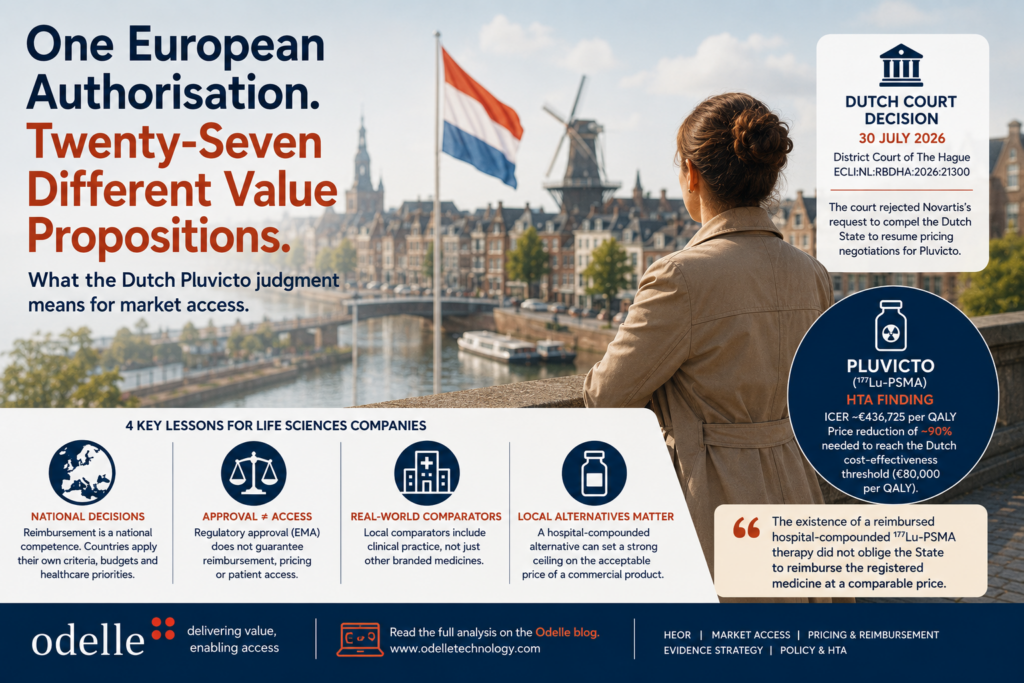
| THE CASE IN ONE MINUTECourt: District Court of The Hague, civil interim proceedingsJudgment: 30 July 2026; published 31 July 2026Identifier: ECLI:NL:RBDHA:2026:21300Dispute: Novartis sought an order requiring the Dutch State to resume terminated financial negotiations for PluvictoResult: The application was rejectedHTA signal: Zorginstituut Nederland estimated that a price reduction of about 90% would be required on its cost-effectiveness analysis |
The judgment is about more than one medicine
The dispute arose after Novartis and the Dutch State failed to reach a financial arrangement for lutetium (177Lu) vipivotide tetraxetan, marketed as Pluvicto, for patients with metastatic castration-resistant prostate cancer. Novartis asked the District Court of The Hague, in urgent civil proceedings, to require the State to return to the negotiating table.
The court declined to do so. Importantly, this was not a conventional judicial review in which the court recalculated the health-economic model or replaced the judgment of Zorginstituut Nederland with its own. The proceeding concerned the lawfulness of the State’s negotiation conduct and its decision to terminate the negotiations. That distinction matters: the judgment does not convert the court into an HTA body, but it does confirm the breadth of national discretion surrounding reimbursement and price negotiation.
“A European marketing authorisation may be centralised. Value is not.”
A clinically valuable treatment can still be economically unacceptable
Zorginstituut Nederland did not treat the medicine as clinically irrelevant. Its package advice recognised a place for 177Lu-PSMA-617 in the relevant patient population. The obstacle was the relationship between the incremental benefit and the proposed cost.
The official assessment reported an incremental cost-effectiveness ratio of approximately €436,725 per quality-adjusted life-year for the relevant comparison. Against the Dutch reference value applied in this severe disease setting, the resulting gap was profound. Zorginstituut concluded that a price reduction of approximately 90% would be indicated on the cost-effectiveness analysis.
The published assessment placed the treatment cost of Pluvicto at approximately €87,570 per patient for an average of 4.5 cycles. The Adviescommissie Pakket also considered the much lower cost of the Dutch hospital-prepared alternative and advised that the prevailing hospital-compounded price should inform negotiations, while acknowledging that the compounded treatment itself was not necessarily cost-effective.
Why prices elsewhere in Europe did not decide the Dutch case
Novartis relied, among other matters, on reimbursement conditions in other European countries. Commercially, the argument is understandable: where neighbouring systems reimburse the same registered medicine at higher prices, a manufacturer may see the Dutch position as an outlier.
Legally and institutionally, however, reimbursement remains national. Member States use different benefit packages, comparators, cost-effectiveness methods, budget-impact thresholds, negotiation structures and political priorities. Published or inferred prices elsewhere may therefore provide context, but they do not create an enforceable Dutch benchmark.
That is the deeper European lesson. Centralised authorisation answers whether a medicine may be placed on the market. It does not answer what a national health system must pay, which displaced care it must accept, or whether the local incremental benefit justifies the local opportunity cost.
The hospital-compounded comparator is the commercially decisive issue
The most instructive feature of the case is the position of the hospital-prepared 177Lu-PSMA therapy already used in the Netherlands. Novartis argued that the treatment landscape could not be understood without acknowledging that a similar hospital-compounded product was being funded.
The existence of that alternative did not establish a right to reimburse the registered product at a comparable commercial price. A registered, standardised and industrially manufactured medicine may offer meaningful advantages in quality assurance, consistency, capacity and national access. Those advantages still have to be translated into demonstrable incremental value. Registration alone does not manufacture a reimbursable premium.
For innovators, the comparator is therefore not simply the branded product named in a pivotal trial. It is the treatment the health system can actually deliver: hospital manufacture, pharmacy preparation, off-label therapy, an established procedure, or even structured non-treatment. When that local pathway produces similar clinical value at materially lower cost, it can impose a powerful ceiling on the acceptable commercial price.
Four lessons for pharmaceutical and MedTech companies
1. Regulatory success and reimbursement success are separate achievements
The evidence sufficient for authorisation may be insufficient for a national payer. Market-access strategy must begin before pivotal evidence is fixed, not after approval.
2. International prices are context, not entitlement
Cross-country reimbursement can support a narrative, reveal negotiating ranges and expose inconsistency. It rarely displaces the need to meet the national decision rule.
3. The true comparator is local practice
A value proposition that ignores hospital preparation, local procurement, treatment sequencing or existing capacity is unlikely to survive rigorous assessment.
4. A premium must be evidenced, not asserted
Industrial quality, equitable availability, logistics and scalable supply can be valuable. They require measurement and economic translation if they are to sustain a price premium.
What companies should do differently
The practical response is not to abandon European strategy, but to stop treating Europe as a single reimbursement market. A common clinical dossier should sit beneath country-specific value stories. Those stories should identify the actual treatment pathway, the funded comparator, the relevant decision threshold, the budget owner and the consequences of adoption for local capacity.
Where a hospital-compounded or locally prepared alternative exists, the manufacturer should quantify differences in batch consistency, safety assurance, treatment availability, workforce burden, scheduling, geographical equity, capital requirements and throughput. Assertions about superior manufacturing standards will not, by themselves, establish the magnitude of an acceptable premium.
The Dutch Pluvicto dispute also shows the danger of allowing price strategy to become disconnected from evidence strategy. By the time a court is asked to revive a failed negotiation, the central commercial problem has usually arisen much earlier: the evidence package, comparator choice and proposed price have not converged around a value proposition the national system can defend.
Conclusion

The judgment is not hostile to innovation. It is a reminder that innovation competes for resources inside a finite health system. Clinical benefit, regulatory quality and European precedent all matter, but none independently determines a reimbursable price.
The most durable market-access principle is therefore also the simplest: one European marketing authorisation can support entry into multiple countries, but each country will still ask its own question about value. The answer must be built locally.
About Odelle Technology
Odelle Technology supports pharmaceutical, biotechnology, MedTech and digital-health companies with evidence strategy, health economics, reimbursement, pricing and implementation across European and international markets.
Odelle Technology Ltd • August 2026 • odelletechnology.com
ODELLE TECHNOLOGY | MARKET ACCESS INSIGHT
Official sources and reference list
The analysis above is based principally on the official Dutch court record and official documents published by Zorginstituut Nederland. Accessed 4 August 2026.
1. Rechtbank Den Haag. ECLI:NL:RBDHA:2026:21300. Case C/09/706883 / KG ZA 26-631. Judgment dated 30 July 2026; published 31 July 2026. Official judgment on Rechtspraak.nl
2. Zorginstituut Nederland. Pakketadvies sluisgeneesmiddel lutetium (177Lu)-vipivotide tetraxetan (Pluvicto) bij gemetastaseerd castratieresistente prostaatkanker. 12 March 2025. Official package-advice PDF
3. Adviescommissie Pakket, Zorginstituut Nederland. ACP-advies over injectie Pluvicto voor de behandeling van prostaatkanker. 21 February 2025. Official ACP webpage
4. Adviescommissie Pakket, Zorginstituut Nederland. ACP-advies aan de Raad van Bestuur over lutetium (177Lu)-vipivotide tetraxetan (Pluvicto). Reference 2025005003. Official ACP advice PDF
Editorial note
This article is a market-access and policy analysis, not legal advice. Monetary and health-economic figures are reported from the cited official documents and should be read in the context of the specific indication, comparator assumptions and assessment date.