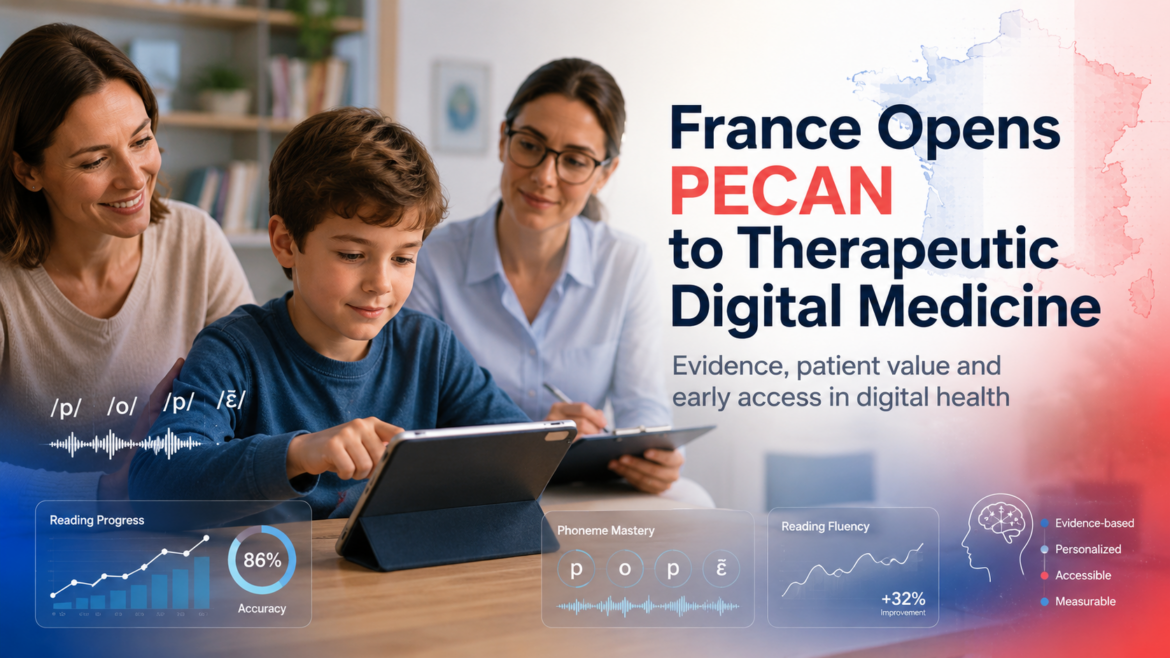
What the Poppins Clinical decision reveals about evidence, patient value, health-system capacity and the economics of early digital reimbursement.
A precedent with wider significance
France has granted early PECAN reimbursement to Poppins Clinical, a therapeutic digital medical device for children aged 7–11 with developmental learning disorder affecting reading. The decision is important because it shows that the French early-access pathway can support a digital intervention intended to produce a therapeutic effect, rather than only a remote-monitoring service. The legal decision was made by ministerial order on 17 July 2026 and published in the Journal officiel on 21 July 2026, following a favourable CNEDiMTS opinion dated 23 June 2026.[1,2]
The reimbursed indication is narrow and clinically anchored: cognitive and rhythmic rehabilitation for children aged 7–11, used in primary care and in addition to twice-monthly speech and language therapy. Poppins is therefore not reimbursed as a general educational application, nor as a substitute for an orthophoniste. It is funded as a prescribed component of an existing care pathway.[1]
What the intervention does
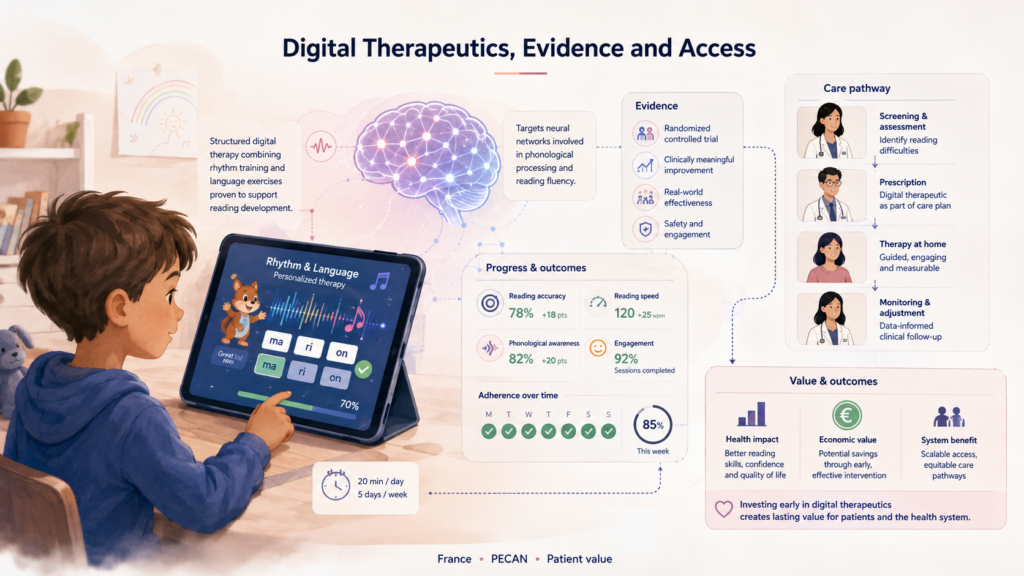
Poppins Clinical delivers an adaptive programme of written-language and musical exercises. The intervention addresses phonology, graphophonology, spelling and comprehension through two linked modules: multimodal rhythmic training and written-language training. The application limits each session to 20 minutes and the reimbursed regimen specifies five sessions each week at home, alongside twice-monthly speech therapy.[1]
The scientific rationale is plausible. Developmental reading disorders commonly involve impaired phonological processing and difficulty linking speech sounds to written symbols. Temporal and rhythmic processing may also influence the perception and segmentation of speech. Poppins translates those hypotheses into repeated, structured practice rather than presenting music as therapy in isolation.[3,4]
What the patient evidence shows — and does not yet show
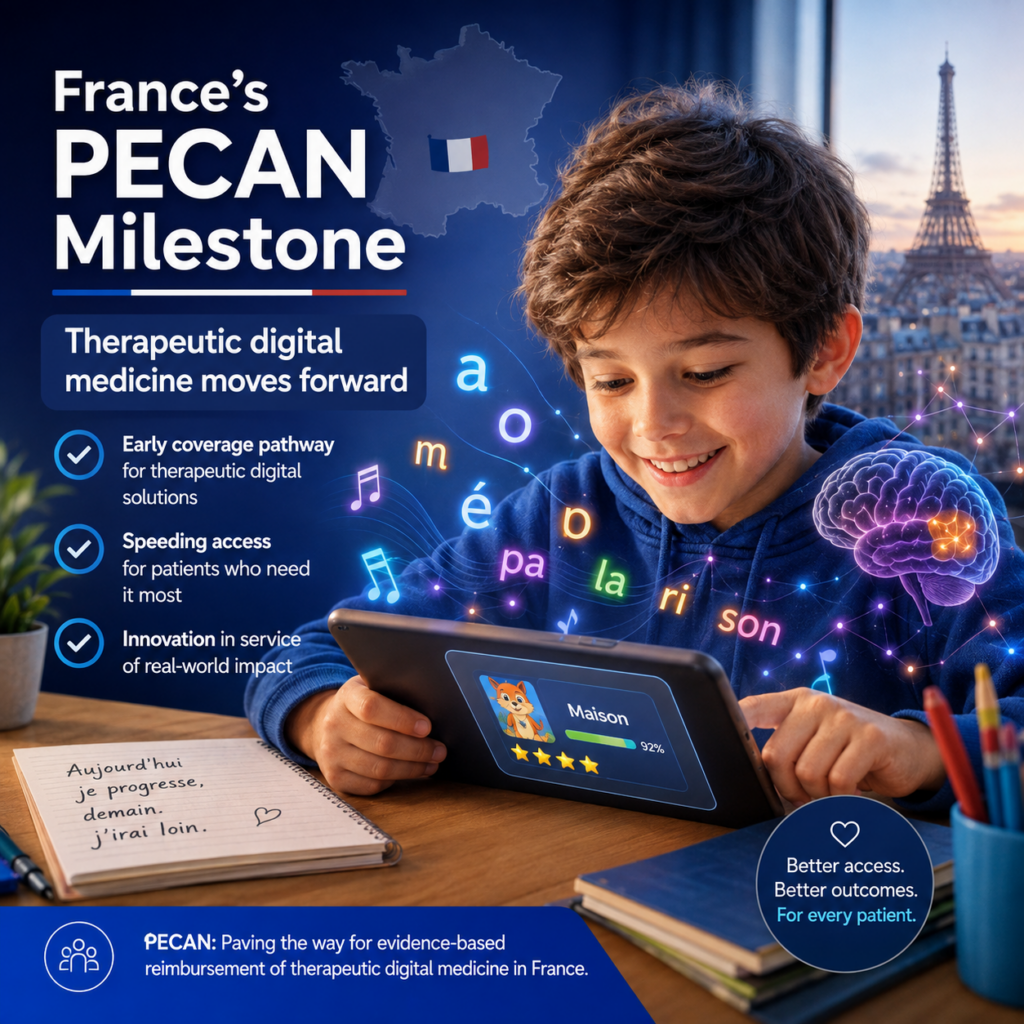
The first published Poppins study was a single-arm intervention study in children with specific learning disorder affecting reading. It reported improvements in reading and phonological measures after combined rhythm-based and graphophonological training, with no major safety signal identified. The authors nevertheless acknowledged the need for longer follow-up, comparison with conventional therapy and medico-economic evaluation.[3]
Those limitations matter. Without a concurrent control group, observed improvement cannot be attributed confidently to the device alone. Children may improve through ongoing therapy, schooling, maturation, repeated testing or regression toward the mean. The early study therefore supports clinical promise, but not a definitive causal or comparative claim.
The key confirmatory programme is POPPINS-02, a multicentre randomised non-inferiority trial. It compares Poppins Clinical plus reduced-frequency speech therapy with standard speech therapy and asks a practical health-system question: can structured digital practice preserve reading outcomes while using fewer face-to-face sessions? The registered study also examines safety, adherence and resource consequences.[4,5]
A follow-up study, POPPINS-02b, evaluates whether outcomes persist after the digital intervention stops and children return to their usual therapy. Durability is essential because short-term gains during intensive practice may not translate into sustained reading improvement.[6]
PECAN does not mean that uncertainty has disappeared. It means that the remaining uncertainty was judged explicit, manageable and capable of being resolved during early coverage.
The patient value proposition
For children and families, the potential benefit is greater therapeutic intensity without an equivalent increase in clinic attendance. The reimbursed regimen provides up to 100 minutes of home-based practice each week while retaining professional therapy. Repetition may reinforce reading-related skills between appointments and reduce travel and scheduling burdens for families.[1]
The model also creates practical risks. Effective use depends on access to a compatible smartphone or tablet, family engagement, digital literacy and sustained adherence. For that reason, the reimbursement conditions include family onboarding, technical assistance and access to usage information such as session completion and duration. These are not peripheral implementation details: for a digital therapeutic, exposure to the prescribed therapeutic dose is part of the treatment itself.[1]
The economics: a modest tariff, but a valuable evidence platform
The PECAN tariff comprises an initial payment of €435 including tax for effective use during a period of up to three months, followed by payments calculated on a monthly basis of €38.30. Total compensation is capped at €780 per patient per year.[1]
That tariff is modest relative to the costs of software development, clinical research, regulatory compliance, cybersecurity, maintenance, family support and professional engagement. PECAN should therefore not be viewed primarily as a high-margin commercial channel.
Its economic value lies in creating a nationally funded environment for prescribing, uptake and evidence generation. Reimbursement can reduce the direct financial barrier for families, establish routine prescribing behaviour, produce adherence and utilisation data, and support the transition toward permanent reimbursement.
The central economic hypothesis is not simply that software is cheaper than a clinician. It is that digital practice may extend scarce professional capacity. If Poppins plus less frequent face-to-face therapy produces outcomes that are not clinically worse than weekly conventional therapy, the same professional workforce may be able to support more children. Total spending may not fall, because unmet need may become visible and more children may enter treatment. The economically important outcome could therefore be improved capacity and equity rather than simple budget reduction.
What a credible economic evaluation should measure
speech and language therapy sessions and professional time;
waiting times, referral-to-treatment intervals and service capacity;
family travel, time and productivity costs;
adherence, discontinuation and actual therapeutic exposure;
reading, phonological and comprehension outcomes;
persistence of benefit after treatment ends;
school participation and use of educational support;
the distribution of benefit across socioeconomic and digitally excluded groups.
Why France approved early coverage
Poppins did not succeed merely because it was innovative. The dossier combined a defined medical indication, a specified patient population, a prescribed therapeutic dose, CE-marked medical-device status, professional oversight, digital conformity requirements, published early evidence and an active comparative research programme. The intervention was also positioned as an adjunct to speech therapy, avoiding the unsupported claim that an application could replace clinical care.[1–4]
The French decision therefore reflects a disciplined form of uncertainty tolerance. Early evidence was sufficient to support a presumption of benefit, while the remaining questions were linked to ongoing studies with defined endpoints and timelines. This is the core logic of PECAN: reimbursement is used to complete an evidence programme, not to avoid one.
The wider lesson for digital-health companies
The Poppins precedent suggests that a successful therapeutic PECAN strategy requires six elements: a plausible therapeutic mechanism; patient-relevant outcomes; evidence generated in the intended population; integration into a recognisable care pathway; acceptable security, interoperability and usability; and a confirmatory study capable of supporting the next reimbursement decision.
The most important feature of the decision is therefore not the €780 annual ceiling. It is the demonstration that France will fund a therapeutic digital medical device before the evidence package is fully mature when clinical promise is credible, residual uncertainty is explicit and the route to resolving it is already underway.
PECAN is not reimbursement instead of evidence. It is reimbursement to complete the evidence journey.
References
1. République française. Arrêté du 17 juillet 2026 relatif à la prise en charge anticipée numérique de certains dispositifs médicaux numériques à visée thérapeutique et certaines activités de télésurveillance médicale en application de l’article L. 162-1-23 du code de la sécurité sociale. Journal officiel de la République française. 21 July 2026. https://www.legifrance.gouv.fr/jorf/id/JORFTEXT000054448186
2. Haute Autorité de Santé, Commission nationale d’évaluation des dispositifs médicaux et des technologies de santé. Poppins Clinical: avis relatif à la prise en charge anticipée numérique. Opinion adopted 23 June 2026. HAS, Paris, 2026.
3. Grossard C, Descamps M, Pellerin H, Vonthron F, Cohen D. Children’s Improvement After Language and Rhythm Training With the Digital Medical Device Poppins for Dyslexia: Single-Arm Intervention Study. JMIR Serious Games. 2025;13:e76435. doi:10.2196/76435. PMID: 40750096.
4. Grossard C, et al. Assessing the Noninferiority of a Rhythm and Language Digital Medical Device Combined With Reduced Reading Therapy Versus Standard Reading Therapy: Protocol for a Multicenter Randomized Trial. JMIR Research Protocols. 2025. PMID: 40179385.
5. ClinicalTrials.gov. Examining the Effect of a Digital Medical Device Combined With Reduced Reading Therapy Versus Standard Reading Therapy (POPPINS-02). Identifier NCT06592911. U.S. National Library of Medicine.
6. ClinicalTrials.gov. Examining the Medium-term Effect on Non-Inferiority of the Poppins Clinical Digital Medical Device (POPPINS-02b). Identifier NCT06902610. U.S. National Library of Medicine.
7. Code de la sécurité sociale, Article L. 162-1-23 and Articles R. 162-112 to R. 162-117: French statutory framework for prise en charge anticipée numérique.
Prepared for publication by Odelle Technology Ltd | 5 August 2026