What to partner with, when to approach pharmaceutical companies and how to turn an app into a strategic treatment asset
A medicine does not create value when it leaves the factory.
It creates value when the right patient receives it, begins treatment correctly, understands what to do, continues for long enough and achieves an outcome that matters.
Between prescription and outcome lies a long chain of human behaviour, clinical decisions, service capacity and incomplete information.
Patients become anxious. Instructions are forgotten. Symptoms change between appointments. Side effects go unreported. Doses are not adjusted. Treatments are abandoned. Clinicians discover the problem weeks or months later.
That chain is where digital health may help.
It is also where many pharmaceutical partnerships go wrong.
The app may be attractive. Patients may say they like it. A pharmaceutical company may sponsor a pilot. Yet twelve months later, nobody can demonstrate whether it improved treatment initiation, adherence, clinical outcomes, healthcare utilisation or the quality of evidence available to decision-makers.
The problem is not necessarily the technology.
The problem is that the partnership began with an app rather than with an unresolved problem in the medicine’s pathway.
The central question is therefore not:
Which pharmaceutical company might be interested in our app?
It is:
Which medicine is losing clinical or commercial value because of a measurable problem that our digital technology can help solve?
That is the beginning of a serious pharmaceutical partnership.
Why pharmaceutical companies partner with digital health
Medicines are tested in controlled studies, but they are used in complicated lives.
Patients may have several conditions, multiple medicines, limited clinical contact, different levels of health literacy and varying confidence in managing treatment. Some therapies require training, titration, repeated monitoring or sustained behavioural change.
A digital product can potentially support several parts of this journey:
- identifying appropriate patients;
- preparing them to begin treatment;
- improving administration technique;
- supporting dose titration;
- monitoring symptoms and adverse effects;
- increasing persistence;
- connecting patient information with the clinical team;
- and collecting longitudinal real-world data.
But these functions are not equally valuable.
A reminder is not automatically an adherence intervention. Engagement is not a clinical outcome. Data collection is not necessarily useful evidence. A patient-support programme does not become commercially strategic simply because it has been digitised.
The pharmaceutical company must be able to connect the app to an outcome it values.
That may be a clinical outcome, such as improved symptom control.
It may be an operational outcome, such as fewer unnecessary appointments.
It may be a commercial outcome, such as greater persistence with therapy.
It may be an evidence outcome, such as better information on effectiveness, tolerability or quality of life in routine care.
Or it may be a combination of all four.
Research on digital therapeutics shows growing pharmaceutical involvement in development, licensing and commercialisation, but it also shows wide variation in product maturity, evidence quality and business models. (PubMed Central (PMC))
That variation matters.
Pharma is not buying “digital”.
It is buying a capability that strengthens a therapeutic asset, a patient service, an evidence programme or a commercial pathway.
1. Start with the medicine, not the app
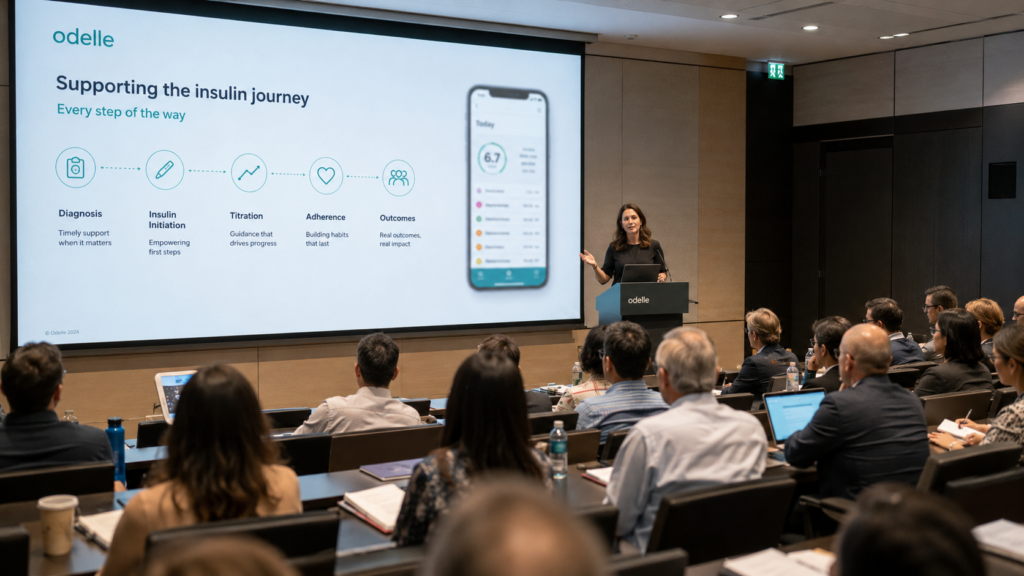
The weakest digital-health presentation begins with features.
We have reminders, educational content, symptom tracking, messaging, artificial intelligence and a clinician dashboard.
The stronger presentation begins with loss.
Patients starting this therapy struggle with administration and discontinue during the first six months. Clinicians do not receive information until the next scheduled appointment. The consequences are poorer outcomes, wasted treatment and avoidable clinical contact.
The app is then introduced as the mechanism for addressing that loss.
This distinction changes the entire partnership discussion.
A pharmaceutical company can evaluate a defined pathway problem. It cannot easily evaluate a collection of attractive software functions.
The Dibi lesson: focus on a specific treatment transition
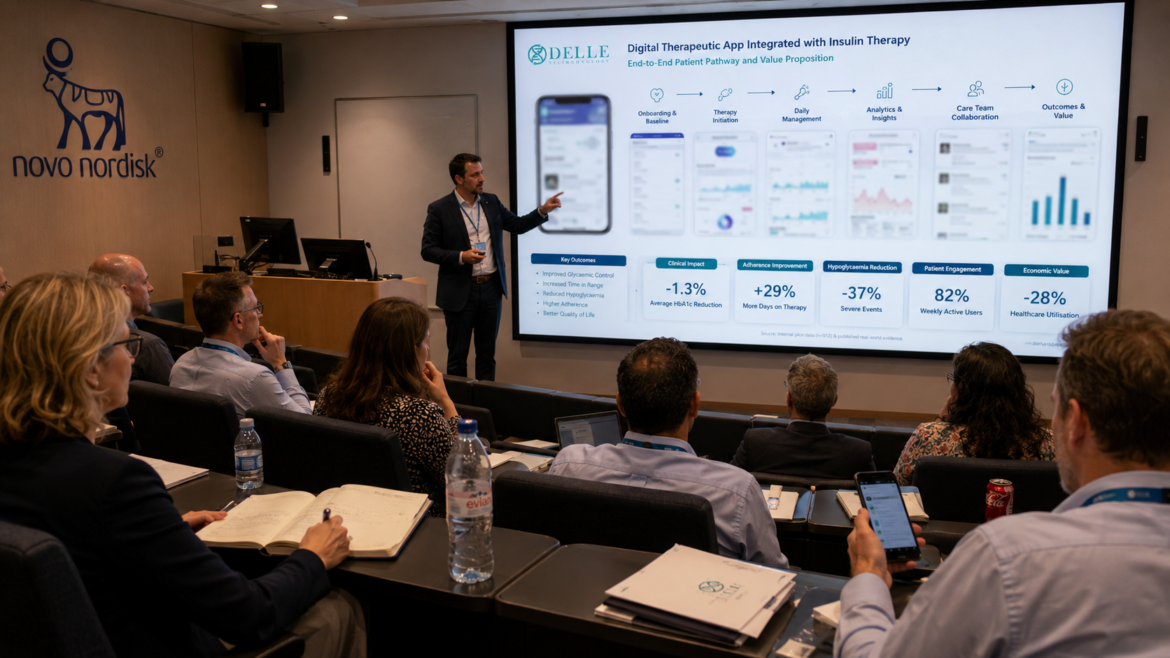
In Germany, Temedica launched Dibi, a digital companion for people with type 2 diabetes sponsored by Novo Nordisk Pharma GmbH.
Its strongest feature is not that it addresses diabetes broadly. It places particular emphasis on people beginning insulin treatment—a clinically important transition that can involve uncertainty, education, monitoring and behavioural support.
The app provides disease-management support, medication tracking, educational resources and patient insights. It is also connected to Temedica’s real-world evidence platform, allowing consenting users to contribute experience data to research. (temedica.com)
The strategic lesson is precise:
Do not partner an app with “diabetes”. Partner it with a defined problem such as insulin initiation, titration, hypoglycaemia management or persistence.
The narrower proposition is easier to study, easier to fund and easier for a pharmaceutical team to own.
2. Decide what type of partnership you are offering

A “pharma partnership” can mean several entirely different things.
The evidence, regulatory burden, ownership structure and commercial value will depend on which one you are proposing.
A treatment companion
The app supports patients receiving an existing medicine.
It may provide:
- onboarding;
- administration support;
- treatment education;
- reminders;
- symptom monitoring;
- side-effect information;
- or preparation for clinical appointments.
This is often the most accessible first partnership for a smaller digital-health company.
The early evidence may focus on feasibility, acceptability and patient use, but the programme should eventually demonstrate consequences beyond engagement.
A connected treatment-support system
The app is linked more directly to the administration or use of a medicine.
Aptar Digital Health and Stallergenes Greer developed iPUMP, a connected assistant for patients beginning liquid sublingual allergen immunotherapy in France.
The programme supports the correct technique, duration and frequency of therapy. Stallergenes Greer subsequently reported results from the SPEED real-world survey suggesting a 15% improvement in adherence among users. (aptar.com)
This is a particularly strong partnership model because the digital function is directly connected to the practical demands of the treatment.
The app is not an optional wellness layer.
It helps the patient use the pharmaceutical company’s therapy as intended.
A digital therapeutic used alongside medicine

Here, the software is intended to produce a therapeutic effect of its own.
This requires a substantially higher evidence standard.
Boehringer Ingelheim and Click Therapeutics developed CT-155 as an investigational prescription digital therapeutic used alongside standard antipsychotic treatment for negative symptoms of schizophrenia.
The Phase III CONVOKE study was multicentre, randomised and double-blind and compared CT-155 with a digital control. The companies reported that the study met its primary endpoint, with pivotal results subsequently presented in 2025. (clicktherapeutics.com)
This is not a conventional patient-support app.
It is a software-based therapeutic intervention being evaluated with a study design resembling pharmaceutical clinical development.
The lesson is important:
The stronger the clinical claim, the stronger the evidence architecture must become.
A real-world evidence partnership
Sometimes the most valuable digital asset is not the intervention.
It is the evidence infrastructure.
In France, Resilience Care and Ipsen launched a national multicentre retrospective study examining first-line combination therapies in metastatic renal-cell carcinoma.
The one-year study is intended to include 400 patients across 24 French centres. Resilience contributes natural-language processing of routine clinical records, longitudinal patient-reported outcomes and access to a broader network of partner healthcare facilities. (resilience.care)
This model demonstrates a different reason for pharma to partner with digital health:
The digital company can make routine-care evidence more structured, longitudinal and useful.
For some companies, the greatest asset is not the app interface. It is the ability to connect patient experience, clinical records and outcomes across a credible care network.
A clinical-trial technology partnership
An app may support:
- electronic consent;
- decentralised visits;
- remote outcome measurement;
- electronic patient-reported outcomes;
- adherence monitoring;
- recruitment;
- or retention.
The commercial buyer may be clinical development rather than medical affairs or patient services.
The value proposition is then about trial quality, efficiency and representativeness—not routine patient support.
A commercial patient-service programme
The app becomes part of the service surrounding a medicine or portfolio.
These projects can begin more quickly, but they are also vulnerable to becoming short-lived marketing initiatives.
The difference between a useful service and a strategic asset is measurement.
The partners must agree what success means before deployment.
3. Choose a medicine with a solvable digital problem
Not every medicine needs an app.
Some therapies are simple to administer, used for short periods and require limited monitoring. Adding software may create burden without meaningful benefit.
The strongest opportunities tend to involve one or more of the following conditions.
Treatment initiation is difficult
The patient may require:
- education;
- reassurance;
- administration training;
- baseline assessment;
- or behavioural preparation.
Dibi’s focus on people beginning insulin therapy is an example of a digital product aligned with a difficult transition. (temedica.com)
Treatment is prolonged
Long-duration therapies create opportunities to support persistence and identify where patients disengage.
Allergen immunotherapy is a good example because correct administration and continuing adherence matter over time. iPUMP was designed specifically around this sustained treatment process. (stallergenesgreer.com)
Symptoms change between appointments
Neurology, oncology, respiratory medicine and inflammatory disease often involve fluctuations that may not be visible during occasional clinical reviews.
A digital system may capture:
- symptom patterns;
- patient-reported outcomes;
- adverse effects;
- physiological measurements;
- and changes in function.
Treatment requires titration
Digital support may help patients and clinicians understand:
- whether the intended dose has been reached;
- whether symptoms are improving;
- whether adverse effects are limiting treatment;
- and when review is required.
Poor use produces expensive consequences
An app becomes more commercially interesting when the consequences of treatment failure are substantial.
Those consequences may include:
- emergency attendance;
- admission;
- complications;
- disease progression;
- avoidable switching;
- or treatment waste.
The therapy needs better real-world evidence
A pharmaceutical company may have strong trial data but limited knowledge of:
- effectiveness in routine care;
- treatment sequencing;
- underrepresented populations;
- patient experience;
- quality of life;
- persistence;
- or resource utilisation.
The Resilience–Ipsen collaboration illustrates how digital infrastructure can be used to answer questions that conventional trials may not fully resolve. (resilience.care)
4. Approach pharma at the right time
There is a useful window for partnership.
Before that window, the digital company is asking pharma to fund an idea.
After it, the company may have built the wrong product and collected the wrong evidence.
Too early
A substantive partnership is unlikely when the developer has:
- no defined treatment pathway;
- no clear patient group;
- no clinical support;
- no regulatory position;
- no data-governance architecture;
- no evidence plan;
- and no explanation of how the app affects the medicine.
At this stage, the company may seek exploratory conversations, but it should not mistake interest for commitment.
The productive stage
The strongest moment is often when the company has:
- a working product;
- evidence that the intended users can and will use it;
- a defined treatment-stage problem;
- initial clinical or observational data;
- a credible regulatory plan;
- and sufficient flexibility to co-design the evidence programme.
The company knows enough to be credible but has not yet locked every important decision.
Too late
A digital-health company can also approach pharma after it has fixed:
- the wrong population;
- the wrong comparator;
- endpoints that do not matter;
- an unsuitable commercial model;
- or a data structure that cannot support the proposed partnership.
At that point, the pharmaceutical company may like the technology but be unable to use it.
The right principle is:
Engage after the problem and mechanism are credible, but before the pivotal evidence and commercial architecture are irreversible.
5. Find the real owner inside pharma
Large pharmaceutical companies do not operate as single buyers.
A digital programme may interest several departments while being owned by none of them.
Potential internal owners include:
- medical affairs;
- patient services;
- digital health;
- commercial innovation;
- clinical development;
- real-world evidence;
- market access;
- brand teams;
- and national affiliates.
Each sees a different form of value.
Medical affairs may care about patient education and treatment optimisation.
Clinical development may care about endpoints and trial efficiency.
Market access may care about patient outcomes, resource use and evidence generation.
Commercial teams may care about differentiation and persistence.
The national affiliate may care about a practical programme that can be implemented under local rules.
The wrong contact may praise the technology without being able to fund, govern or deploy it.
Before approaching a company, map:
- the relevant medicine;
- the therapeutic-area business unit;
- the country or countries concerned;
- the department that experiences the problem;
- the department that controls the budget;
- the department that will use the evidence;
- and the function that will operate the programme.
The most enthusiastic stakeholder is not always the person who can move the partnership forward.
6. Build the evidence around the claim
Digital-health companies often collect what is easy to measure.
Pharma will ask what the measurement means.
Downloads, log-ins, session duration and satisfaction scores may describe use. They do not necessarily demonstrate treatment value.
For a support app
Early outcomes may include:
- successful onboarding;
- treatment understanding;
- correct administration;
- confidence;
- engagement;
- and patient satisfaction.
But these should connect to later outcomes such as:
- persistence;
- treatment completion;
- dose optimisation;
- reduced complications;
- or fewer avoidable clinical contacts.
For an adherence proposition
Adherence claims require caution.
Reviews of medication apps have reported potentially beneficial effects, but findings vary across conditions, technologies, outcome definitions and study quality. Low-certainty or heterogeneous evidence means that reminders and tracking features should not automatically be assumed to improve clinical outcomes. (PubMed)
The app should therefore specify:
- what behaviour is expected to change;
- why the intervention should change it;
- how adherence will be measured;
- and what clinical consequence is expected.
Objective measures may include:
- pharmacy refill;
- electronic administration;
- persistence;
- dose attainment;
- treatment interruption;
- or verified device use.
For a clinical claim
A software intervention claiming therapeutic benefit may require:
- an appropriate control;
- validated endpoints;
- sufficient follow-up;
- prespecified analysis;
- risk-of-bias management;
- and evidence that the effect is additional to standard care.
The CT-155 programme demonstrates the type of controlled design that may be required when software is intended to provide a therapeutic effect rather than general support. (PR Newswire)
For a real-world evidence claim
The data programme should define:
- the decision question;
- data sources;
- provenance;
- completeness;
- representativeness;
- missing-data handling;
- endpoint validity;
- interoperability;
- consent;
- governance;
- and statistical analysis.
Published frameworks emphasise that real-world evidence should be planned across product design, deployment and continuing evaluation rather than treated as an incidental by-product of app use. (PubMed Central (PMC))
Data become valuable when they answer a decision.
Volume alone does not create value.
7. Start with one country and one pathway
A global agreement can be attractive in principle and unusable in practice.
Digital-health adoption remains fragmented across Europe. Regulatory classification, reimbursement, privacy interpretation, prescribing, patient services and clinical workflow differ between countries. (PubMed Central (PMC))
The better first programme may involve:
- one country;
- one indication;
- one medicine or portfolio;
- one patient population;
- a small number of centres;
- and a clearly defined evidence objective.
France: iPUMP and allergen immunotherapy
The Aptar–Stallergenes Greer collaboration began with a highly specific French pathway: patients initiating sublingual liquid allergen immunotherapy.
This was commercially sensible because the digital function, administration method and adherence problem were closely linked. (aptar.com)
Germany: Dibi and insulin initiation
Dibi is similarly focused on the German type 2 diabetes pathway, with particular relevance to insulin-naïve patients. (temedica.com)
France: Resilience and oncology evidence
The Resilience–Ipsen study uses a network of French treatment centres to answer a defined national real-world evidence question in metastatic kidney cancer. (resilience.care)
These examples share an important characteristic.
They do not begin by trying to transform all care everywhere.
They begin with one important problem in a setting where the partnership can be implemented and measured.
8. Structure the first agreement to match the uncertainty
The commercial structure should reflect what is known and what remains uncertain.
Feasibility study
Use this when the main question is:
- Will patients use it?
- Can clinicians integrate it?
- Can the data be captured?
- Does it fit the pathway?
Pilot programme
Use this when the product is mature enough for deployment but the partners need to test implementation and initial outcomes.
Sponsored evidence study
Use this where the principal objective is to generate clinical, behavioural, economic or real-world evidence.
Co-development
Appropriate where the pharmaceutical company will materially influence:
- product design;
- evidence;
- content;
- integration;
- regulatory strategy;
- or national adaptation.
Licence
Appropriate when the product is mature and the pharmaceutical company wants rights for:
- a defined therapy area;
- product;
- population;
- country;
- or region.
Distribution or service agreement
Useful where the principal value lies in access to patients, clinical networks or operational delivery.
Strategic investment
This can finance development while preserving some independence and may create a route towards a deeper future transaction.
Acquisition
Acquisition becomes rational when the digital capability is:
- strategically important;
- evidence-backed;
- difficult to recreate;
- scalable;
- integrated with pharma workflows;
- and capable of supporting more than one product or market.
A pilot should not be treated as a miniature acquisition.
Each stage should answer the question required to justify the next stage.
9. Protect the asset while co-creating
Pharmaceutical partnership can provide:
- therapeutic-area expertise;
- medical networks;
- evidence funding;
- regulatory resources;
- country access;
- commercial reach;
- and credibility.
It can also unintentionally reduce the digital company’s future value.
The agreement should clearly define:
- ownership of pre-existing technology;
- ownership of new developments;
- rights to algorithms;
- control of patient and clinical data;
- rights to derived analyses;
- exclusivity;
- therapeutic-area restrictions;
- geographic restrictions;
- publication rights;
- future indication rights;
- and what happens when the agreement ends.
A company can win a prestigious partner and still damage its strategic position if:
- exclusivity is too broad;
- the partner controls every improvement;
- the data cannot be reused;
- the product becomes dependent on one brand;
- or expansion into other diseases becomes impossible.
The aim is not simply to secure a deal.
It is to secure the right deal.
10. Understand why pilots disappear
Many pharma–digital projects do not fail publicly.
They simply stop.
The usual causes are not dramatic.
They include:
- no accountable internal owner;
- no agreed outcome;
- poor clinical integration;
- low recruitment;
- insufficient patient use;
- slow contracting;
- uncertainty over regulation;
- weak data quality;
- country teams becoming involved too late;
- and no budget for the stage after innovation funding.
A successful pilot needs an answer to five questions before it begins:
- What decision will the pilot support?
- Which outcome will determine success?
- Who owns implementation?
- Who owns the next budget?
- What happens if the result is positive?
Without those answers, the pilot may produce interesting activity and no commercial progression.
11. What pharma will examine before partnering
A serious diligence process will typically assess several connected dimensions.
Strategic relevance
Does the technology strengthen a particular medicine, portfolio or therapeutic area?
Clinical plausibility
Is the problem important, and is there a credible mechanism through which the app could change it?
Evidence maturity
What has been demonstrated?
What remains assumed?
Patient fit
Can the intended patients use the technology over the required period?
Clinical workflow
Who introduces the app?
Who monitors the information?
What action follows an alert?
Regulation and quality
Is the product correctly classified and supported by suitable quality systems?
Data value
Are the data complete, lawful, interoperable and useful for the intended question?
Economic relevance
Could the intervention affect:
- resource use;
- treatment waste;
- complications;
- workforce;
- hospital activity;
- or payer expenditure?
Scalability
Can the product be adapted across countries and portfolios without being rebuilt each time?
12. The Odelle Pharma Partnership Readiness Process
Odelle can help digital-health companies move from a general ambition to “work with pharma” to a defined and evidence-based partnership proposition.
Stage 1: Identify the pharmaceutical fit
We examine:
- the app’s functions;
- the relevant therapeutic areas;
- medicines and pipelines;
- treatment-stage problems;
- and the pharmaceutical companies most exposed to those problems.
Stage 2: Map the patient pathway
We define:
- where value is being lost;
- where the app enters;
- who introduces it;
- who receives the information;
- what decision changes;
- and where implementation may fail.
Stage 3: Audit the evidence and claims
We assess:
- which claims are supported;
- what remains uncertain;
- whether the current outcomes matter;
- and what evidence the pharmaceutical partner will require.
Stage 4: Build the pharma value proposition
We translate the technology into benefits such as:
- improved initiation;
- administration quality;
- persistence;
- treatment optimisation;
- toxicity management;
- real-world evidence;
- clinical-trial support;
- patient services;
- and lifecycle value.
Stage 5: Select the first market
We identify the country where:
- the medicine is important;
- the pathway problem is visible;
- clinical partners are available;
- data can be collected;
- and implementation is feasible.
Stage 6: Select the transaction
We determine whether the logical first structure is:
- feasibility;
- pilot;
- sponsored study;
- co-development;
- licence;
- distribution;
- investment;
- or acquisition preparation.
Stage 7: Prepare engagement
Odelle can support structured discussions with:
- medical affairs;
- real-world evidence;
- patient services;
- digital-health functions;
- clinical development;
- market access;
- commercial teams;
- and country affiliates.
Stage 8: Design the route beyond the pilot
The partnership plan should connect:
- product development;
- evidence;
- regulatory status;
- national implementation;
- reimbursement;
- commercial milestones;
- and future transaction value.
The real test
A pharmaceutical company does not need another app.
It needs an answer to a problem that already matters.
The app becomes valuable when it can show that:
- the medicine reaches the right patient;
- treatment begins successfully;
- the patient uses it correctly;
- clinicians receive better information;
- complications or avoidable activity are reduced;
- or the company obtains evidence that could not otherwise be generated efficiently.
The digital-health company should therefore stop asking:
How do we persuade pharma to like our technology?
The better question is:
Which part of this medicine’s pathway is failing, what does that failure cost, and can our technology demonstrate that it improves the result?
That is how an app becomes more than a pilot.
It becomes part of the medicine’s value.
And that is when partnership, investment or acquisition begins to make strategic sense.
Selected references
- Kim M, et al. The Digital Therapeutics Real-World Evidence Framework. 2024. (PubMed Central (PMC))
- Fassbender A, et al. Adoption of Digital Therapeutics in Europe. 2024. (PubMed Central (PMC))
- Wang C, et al. Digital therapeutics from bench to bedside. 2023. (PubMed Central (PMC))
- Dagenais S, et al. Use of real-world evidence to drive drug-development strategy. 2021. (PubMed Central (PMC))
- Temedica. Launch of Dibi for type 2 diabetes, sponsored by Novo Nordisk Pharma GmbH. 2024. (temedica.com)
- Resilience Care. Partnership with Ipsen for real-world research in metastatic renal-cell carcinoma. 2026. (resilience.care)
- Stallergenes Greer and Aptar Digital Health. iPUMP connected assistant for allergen immunotherapy. (aptar.com)
- Boehringer Ingelheim and Click Therapeutics. CT-155 Phase III CONVOKE programme. (clicktherapeutics.com)