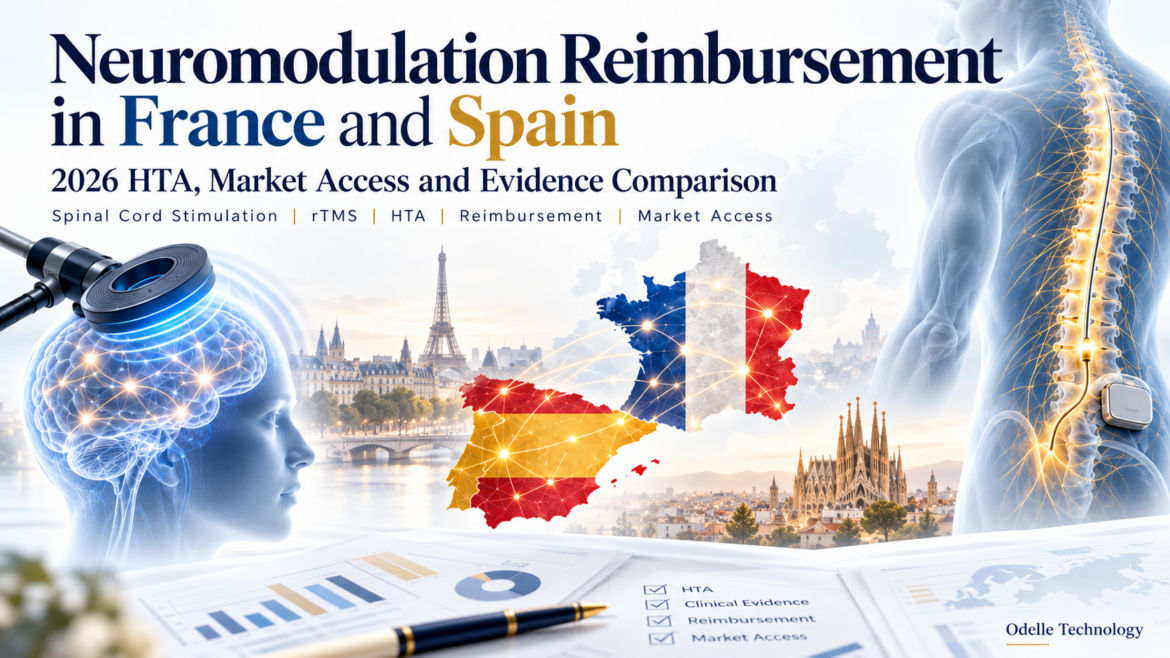
Why spinal cord stimulation, rTMS, and neuropathic pain assessments demand indication-specific comparators, credible long-term outcomes, and a pathway from clinical evidence to funding. Spain and France are scrutinising neuromodulation from different clinical and policy starting points. Spain’s RedETS 2026 work plan commissions separate evaluations of multimodal neuropathic pain treatment, spinal cord stimulation for chronic trunk and lower-limb pain, and repetitive transcranial magnetic stimulation (rTMS) for the sequelae of stroke [1]. Meanwhile, France’s Haute Autorité de Santé (HAS) is developing an assessment of rTMS for refractory chronic neuropathic pain while continuing product-specific evaluation of implantable spinal cord stimulation (SCS) systems [3–5].
The implication is not that Europe has reached a single verdict on neuromodulation. It is that reimbursement questions are indication-specific: who benefits, against which alternative, for how long, at what cost and with what burden on patients and providers? Those questions should influence trial design well before a manufacturer assembles a reimbursement dossier.
Spain: three assessments, three different clinical questions
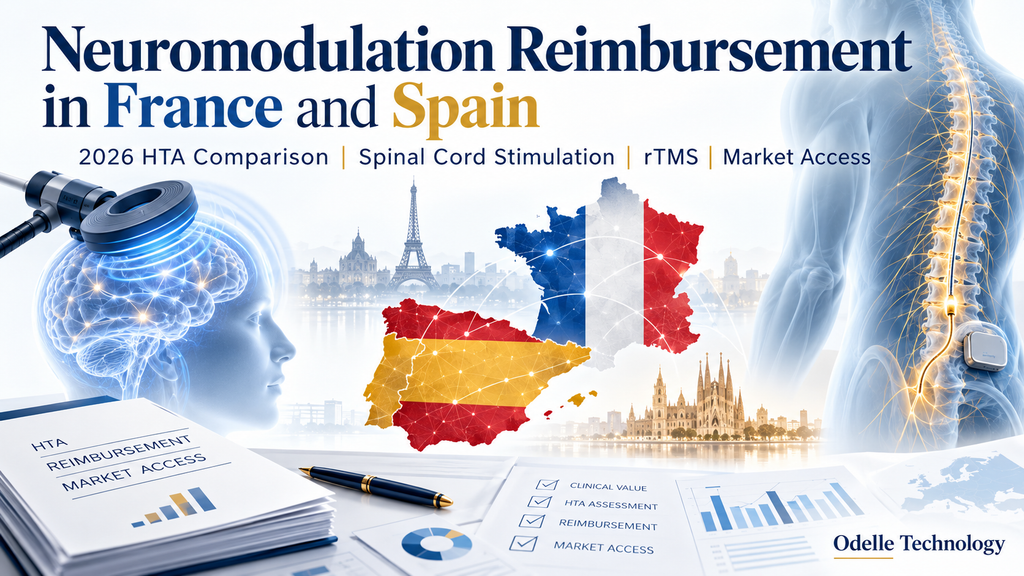
The RedETS 2026 programme assigns a multimodal approach to neuropathic pain to AETSA and two further topics to SESCS: spinal cord neurostimulation for chronic pain of the trunk and lower extremities, and rTMS for stroke sequelae [1]. Although often grouped under a neurology or pain-technology heading, they are not interchangeable interventions or indications.
For multimodal neuropathic pain care, the decision problem is how combinations of pharmacological, psychological, rehabilitation and interventional approaches should be positioned. For SCS, patient selection, procedural risk, durability, device management and comparison with established care are central. For post-stroke rTMS, the relevant functional domains must be specified: motor recovery, disability or other sequelae cannot automatically be treated as pain outcomes. The published work-plan titles do not yet specify final PICO questions, accepted comparators or reimbursement outcomes [1].
Spain’s new HTA legislation changes the context
Royal Decree 415/2026, dated 27 May 2026, creates a framework for assessing health technologies to inform decisions about adoption, public financing, price, reimbursement, changes in use and disinvestment. It explicitly distinguishes assessment from the subsequent decision: an HTA report informs government action but is not itself the funding decision [2].
The decree encompasses clinical domains the health problem, the technology, relative safety and relative clinical effectiveness — alongside non-clinical dimensions including cost, resource use, economic and budget impact, and organisational, ethical, social, legal and environmental factors [2]. Its emphasis on transparent and participatory processes offers a reason for developers to prepare structured evidence early, while recognising that participation in a particular assessment depends on its published procedures.
France: the comparator may decide the value proposition
HAS published its scoping note for adult refractory chronic neuropathic pain rTMS in March 2026. It proposes to assess effectiveness and safety against SCS or sham stimulation according to the relevant neuropathic pain condition, to examine optimal delivery and organisational implications where appropriate, and to inform possible inclusion of the procedure in France’s CCAM classification [3]. A scoping note is not a positive reimbursement decision.
This French indication should not be conflated with Spain’s broader title “rTMS for stroke sequelae”. Post-stroke neuropathic pain can be a relevant pain condition, but an intervention aimed at analgesia and one aimed at neurological rehabilitation may need different endpoints, comparators, trial populations and clinical follow-up. Evidence cannot be safely transferred between them without first establishing its relevance.
What two 2026 French device opinions actually tell us
Two HAS CNEDiMTS opinions provide a practical distinction between clinical utility and additional comparative benefit. In June 2026, HAS assessed Abbott’s non-rechargeable PROCLAIM XR SCS system in a request to renew its listing. It judged the expected service sufficient for specified conditions but rated the improvement over the comparator category ASA V — no demonstrated additional benefit [4]. In July 2026, HAS also assessed Boston Scientific’s rechargeable WAVEWRITER ALPHA SYSTEM in a renewal request and reported sufficient expected service with ASA V relative to the specified rechargeable SCS comparators [5].
These opinions concern different device categories and should not be treated as head-to-head findings against each other. Nor does ASA V mean a device has no therapeutic value, that its reimbursement is automatically withdrawn or that its sale price is mechanically determined by that grade. Rather, they illustrate the stringent distinction between an acceptable reimbursable option and a device shown to add incremental value over established alternatives.
A scientific challenge: what do sham-controlled trials show?
The Cochrane review by Traeger and colleagues included 13 studies with 699 participants in chronic low back pain. It reported that, at six months, SCS probably does not improve pain, function or health-related quality of life compared with placebo, and identified an absence of sham-controlled studies extending beyond six months [6]. Its conclusions merit serious attention to trial methodology, expectation effects and durability.
But these findings cannot be indiscriminately extrapolated to all SCS indications. Chronic low back pain is not equivalent to every neuropathic pain syndrome, and individual HAS-listed indications, stimulation modalities and comparator strategies differ. Scientific credibility requires both acknowledging the negative or uncertain evidence and specifying exactly which patient populations it addresses.
France–Spain comparison for manufacturers
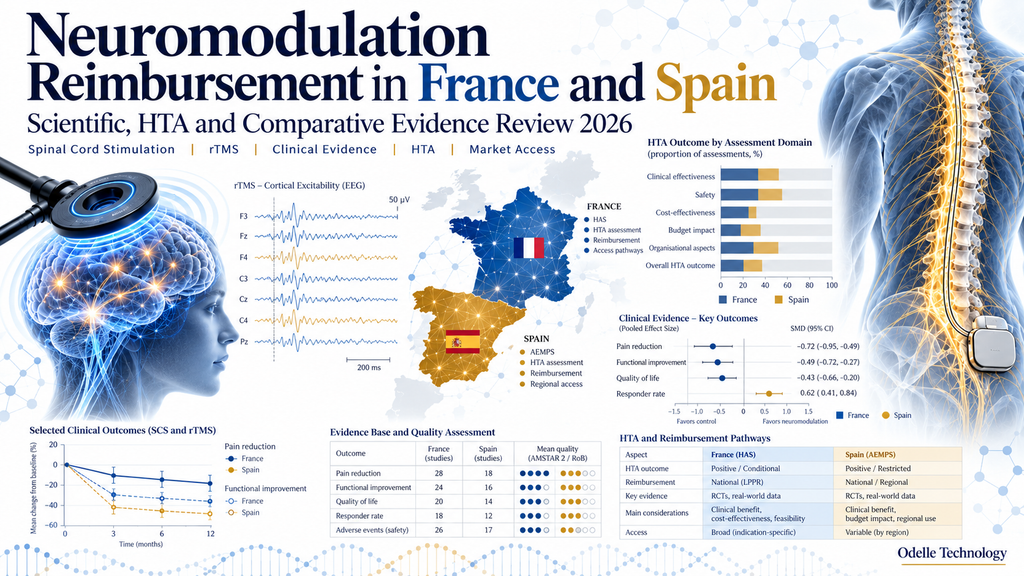
| Dimension | Spain | France |
| Assessment focus | RedETS programme topics, including multimodal care, SCS and post-stroke rTMS | HAS rTMS pain-procedure assessment and SCS product opinions |
| Relevant rTMS indication | Sequelae of stroke (final scope not defined by work-plan title) | Adult refractory chronic neuropathic pain |
| Comparison strategy | Must be established from specific assessment protocol | rTMS vs SCS or sham, according to pain type; SCS vs device category comparators |
| Economic framework | Clinical and non-clinical HTA domains in RD 415/2026 | Procedure assessment for possible CCAM listing; device opinions relevant to LPP/LPPR |
| Status | Assessment topics in 2026 work plan | rTMS scoping stage; published SCS renewal opinions |
The evidence package should start with the decision problem
1. Define the indication before selecting the comparator
“Neuromodulation” is not a reimbursement indication. Separate refractory neuropathic pain, persistent low back pain and post-stroke functional impairment, and define severity, prior treatments, baseline disability and eligibility criteria. This determines whether sham, usual care, multimodal treatment or another intervention is a scientifically and policy-relevant comparison.
2. Design for durable patient-important outcomes
A single short-term pain-score improvement may be insufficient. Depending on the indication, studies should consider responder thresholds, physical function, participation, quality of life, opioid or other medication consumption, adverse events and long-term persistence of effect. For implantables, revision, explantation, device replacement and programming burden may materially affect value. For rTMS, session schedules, repeat courses, staff time and adherence matter.
3. Model the complete pathway, not merely the treatment price
Economic models should transparently compare total resource use from referral and selection through treatment, follow-up, treatment failures and downstream care. For SCS this may include a trial phase, implantation, complications, replacement and revisions. For rTMS it may include repeated attendance, specialist capacity and treatment courses. A cost per sustained clinically meaningful responder can be a helpful supplementary measure, but it must sit alongside appropriate health-economic analysis, uncertainty analysis and budget impact.
4. Do not equate HTA publication with coverage
In Spain, national assessment feeds into decisions and subsequent implementation by the relevant public authorities. In France, procedure inclusion through CCAM and device listing through the LPP/LPPR are distinct routes. A favourable assessment is an important part of the pathway, not automatic payment or uniform hospital uptake [2–5].
What should neuromodulation manufacturers do now?
First, map each country’s exact assessment population and intervention, including what is excluded. Second, identify whether an existing study provides the right comparative evidence or merely demonstrates change from baseline. Third, stress-test the economic argument against alternatives already used and funded in that health system. Fourth, identify whether patient, clinician or developer input can appropriately inform scoping. Finally, build a publication and evidence-generation plan that addresses the uncertainties an HTA committee is likely to find important rather than relying only on regulatory conformity or technical novelty.
Conclusion: clinical benefit is only the starting point
The developments in Spain and France do not prove that all European neuromodulation reimbursement requirements are becoming uniformly stricter. They do show why a single undifferentiated European evidence package is risky. Spain is simultaneously reconsidering several neurological and pain-related interventions within a refreshed HTA architecture. France is asking explicit comparator questions for rTMS while distinguishing sufficient service from incremental benefit in SCS device renewals. Manufacturers who build the reimbursement question into their clinical development programme are better placed to show not merely that a technology works, but why it deserves a defined place in a funded care pathway.
Odelle Technology supports medical technology and digital health developers with comparative evidence strategy, health technology assessment, coding, reimbursement and market access across European and international markets.
References
1. RedETS. Plan de Trabajo 2026. Spanish Network of Agencies for Health Technology Assessment. Open original source
2. Gobierno de España. Real Decreto 415/2026, de 27 de mayo, por el que se regula la evaluación de tecnologías sanitarias. BOE-A-2026-11587. Open original source
3. Haute Autorité de Santé. Évaluation de la stimulation magnétique transcrânienne répétitive dans les douleurs neuropathiques chroniques réfractaires de l’adulte — note de cadrage. March 2026. Open original source
4. Haute Autorité de Santé, CNEDiMTS. PROCLAIM XR. Opinion dated 9 June 2026; online 3 July 2026. Open original source
5. Haute Autorité de Santé, CNEDiMTS. WAVEWRITER ALPHA SYSTEM. Opinion dated 29 July 2026. Open original source
6. Traeger AC, Gilbert SE, Harris IA, Maher CG. Spinal cord stimulation for low back pain. Cochrane Database Syst Rev. 2023;3:CD014789. doi:10.1002/14651858.CD014789.pub2. Open original sour